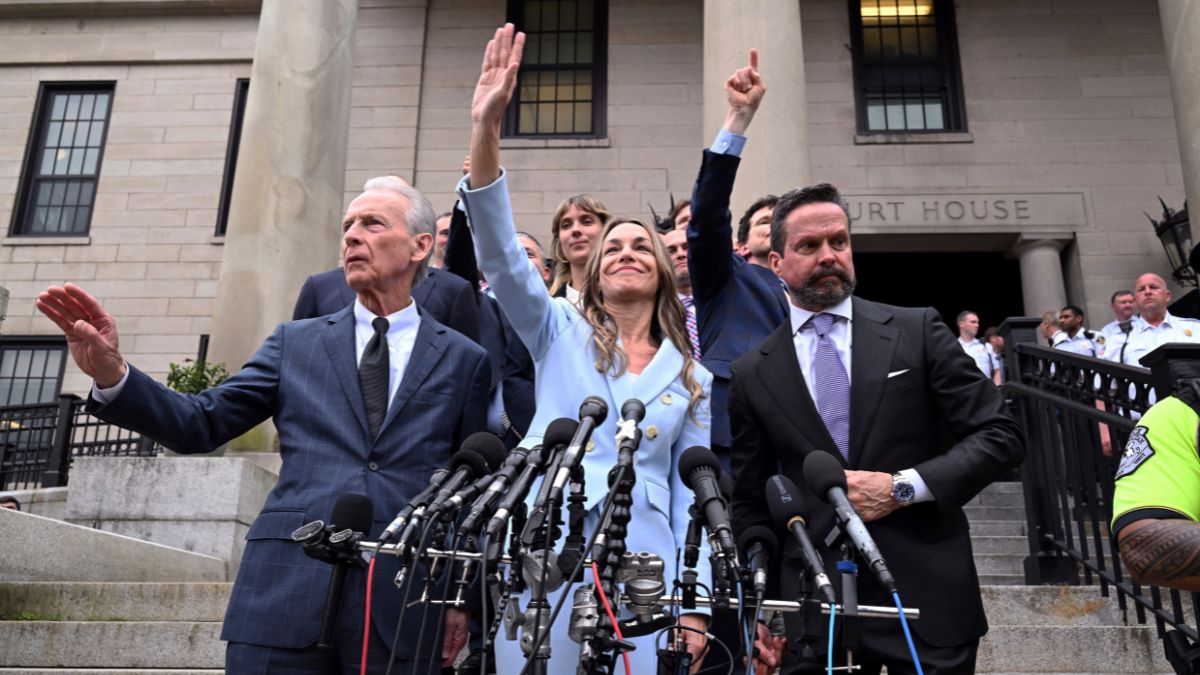
 "Karen Read, centre, waves to supporters after she was found not guilty of second-degree murder on Wednesday, June 18, 2025, in Dedham, Mass. AP")
After more than three years of legal battles, two trials, and growing attention in the US, Karen Read has been acquitted of second-degree murder and other serious charges in the 2022 death of Boston police officer John O’Keefe. T
he long-running case, which captivated courtroom observers and online communities alike, concluded with a jury finding that the prosecution had not proven beyond a reasonable doubt that Read had fatally struck her boyfriend with her SUV during a snowstorm.
The courtroom’s verdict was met with jubilation outside the Norfolk County courthouse, where hundreds of supporters, many dressed in pink, waited in anticipation.
Cheers erupted as the not-guilty verdicts were read out, and Read exited the courthouse a free woman.
Though she was convicted of a lesser charge of drunk driving, for which she will serve a year of probation, the acquittals marked a dramatic end to one of the most closely watched criminal trials in recent Massachusetts history.
The snowy night that started it all
On the night of January 28, 2022, Karen Read and John O’Keefe, along with a group of friends, went out drinking at the Waterfall Bar and Grill in Canton. Over the course of the night, they reportedly consumed several alcoholic drinks.
Later, Read drove O’Keefe to the home of retired Boston police detective Brian Albert, where some members of the group were gathering again. It was snowing heavily by then.
At approximately 1 am, tensions between the couple — described by prosecutors as strained and increasingly volatile — were evident in communications exchanged between them.
A voicemail from Read to O’Keefe included statements such as “…you are a f—— loser, f— yourself” and “John, I f—— hate you,” according to court filings.
By 4:23 am, O’Keefe’s niece had contacted Jennifer McCabe, a family friend and Albert’s sister-in-law, saying Read was distraught because O’Keefe had not returned and wasn’t answering his phone.
Read was reportedly crying and telling people, “John didn’t come home. We had a fight.”
At 5:07 am, surveillance footage captured Read’s SUV maneuvering near O’Keefe’s parked vehicle. She later suggested to others that her cracked tail light may have resulted from accidentally hitting O’Keefe.
At around 6 am, Read, McCabe, and another friend found O’Keefe unresponsive in a snowbank outside Albert’s house. A first responder at the scene testified that a hysterical Read repeatedly exclaimed, “I hit him. I hit him.”
O’Keefe was pronounced dead soon after.
Prosecution vs Defence
The case brought by prosecutors alleged that Read, intoxicated and emotionally charged after a night of drinking and relationship strife, struck O’Keefe with her SUV and left him in the snow.
They charged her with second-degree murder, manslaughter and leaving the scene of a deadly collision. Their theory was supported, they argued, by tail light fragments allegedly found at the scene, autopsy findings and statements attributed to Read.
Prosecutors said Read’s SUV, a large 6,000-pound vehicle, had collided with O’Keefe, causing blunt force trauma and rendering him unconscious.
They also claimed that her comments to friends and emergency responders, including “I hit him,” pointed to guilt. Toxicology reports estimated that Read’s blood alcohol content was between .13 and .29 around the time of the incident — well above the legal limit.
The autopsy concluded that O’Keefe died due to blunt head trauma and hypothermia. The medical examiner did not note clear signs of an altercation or a fight, which prosecutors said supported the theory of a vehicular strike and abandonment in subfreezing conditions.
However, Read’s defence countered with an explosive theory: that O’Keefe was not killed by her SUV but instead died after an altercation inside the Albert residence, and that a network of officers engaged in a cover-up to protect one of their own.
Her lawyers presented their client as a scapegoat, framed by a system riddled with corruption and bias.
Building the doubt
At the heart of the defence’s strategy was the argument that the physical and circumstantial evidence did not conclusively point to Read’s guilt and was marred by misconduct and mishandling.
One of the most controversial figures in the trial was Michael Proctor, the Massachusetts State Police investigator assigned to the case. Proctor was ultimately dismissed from his position after text messages he sent during the investigation revealed bias.
In one message sent within hours of the initial investigation, Proctor wrote: “There will be some serious charges brought on the girl … Zero chance she skates. She’s f’d.”
He also referred to Read as a “whack job” in texts to family and friends, suggesting a premature presumption of guilt.
Further scrutiny was directed at federal agent Brian Higgins, who was present at the party. He admitted on the stand to destroying both his phone and SIM card after the incident and discarding them in separate locations on a military base.
The defence pointed to suggestive text messages between Higgins and Read, including one flirtatious message sent while the two were at a bar the night of the incident: “Umm, well?”
They also noted Higgins was seen “play fighting” with Brian Albert shortly after that message.
The defence also called into question the actions of those in the Albert home. Not only did none of them exit the house during the commotion of police and paramedics arriving, but Brian Albert later sold the home, got rid of the family dog and changed phones.
A text from a group chat among those present included a message where someone said they should agree O’Keefe “never entered the home,” to which Albert responded: “exactly.”
Physical evidence further complicated the prosecution’s theory. While tail light shards were found at the scene, the defence contended they were planted after being removed from Read’s vehicle, which had been impounded.
There was no blood, tissue or DNA on the shards, they argued, and the only taillight fragment with identifiable DNA found on Read’s SUV included samples from three people — O’Keefe and two unknown males.
Crash reconstruction experts testified for the defence that O’Keefe’s injuries were not consistent with being hit by such a large vehicle. A medical expert introduced by the defence even stated that the wound on O’Keefe’s arm resembled an animal bite — raising the possibility that the Albert family dog was involved.
Additional injuries, including a gash over the right eye and trauma to the back of the head, were argued to be more consistent with a blow to the head and a fall onto a hard surface.
One of the more contested digital forensics points involved a Google search for “hos long to die in cold.” Prosecutors claimed it was made after O’Keefe’s body was found, possibly at Read’s request.
The defence, however, presented expert testimony indicating that the search occurred at 2:27 am — hours before police were notified of the body — casting doubt on who conducted the search and why.
How the trial became a public spectacle
While the case unfolded inside a Massachusetts courtroom, it simultaneously exploded across social media in the US.
TikTok accounts, Facebook groups and podcasts focused obsessively on every development, turning Read into a symbolic figure for many who believed she was wrongly accused.
Outside the courthouse, supporters wore pink and held up signs emblazoned with the slogan “Free Karen Read.”
Many followers, especially women, identified with Read and viewed the trial through the lens of systemic bias and institutional overreach. “It could be me,” Patti Lima told CBS. “I would have done everything she did. Exact same thing.”
Robin Burns, who came to court with her daughters, told CBS: “I really believe there’s a lot of corruption here and I believe it runs deep. And I’ve got three girls, and this could be one of my kids.”
As Read emerged from court following her acquittal, she addressed her supporters directly: “Number one is I could not be standing here without these amazing supporters who have supported me and my team financially, and more importantly emotionally for almost four years. The second thing I want to say is no-one has fought harder for justice for John O’Keefe than I have, than I have and my team.”
What next for Karen Read?
Though the criminal case is now closed, Read’s legal battles continue.
The family of John O’Keefe has filed a civil wrongful death lawsuit against her and two bars where she and O’Keefe drank that night, setting the stage for further courtroom proceedings.
Despite the acquittal, a central question remains unanswered: If Karen Read did not kill John O’Keefe, who did?
Also Watch:
With inputs from agencies