

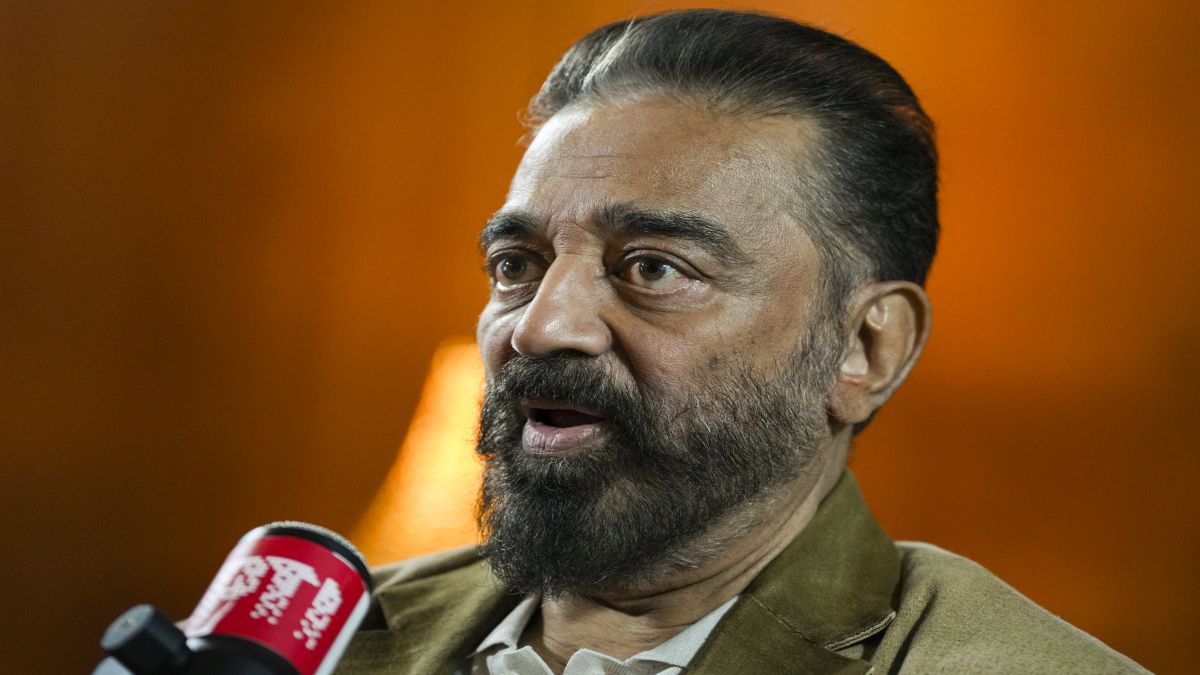
 "Was Kannada born out of Tamil? Is there any truth to Kamal Haasan’s claim?")
Language is a pretty sensitive topic in India and actor Kamal Haasan learnt that on Tuesday (May 27) when he created a firestorm by mentioning that Kannada “was born out of Tamil” during a public event in Chennai, Tamil Nadu.
The remark has triggered sharp political reactions and public outrage in Karnataka, with pro-Kannada groups condemning his statement and demanding an unconditional apology.
But amid the criticism and firestorm that Haasan’s remark evoked, what is the truth? Is the actor right in his claim that Kannada was indeed born out of Tamil? Here’s what we found out.
Haasan’s controversial remark
At an event to promote his upcoming movie, _Thug Life_ , the veteran actor took to the stage and said, “Uyire Urave Tamizhe”, meaning “my life and my family is Tamil language.”
He then pivoted to Shivarajkumar, a Kannada actor, who was also present at the event and said, “This is my family in that place. That’s why he (Shivarajkumar) has come here. That’s why I began my speech saying life, relationship and Tamil. Your language (Kannada) was born out of Tamil, so you too are included (part of it).”
Many believe that Haasan made the remark with the intention of promoting cultural unity. However, it did the exact opposite, evoking strong reactions and condemnation.
Anger and ire at Haasan over Kannada remarks
But Haasan’s remarks quickly invited him sharp criticism from pro-Kannada groups. Karnataka BJP president BY Vijayendra condemned the actor’s remarks as “uncultured” and “insulting” to Kannada and its 6.5 crore speakers.
“It is the height of arrogance that Kamal Haasan, who has acted in many Indian languages including Kannada, has insulted Kannada in the name of glorifying Tamil,” Vijayendra wrote on X. He also questioned Haasan’s authority to speak on the linguistic origins of Kannada, saying, “He [Kamal Haasan] is not a historian.”
ಮಾತೃಭಾಷೆಯನ್ನು ಪ್ರೀತಿಸಬೇಕು, ಆದರೆ ಅದರ ಹೆಸರಿನಲ್ಲಿ ದುರಭಿಮಾನ ಮೆರೆಯುವುದು ಸಂಸ್ಕೃತಿ ಹೀನ ನಡವಳಿಕೆಯಾಗುತ್ತದೆ. ಅದರಲ್ಲೂ ಕಲಾವಿದರಿಗೆ ಪ್ರತಿಯೊಂದು ಭಾಷೆಯನ್ನೂ ಗೌರವಿಸುವ ಸಂಸ್ಕಾರ ಇರಬೇಕು. ಕನ್ನಡವೂ ಸೇರಿದಂತೆ ಅನೇಕ ಭಾರತೀಯ ಭಾಷೆಗಳಲ್ಲಿ ನಟಿಸಿರುವ ನಟ @ikamalhaasan ತಮ್ಮ ತಮಿಳು ಭಾಷೆಯನ್ನು ವೈಭವಿಕರಿಸುವ ಮತ್ತಿನಲ್ಲಿ ನಟ… pic.twitter.com/PrfKX099lZ
— Vijayendra Yediyurappa (@BYVijayendra) May 27, 2025
He further slammed Haasan for his remarks, urging him to apologise to the speakers of the language.
Other pro-Kannada groups also voiced their anger at Haasan, with some even resorting to violence and vandalism. Reports have emerged that some unidentified people tore down posters of Thug Life in Bengaluru and issued threats of a statewide ban on the film, set to release on June 5.
Praveen Shetty, president of Karnataka Rakshana Vedike (KRV), was quoted as saying, “If you continue to speak against Karnataka and Kannadigas, there will be protests. Your movie will be banned.” Shetty said it was “unacceptable” that Haasan was insulting the language.
Karnataka Chief Minister Siddaramaiah also waded into the row, saying: “Kannada has a long-standing history. Poor Kamal Haasan, he is unaware of it.”
Tamil Nadu BJP vice president Narayanan Thirupathy also questioned Hasaan’s remark and clarified that both Kannada and Tamil are sister languages. “Kamal Haasan has always been acting smart. You cannot belittle a language just to praise your own language. From where did Kamal Haasan learn that Kannada is born from Tamil?”, Thirupathy told reporters.
Origins of Kannada and its ‘link’ to Tamil
At the heart of the Haasan row is the origin of Tamil and Kannada – both Dravidian languages with a rich history. Linguists find that both Kannada and Tamil are major languages of the Dravidian family, but they developed as separate branches from a common ancestor, known as Proto-Dravidian.
Today, Kannada is the official language of Karnataka as well as one of the 22 official languages of India. Data indicates that some 38 million individuals speak Kannada as their first language; another nine to 10 million were thought to speak it as a secondary language.
Linguists note that Kannada is about 2,500 years old. The oldest Kannada inscription was discovered at the small community of Halmidi and dates to about 450 ce. The Kannada script evolved from southern varieties of the Ashokan Brahmi script.
According to Dr S Settar, who is a prolific writer in two languages — English and Kannada, the turning point of Kannada as a language came during the ninth century with the work Kaviraja Marga by the then ruler Nrupatunga. It was the first time when the language was referred to as ‘Kannada’. It acknowledged the presence of the varieties of Kannada. The work beautifully illustrates the various letters and gently pushes the fact that antiquity does not have to be permanent, and the vocabulary and style of an age is the change that must be embraced.
Today, the language has about 20 dialects; some of the prominent ones being Havyaka, Soliga Kannada, Kodava, Kunda, Are Bhashe, Badaga Kannada, Hubli Kannada, and Gulbarga Kannada.
Moreover, since 2008 it also earned the status of being a classical language. This recognition came after years of struggle.
Then what about Tamil? This language prevalently spoken in Tamil Nadu is believed to be more than 2,500 years old and part of the Dravidian family. As per a News18 report, linguists believe Dravidian languages were spoken in India before the arrival of Indo-Aryans (who brought Sanskrit and related languages).
It is stated that Tamil evolved from Proto-Dravidian, spoken 2500–1500 BCE in peninsular India and started diverging into a distinct language by 1000 BCE. From the 3rd century BCE to the 3rd century CE, Tamil can be found in literature, poetry, and religious texts.
Gradually, Tamil evolved into Classical Tamil, used in religious and philosophical texts. In the medieval era, Chola emperors such as Rajaraja Chola I and Rajendra Chola I promoted Tamil inscriptions, temple architecture, and literature.
Today, Tamil is widely spoken not only in India but also is also an official language in Sri Lanka and Singapore and has significant numbers of speakers in Malaysia, Mauritius, Fiji, and South Africa. In 2004, it also received the honour of being recognised as a classical language in India — the first to receive this distinction.
With inputs from agencies

 "Russian drones over Poland: Trump’s tepid reaction a wake-up call for Nato?")
 "As Russia pushes east, Ukraine faces mounting pressure to defend its heartland")
 "Why Mossad was not on board with Israel’s strike on Hamas in Qatar")
 "Turkey: Erdogan's police arrest opposition mayor Hasan Mutlu, dozens officials in corruption probe")
 "Russian drones over Poland: Trump’s tepid reaction a wake-up call for Nato?")
 "As Russia pushes east, Ukraine faces mounting pressure to defend its heartland")
 "Why Mossad was not on board with Israel’s strike on Hamas in Qatar")
 "Turkey: Erdogan's police arrest opposition mayor Hasan Mutlu, dozens officials in corruption probe")



