

 "Will Kabul be the world’s first city to run out of water?")
Kabul could become the first modern city to run out of water in the next five years. A report published by the nonprofit Mercy Corps has raised alarm about water shortages in Afghanistan’s capital.
Climate change and decades of conflict have deepened Kabul’s water woes. Experts warn millions of people could be displaced if the problem is not addressed.
Let’s take a closer look.
Kabul’s water crisis
Groundwater levels have drastically plummeted in Kabul due to over-extraction and climate change, as per the report by the NGO Mercy Corps.
Kabul’s aquifer levels have dropped by up to 30 metres over the past decade, while nearly half of the city’s boreholes have dried up, the report stated.
These boreholes are the main source of drinking water for the residents.
The extraction of water surpasses the natural recharge rate by 44 million cubic metres each year.
If this trend continues, Kabul’s aquifers will become dry by 2030, posing an existential threat to the Afghan capital.
The report warned that the water crisis in the city could displace some three million (30 lakh) Afghan residents.
What’s behind Kabul’s water woes?
Experts blame the rapidly growing population, climate change and governance failures for the current water crisis in Kabul.
The city’s population has significantly increased from less than one million (10 lakh) in 2001 to nearly six million (60 lakh) today, as per Al Jazeera.
Mercy Corps and Afghan water management experts told RFE/RL that 100,000 unregulated borewells and hundreds of factories and greenhouses are also putting strain on the city’s aquifers.
“Kabul has some 400 hectares of greenhouses that consume about four million cubic meters of water annually,” Najibullah Sadid, a water resources and climate change researcher based in Germany, told the news outlet. “There are also more than 500 beverage businesses operating in Kabul. Just one such company, Alokozay, the largest soft drink company in the city, uses about one million cubic meters of groundwater each year.”
The report by Mercy Corps underlined widespread water contamination in Kabul. Up to 80 per cent of groundwater in the city is believed to be unsafe, with high levels of sewage, arsenic and salinity.
The water shortage is a daily worry for residents of Kabul. Some households spend up to 30 per cent of their income on water, with more than two-thirds having incurred water-related debt.
“Afghanistan is facing a lot of problems, but this water scarcity is one of the hardest. Every household is facing difficulty, especially those with low income. Adequate, good quality well water just doesn’t exist,” Nazifa, a teacher living in the Khair Khana neighbourhood of Kabul, told The Guardian.
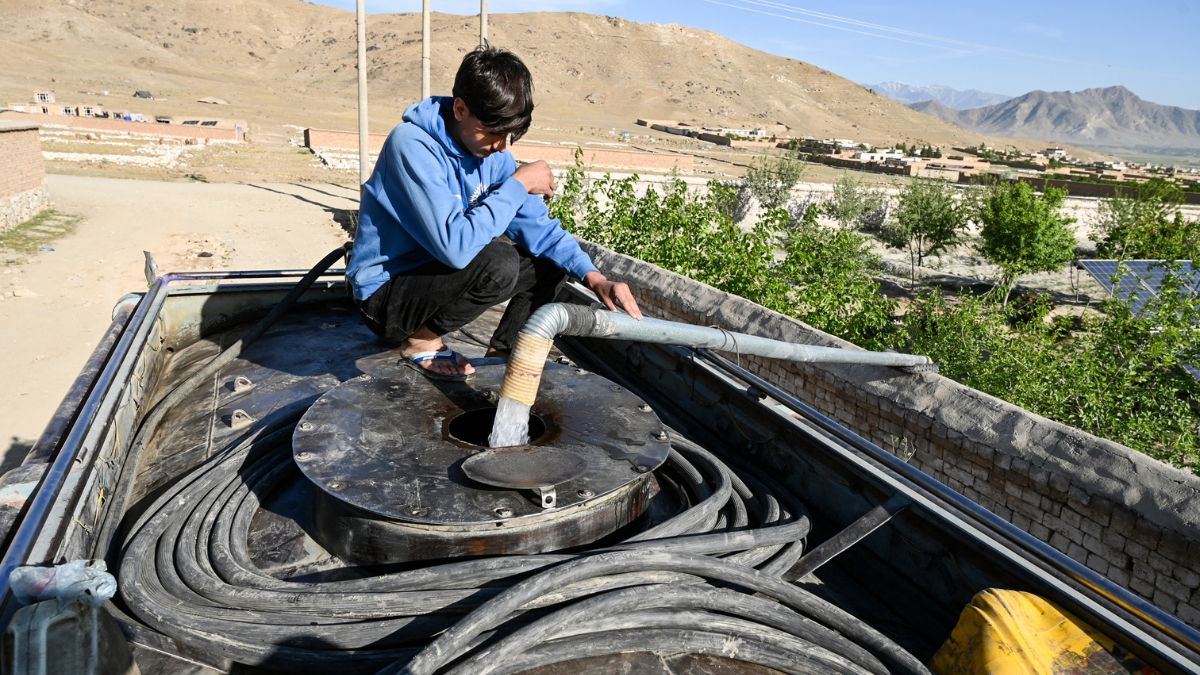
Many parts of the city have run dry and residents rely on tankers for water. Some private companies are digging wells and extracting large amounts of public groundwater. Taking advantage of the crisis, they are then selling water to the residents at inflated rates.
“My monthly salary is 21,000 Afghani (Rs 25,797.54) and I spend at least 5,000 Afghani (Rs 6,142) on water for our family of 10 people,” a resident of the relatively affluent area of Taimani in northwestern Kabul, told RFE/RL last month. “We use this water for tea, cooking, washing-up, laundry, and bathing.”
“There are many families that can’t afford to buy water, it’s like having to choose between water and food,” he added.
Two decades of the US-led military intervention in Afghanistan are also believed to have worsened the crisis, as it forced more people to move to Kabul while governance in the rest of the country took a hit, as per the Al Jazeera report.
The water crisis affects the poor more than the rich, who can afford to drill deeper boreholes. Poor children, who should spend their time on education, are instead searching for water.
“Every evening, even late at night, when I am returning home from work, I see young children with small cans in their hands looking for water … they look hopeless, navigating life collecting water for their homes rather than studying or learning,” Abdulhadi Achakzai, director at the Environmental Protection Trainings and Development Organization (EPTDO), a Kabul-based climate protection NGO, said.
Kabul’s water woes are further fuelled by climate change, as rains have reduced in recent years across Afghanistan.
“The three rivers — Kabul river, Paghman river and Logar river—that replenish Kabul’s groundwater rely heavily on snow and glacier meltwater from the Hindu Kush mountains,” according to the Mercy Corps report. “However, between October 2023 to January 2024, Afghanistan only received 45 to 60 per cent of the average precipitation during the peak winter season compared to previous years.”
Can Kabul’s water crisis be averted?
Yes. Experts say it is not too late to alleviate Kabul’s water crisis.
International aid and water-related projects could help the Afghan capital in tackling the problem.
“This problem is not new. For over a decade, various proposals on how to tackle the problem have been presented to Afghan authorities, but it has never been a priority for them,” Sadid was quoted as saying by RFE/RL.
The construction of the Shahtoot dam and reservoir, some 30 kilometres southwest of Kabul, and the Panjshir River pipeline could provide drinking water to millions of the city’s residents.
India and Afghanistan ’s Ashraf Ghani government, which collapsed in 2021, had signed an agreement that year for building the Shahtoot dam on the Kabul River. Sadid told Al Jazeera that the project could provide water to large parts of Kabul, “but its fate is uncertain now.”
Since the Taliban takeover of Kabul in 2021, $3 billion in international water and sanitation funding for Afghanistan has been frozen. The Trump administration’s decision to cut over 80 per cent of its USAID funding has exacerbated the crisis.
In April, the Taliban’s Ministry of Energy and Water said it was awaiting budget approval to begin construction of the Panjsher River pipeline. The Afghan government is seeking additional investors to fund the $170-million plan.
The 200-kilometre pipeline will divert more than 100 million cubic meters of water every year from the Panjshir River to the capital.
“Artificial groundwater recharge and the development of basic water infrastructure around the city are urgently needed. Once these foundations are in place, a citywide water supply network can gradually be developed,” Assem Mayar, water resource management expert and former lecturer at Kabul Polytechnic University, told Al Jazeera.
Experts also call for international aid agencies to step in. According to the International Committee of the Red Cross (ICRC), it undertook several projects, including the repair of “1,315 hand pumps and the installation of 1,888 bio-sand filters to remove contaminants from water,” in several Afghan provinces last year.
Speaking to RFE/RL, Abdul Baset Rahmani, a Kabul-based expert on water resources and climate change, said the water crisis in the city could be “resolved within a year-and-half, if there is a political will to do so.”
However, pointing to urgent short-term needs, he called on global aid agencies “to provide emergency assistance to the impoverished people in Kabul who cannot afford to buy drinking water.”
“Such support would spare these people from enormous financial and mental strain, prevent diseases, and help many children to return to school,” he said. “There are many children who can’t get education because in order to help their families they walk several kilometres every day to places where water is distributed free of charge.”
With inputs from agencies

 "Russian drones over Poland: Trump’s tepid reaction a wake-up call for Nato?")
 "As Russia pushes east, Ukraine faces mounting pressure to defend its heartland")
 "Why Mossad was not on board with Israel’s strike on Hamas in Qatar")
 "Turkey: Erdogan's police arrest opposition mayor Hasan Mutlu, dozens officials in corruption probe")
 "Russian drones over Poland: Trump’s tepid reaction a wake-up call for Nato?")
 "As Russia pushes east, Ukraine faces mounting pressure to defend its heartland")
 "Why Mossad was not on board with Israel’s strike on Hamas in Qatar")
 "Turkey: Erdogan's police arrest opposition mayor Hasan Mutlu, dozens officials in corruption probe")



