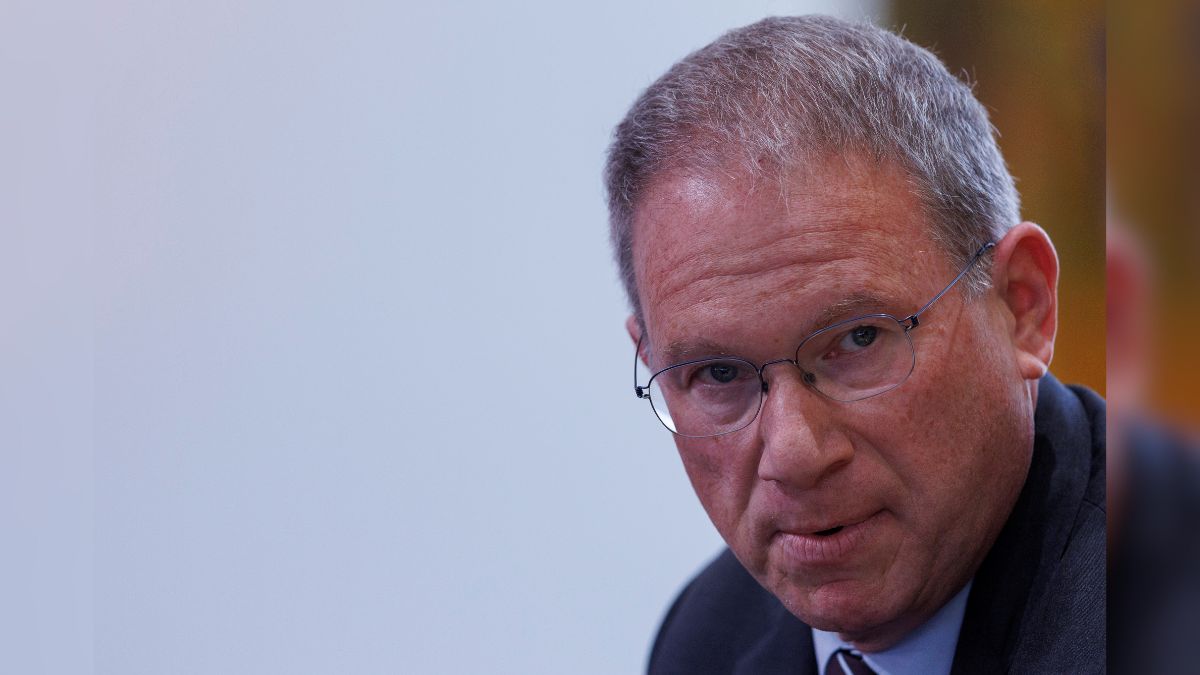
 "Jeffrey Goldberg, Editor-in-Chief of The Atlantic magazine attends the 2022 Milken Institute Global Conference in Beverly Hills, California, US, May 3, 2022. File Image/Reuters")
Jeffrey Goldberg, the editor-in-chief of The Atlantic, recently exposed a significant security blunder within the Trump administration.
According to his report, he was mistakenly added to a Signal group chat where top US national security officials coordinated military strikes against Houthi targets in Yemen .
The chat, which included figures such as US Vice President JD Vance, Secretary of State Marco Rubio, and Secretary of Defence Pete Hegseth, contained sensitive discussions about upcoming military operations.
Goldberg detailed the experience in his article , titled “The Trump Administration Accidentally Texted Me Its War Plans,” stating, “US national-security leaders included me in a group chat about upcoming military strikes in Yemen. I didn’t think it could be real. Then the bombs started falling.”
The leak raises serious concerns over operational security and the potential risks associated with sharing classified information on unsecured platforms.
Who is Jeffrey Goldberg?
Jeffrey Mark Goldberg, born in 1965, is a veteran American journalist known for his expertise in foreign affairs, national security, and Middle Eastern politics. He has served as the editor-in-chief of The Atlantic since 2016.
Goldberg’s journalism career began at The Washington Post as a police reporter before he moved to Israel, where he worked as a columnist for The Jerusalem Post and served in the Israel Defense Forces during the First Intifada as a prison guard at Ktzi’ot Prison.
Upon returning to the United States, he took on various high-profile roles, including serving as the New York bureau chief for The Forward and contributing to The New York Times Magazine, New York Magazine, and The New Yorker.
In 2007, Goldberg joined The Atlantic, where his reporting on global conflicts, terrorism, and diplomacy earned him widespread recognition. His tenure at The Atlantic has included major investigations and interviews with world leaders, including multiple exclusive interviews with US President Barack Obama, Benjamin Netanyahu, Hillary Clinton and King Abdullah of Jordan.
Beyond journalism, Goldberg has been recognised as a leading voice in international reporting. He has received numerous prestigious awards, including the National Magazine Award for Reporting, the Daniel Pearl Award for Courage and Integrity in Journalism and the Overseas Press Club Award.
His book, Prisoners: A Story of Friendship and Terror, explores his experiences in Israel and his complex relationship with a Palestinian prisoner, reflecting his deep understanding of Middle Eastern affairs.
Under him, The Atlantic made history by endorsing Hillary Clinton in the 2016 presidential election, marking only the third time in the magazine’s 160-year history that it had endorsed a candidate. He currently resides in Washington, DC.
What is the scope of the security breach?
The Signal group, called “Houthi PC small group,” was reportedly created by National Security Advisor Michael Waltz. Goldberg was inadvertently added by an account impersonating Waltz .
The chat contained detailed operational plans, including target locations, the types of weapons to be used and the sequencing of the attacks. Goldberg received these messages more than two hours before the US publicly announced the strikes, leading to concerns over the potential risks posed if such information had fallen into the hands of adversaries.
As the revelations surfaced, the National Security Council (NSC) acknowledged the authenticity of the chat. NSC spokesperson Brian Hughes confirmed that an investigation was underway, stating, “The message thread that was reported appears to be authentic.”
He reassured the public that there was no immediate threat to US service members but did not deny the security lapse.
What is the fallout?
The exposure of these conversations has prompted strong reactions from US politicians. House Minority Leader Hakeem Jeffries called the incident “reckless, irresponsible, and dangerous” and urged Congress to launch an investigation into how such a security failure occurred.
Similarly, Senator Roger Wicker, Chairman of the Senate Armed Services Committee, expressed bipartisan concerns, stating, “We’re very concerned about it and we’ll be looking into it.”
Meanwhile, Secretary of Defence Pete Hegseth attempted to downplay the severity of the situation, telling reporters, “Nobody was texting war plans, and that’s all I have to say about that.”
However, his own messages in the leaked chat suggest otherwise, as he had reassured participants that “we are currently clean on OPSEC,” despite the use of an unsecured communication platform.
With inputs from agencies