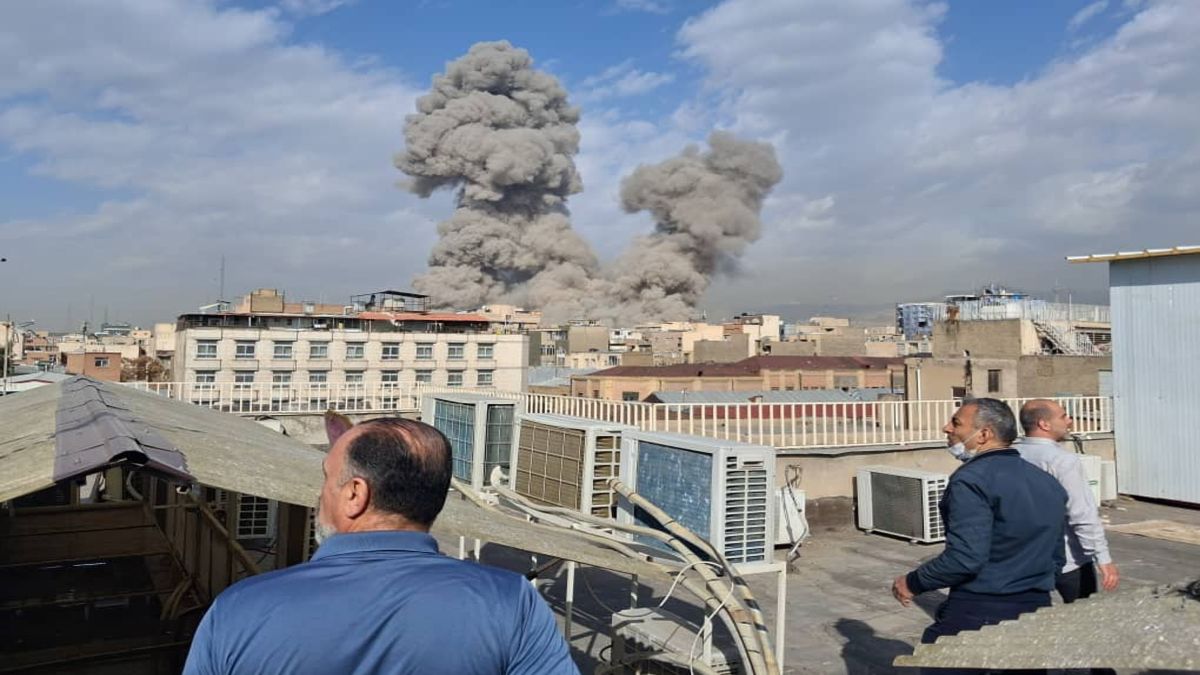
 "People watch as smoke rises on the skyline after an explosion in Tehran, Iran. AP")
After days and days of uncertainty, the moment is here. On Saturday morning (February 28), Israel launched what it called a “pre-emptive attack” against Iran.
Shortly after explosions could be heard in Tehran, Israel’s Defence Minister Israel Katz said the strikes are intended to “remove threats to the State of Israel.” Moreover, sirens were sound across Israel as the IDF Home Front Command warned civilians to stay close to bomb shelters.
In a statement on Telegram, the Israeli army said the alerts are to prepare the public for the possibility of missiles being launched towards Israel. It added in a separate statement that all areas of the country would be shifted from “full activity” to “essential activity”, including the closure of schools, prohibiting gatherings and closure of workplaces except for essential sectors.
- Catch live updates from Israel-Iran attack here
Notably, Israel’s attack on Iran comes at a time when US President Donald Trump has ordered the biggest military build-up in decades in West Asia. The Trump administration has been demanding that Tehran drop its nuclear programme completely.
So, what’s going on? Why has Israel, not the US, attacked Iran? We unpack it all for you.
What do we know of the Israeli strikes on Iran?
On Saturday morning, Iranian state media began reporting that Tehran had witnessed multiple explosions —in the north and east of Tehran, as well as in Isfahan, Karaj, and Kermanshah.
Shortly after, Israel’s Defence Minister Israel Katz affirmed that the Jewish nation had launched a “pre-emptive strike” against Iran. “The State of Israel has launched a pre-emptive strike against Iran to remove threats against the State of Israel,” a spokesperson for the minister said.
Retaliation is expected, the spokesperson added. “As a result, a missile and UAV attack against the State of Israel and its civilian population is expected in the immediate time frame.” After the announcement of the strike, Israel declared that it had shut down its airspace to civilian flights.
As news of the strikes unfolded, media reports citing US and Israeli sources said it was a joint operation between Israel and the United States. CNN reported that Israel’s attack was coordinated with the US, and Israel’s Ynet News has reported the same.
An unnamed security source told Channel 12 that the operation was jointly planned for months. The source said Israel is going “all out” in this operation, and the US is “on the same page.” Moreover, the timing of the initial strikes for the morning hours was designed to surprise the Iranians, who would not have expected a daytime attack.
How has Iran responded so far?
In the immediate aftermath of the strikes, Iran has closed the country’s airspace. Majid Akhavan, spokesperson for Iran’s Civil Aviation Organisation, has announced in an interview with the Mehr News Agency that “the entire country’s airspace has been closed until further notice”.
Moreover, cellphone communications have been disrupted across several areas of Iran’s capital Tehran. No calls are possible at present. There’s a chance internet might be disrupted soon as well.
An Iranian official has told Reuters that Tehran is preparing for a response to US-Israeli attacks and the counterattacks are set to be crushing. In fact, hours after the strikes, Iran launched missiles towards Israel, prompting the IDF to alert people to enter safe rooms.
Why does the timing of the attack matter?
The timing of Israel’s strike on Iran is significant. It came hours after US President Donald Trump said he was “not happy” with the latest negotiations with Iran over its nuclear programme.
“We’re not exactly happy with the way they (Iran) negotiated. They cannot have nuclear weapons, and we’re not thrilled with the way they’re negotiating,” Trump told reporters earlier.
The remarks by the US president came at the White House on Friday after talks between the US and Iran on Tehran’s nuclear programme ended inconclusively, with a suggestion that further discussions would be held next week. Trump told reporters he favoured diplomacy but repeated his insistence that Iran could not possess a nuclear weapon. “It’d be wonderful if they negotiated in good faith and conscience but they are not getting there so far,” he said.
Since the start of the year, Trump has threatened military action against Tehran if it does not reach a deal about its nuclear ambitions. He has ordered the largest US military build-up in West Asia since the US-led invasion of Iraq in 2003, while Iran has vowed to respond to an attack with force.
Washington and Israel have asserted that Iran is moving towards developing a nuclear weapon, which Tehran has always denied. It claims its programme is intended for peaceful, civilian purposes despite having enriched uranium up to near weapons-grade level. The US president told reporters on Friday: “I say no enrichment… I think it’s uncivil.”
Even during his State of the Union address, Trump referred to the Iranian nuclear threat, repeating the claim that airstrikes last June had “obliterated Iran’s nuclear weapons programme” but warning that Tehran was starting to rebuild it and “are at this moment pursuing their sinister ambitions.”
And even as negotiations were being held, the US authorised the departure of non-essential government workers and their families from Israel as the threat of an American strike on Iran looms. US citizens should “consider leaving Israel while commercial flights are available”, the Department of State advisory added. It also urged against travel to Israel.
So, why now then?
Some note that there’s a symbolic meaning in Judaism. Ahead of the upcoming Jewish holiday of Purim, worshippers read a specific portion from the Old Testament, known as Zachor. The passage from the book of Deuteronomy commands the ancient Israelites to remember an unprovoked attack by the nation of Amalek and to eradicate the memory of Amalek once the Israelites are settled in their land, reports CNN.
According to a Politico report, US officials had told Trump earlier that they would have prefer Israel striking Iran before the United States. These Trump administration officials privately argued that an Israeli attack would trigger Iran to retaliate, helping muster support from American voters.
Some also believe that that this is Benjamin Netanyahu once again trying to force the United States to take action against Iran. As Mehran Kamrava, director of the Iranian studies unit at the Arab Centre for Research and Policy Studies and professor at Georgetown University in Qatar, told Al Jazeera, “As it did last June, it appears to have launched an attack designed to derail the negotiations between Iran and the US.
“I think [US President] Donald Trump pushed himself into a corner from which he couldn’t back out. The so-called armada, the massive military build-up, the constant green lights to Israel over the last year and a half, and so I think in many ways, yet again, what we see is the Israelis forced Donald Trump’s hand and he couldn’t really say no to them at this juncture,” Kamrava explained.
But outwardly, Donald Trump seems to be on board with the strikes. He wrote on Truth Social that the joint US-Israeli attacks on Iran aim at “eliminating imminent threats from the Iranian regime”.
“Short time ago, US military began major combat operation in Iran. Our objective is to defend the American people by eliminating threats from the Iranian regime,” he said.
“It has always been the policy of the United States, in particular my administration, that this terrorist regime can never have a nuclear weapon. I’ll say it again, they can never have a nuclear weapon,” he said.
With inputs from agencies