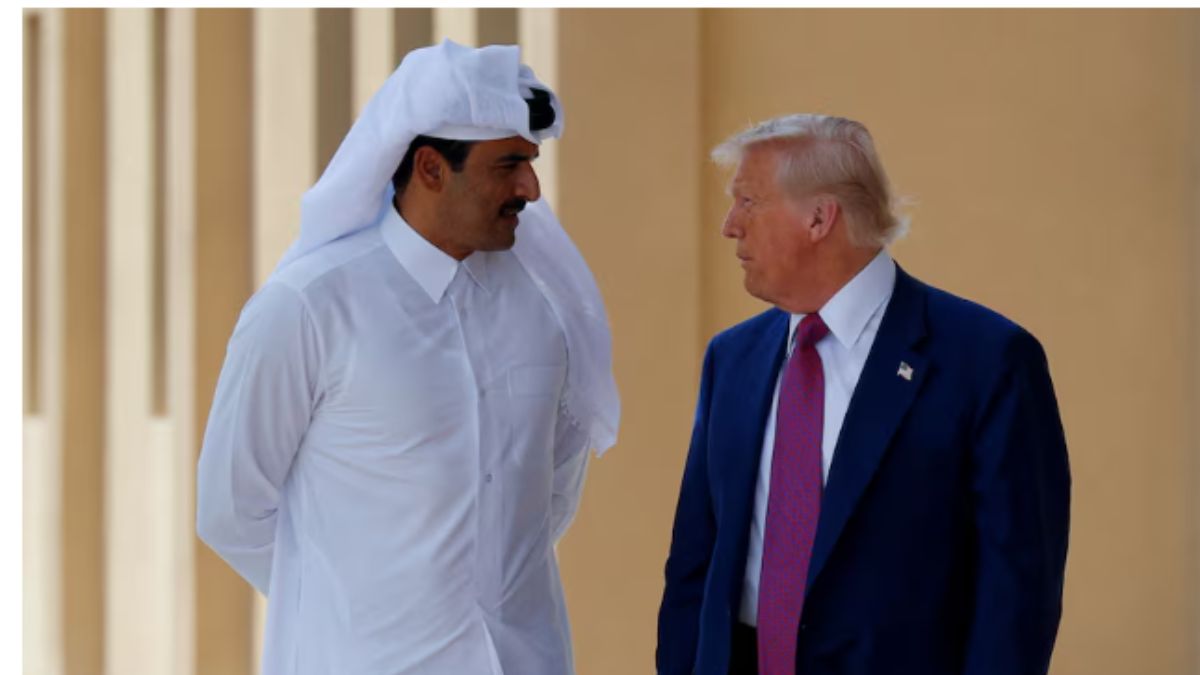
 "U.S. President Donald Trump talks with Qatar's Emir Tamim bin Hamad Al Thani. Reuters")
The ceasefire deal between Israel and Iran left many people shocked and relieved. The deal was announced by US President Donald Trump on social media as a “complete and total ceasefire”.
“On the assumption that everything works as it should, which it will, I would like to congratulate both countries, Israel and Iran, on having the stamina, courage, and intelligence to end what should be called ’the 12-day war’” , Trump wrote on Truth Social.
Trump said that the ceasefire would commence with Iran halting its attacks. Israel would then also stop its attacks within 12 hours. After 24 hours, both sides would completely stop hostilities.
Trump in the announcement gave credit to the Emir of Qatar for the ceasefire.
“I’d like to thank the Highly Respected Emir of Qatar for all that he has done in seeking peace for the Region”, Trump wrote on social media.
The development came after Iran attacked the US’ Al Udeid airbase in Qatar – the largest such base in West Asia – with around a dozen short and medium-range ballistic missiles.
The Iranians gave the Qataris advance warning of the attack – which let them shoot down all but one projectile. No one was hurt in the attack.
The Qatari government had labelled the attack “surprising” given Qatar’s “stances, its commitment to good neighbourliness, and its approach to mediation in resolving crises.”
But what role did Qatar play in the ceasefire?
And how has Qatar emerged as a master negotiator in West Asia?
Let’s take a closer look
What role did Qatar play?
Qatar is said to have played a key role in the ceasefire.
Trump, earlier in the day, spoke to Israeli Prime Minister Benjamin Netanyahu to get him to agree to the ceasefire.
Trump then spoke to Qatar’s Emir Tamim bin Hamad bin Khalifa Al Thani.
Trump told the Emir of Qatar that while he has managed to convince Israel of the need for a ceasefire, he needed help persuading Iran.
Vice President JD Vance and other senior officials also got in touch with the office of Prime Minister of Qatar Sheikh Mohammed bin Abdulrahman Al Thani.
The prime minister of Qatar then managed to get the assent of senior figures in Tehran for the ceasefire with Israel .
A US official said the intervention of the Emir of Qatar was crucial.
How has Qatar emerged as a master negotiator?
Qatar and Iran enjoy a close relationship.
It thus made sense for Trump, Vance and other senior officials to reach out to Qatar to intercede with Tehran on behalf of a ceasefire.
Iran’s Supreme Council even pointed out in a statement that the attack on the US airbas e was clear of residential areas.
“This action does not pose any threat to the friendly and brotherly country, Qatar, and its noble people, and the Islamic Republic of Iran remains committed to maintaining and continuing warm and historic relations with Qatar,” the council said.
But this isn’t the first time Qatar, a monarchy ruled by the al-Thani family, has emerged as a master negotiator in West Asia.
The powerful oil-rich nation has played this role for decades.
In January 2025, Qatar was among the nations that helped negotiate the ceasefire between Israel and Hamas – though it didn’t last. Qatar has also played a key role in getting Hamas to release some of its hostages during its 7 October, 2023, attack.
Qatar previously helped negotiate two ceasefires in the Sudan civil war – in 2011, known as the Doha Agreement, and 2020 called the Juba Agreement.
Qatar also helped smoothen negotiations between the US and the Taliban in 2020 when Washington was looking to exit the country.
Qatar also helped facilitate the negotiation between Israel and the Lebanon-based terror group Hezbollah – which had come to the aid of Palestine.
Qatar also tried to help Ukraine and Russia come to terms – the two countries were said to be on the brink of indirect ceasefire negotiations in August 2023.
It helped more than a dozen children taken by either side including 10 from Ukraine be freed.
In 2023, Qatar helped the US secretly negotiate with long-time enemy Venezuela.
Qatar in 2022 in Chad helped bring 40 opposition groups together to try to forge a roadmap for peace.
In 2008, it helped secure terms between the Lebanon government and Hezbollah – resulting in a civil war being averted.
Qatar is seen by both the West and East as a trusted and reliable partner.
In 2022, the then Emir of Qatar, speaking at the UN, said his country’s goal was to be seen as an impartial mediator when it comes to international conflicts.
Experts say Qatar’s vast networks of contacts and influence – from the Taliban in Afghanistan to the Muslim brotherhood in Egypt to revolutionary groups in Tunisia, Yemen and Syria – leave it uniquely positioned to act as an intermediary between West and East.
“Qatar definitely benefits from this because governments in the West, and the East to some extent, think of them as very useful friends to have,” Cinzia Bianco, an expert on Gulf states at the European Council on Foreign Relations, told DW. “…I think it’s more about an attitude of trying to be as neutral as possible. For them it is so fundamentally important to play this role, and that means they put it above anything else, including internal and regional politics.”
Qatar’s status as a trusted negotiator is also a key peg of its foreign policy.
“Qatar’s emergence as a key mediator has elevated its diplomatic standing, transforming it from a regional outlier into a critical player on the world stage,” Burcu Ozcelik, a senior research fellow at the British think tank Royal United Services Institute, told the outlet. “This newfound role enhances Doha’s influence … and positions it as an indispensable ‘partner for peace’ within the global community.”
With inputs from agencies