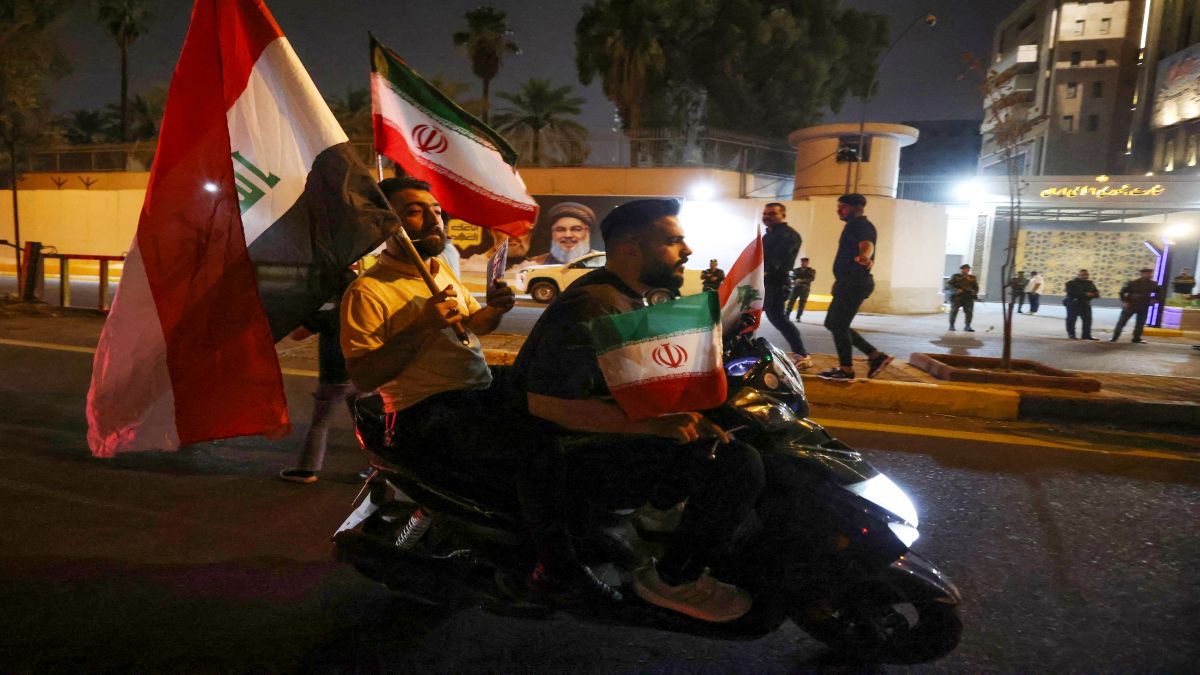
 "People riding on a moped wave Iraqi and Iranian flags as they celebrate in front of the Iranian embassy in Baghdad, following a ceasefire between Israel and Iran. Israel and Iran said they had agreed to US President Donald Trump's proposal for a ceasefire, on the 12th day of war between the foes. AFP")
After 12 days of several missiles being fired, deaths and destruction and a whole lot of threats, the United States President Trump got his “peace”, Israeli Prime Minister Benjamin Netanyahu got his war, and Iran’s Ayatollah Ali Khamenei got to survive.
On Tuesday (June 24), Iran and Israel finally agreed to a ceasefire brokered by the US president and after a rocky start with claims of violations of the truce, which even led to Trump dropping the F-bomb, it seems that the pause in the conflict is holding for now.
As the dust settles, all three — the US, Iran and Israel — have declared victory. But is that true? Or have all three sides lost? Here’s the outcome of the ’12-day war’ and here’s who — if any — came out on top.
How did the Iran-Israel war unfold?
It all began on June 13 when Israel launched Operation Rising Lion to neutralise what it described as an existential threat posed by Iran’s advancing nuclear programme. To reach this end, the Jewish nation fired multiple rockets and missiles at Tehran, aiming military and civil infrastructure.
Iran, in retaliation, hit back with its own barrage of missiles, destroying residential buildings.
Then late on Saturday, Trump, who had until now demanded that Tehran negotiate on the nuclear deal, entered the war with strikes on three nuclear facilities at Fordow, Natanz and Isfahan, “completely obliterating” them as the US president claimed.
In retaliation, Iran struck back, firing missiles at the largest US airbase in the Middle East, Al Udeid in Qatar , a day later. It appeared as though West Asia was poised for a broader, longer war.
But within two hours of that strike and rising fears, Donald Trump announced on Truth Social, “It has been fully agreed by and between Israel and Iran that there will be a complete and total ceasefire.” Trump called it “the 12 Day War … that could have gone on for years and destroyed the Middle East”.
The news resulted in a collective sigh of relief, though many wondered if Israel and Iran would abide by the ceasefire terms. And two-and-a-half hours after it took effect, the world had its answer as the Jewish nation accused Tehran of firing missiles . The Iranian military denied firing on Israel, state media reported, but explosions boomed and sirens sounded across northern Israel, and an Israeli military official said two Iranian missiles were intercepted.
An irate Trump then told reporters that both sides had violated the truce agreement. “We basically have two countries that have been fighting so long and so hard that they don’t know what the f*** they’re doing.”
But it seems that at the end Trump’s strong words helped and both countries held up their ends of the ceasefire.
But what did Israel gain from all of this?
Now, as both — Israel and Iran — adhere to the ceasefire, what is it that Israel gained from the ’12-day war’?
Summing up the war against Iran, Prime Minister Netanyahu said on Tuesday that Israel removed “two existential threats — the threat of destruction via nuclear weapons and the threat of destruction via 20,000 ballistic missiles” that Iran was moving to build. Israel would have faced destruction in the near future “if we hadn’t acted now.”
In a statement to the country, he said, “Israel destroyed Iran’s ballistic missile production program and landed “the most severe blow in [the regime’s] history.”
“We sent Iran’s nuclear programme down the drain,” Netanyahu stated. “If someone in Iran tries to restore that programme, we will act with the same determination, the same power, to cut off any such attempt.”
He also briefly mentioned Israel’s ongoing war in Gaza, and said: “We must defeat Hamas and bring back the hostages.”
Israeli watchers noted that through Operation Rising Lion, Netanyahu and his administration showcased the country’s firepower — it gained air supremacy in the battle against Iran and even claimed to destroy half of Iran’s launchers.
The war also boosted Israel diplomatically. By convincing Trump to launch the strikes on Iran’s nuclear facilities, Israel demonstrated, not just to Tehran but to the world, that Washington stands firmly with Tel Aviv. The ’12-day war’ will also help Netanyahu politically — as he heads into the polls scheduled for next year.
Another gain for Israel was that the missile strikes diverted attention from the conflict in Gaza where it stands accused of weaponising food, which the United Nations deems as a war crime.
How did the ‘12-day war’ bump Trump’s stature?
The US entered the Iran-Israel conflict on late Saturday with its B-2 bombers striking three nuclear strikes in Iran, with Donald Trump stating that the attack was “very successful” and “completely obliterated” Tehran’s nuclear programme.
An early Pentagon assessment and other experts opine that the damage to the three nuclear sites isn’t as far-reaching as Trump claims. As per initial classified US assessment, the strikes only set back the nuclear programme by a few months.
The report produced by the Defense Intelligence Agency – the intelligence arm of the Pentagon – concluded key components of the nuclear programme, including centrifuges, were capable of being restarted within months.
There’s also the case of the 400 kg of enriched uranium that is yet to be found.
However, while Trump may not have succeeded in eliminating Iran’s nuclear ambitions, he was able to play peacemaker, at least somewhat. He was able to broker peace between the two warring nations and also avoided a “forever war”. In fact, US House Representative Buddy Carter nominated Trump for the 2025 Nobel Peace Prize for his “extraordinary and historic role” in brokering a ceasefire between Israel and Iran.
“President Trump’s leadership helped end the armed conflict between Israel and Iran and prevented the world’s largest state sponsor of terrorism from obtaining the most lethal weapon on the planet,” Carter wrote, referencing Iran’s suspected pursuit of nuclear weapons.
Why is all not lost for Iran?
If one goes by Trump and Netanyahu’s statements, then Iran was the biggest loser of this war. However, that’s not the case.
Despite claims that Iran’s nuclear programme has been destroyed, assessments state otherwise. A Pentagon report finds that Tehran’s nuclear programme has been pushed back by just a few months. Iran’s Foreign Minister, Abbas Araghchi said that the war against his country had failed to achieve its goals.
“I’m not saying they haven’t inflicted harm, yes, there was harm,” Araghchi said on Monday. “But they did not achieve their main goal to strip us completely of all our capabilities or any other goals they may have had.”
The war has also helped Iran keep up with its narrative of ‘defiance’. Despite being continuously bombed by Israel, the Islamic Republic continued to strike back, causing equal damage to Israel.
Moreover, through its measured strike on the US’ Al Udeid Air Base , Iran showed that it is capable of restraint. It also helped reassert its military dominance to its own citizens. In a televised speech, a spokesman for Iran’s Armed Forces said the attacks on the American base in Qatar had been carried out by the Revolutionary Guards Corps. “We warn our enemies that the era of hit and run is over,” said the spokesman.
All in all, it seems that no one won this war. As ITV wrote, the war changed little, other than remind the region that survival is a good substitute for success.
With inputs from agencies