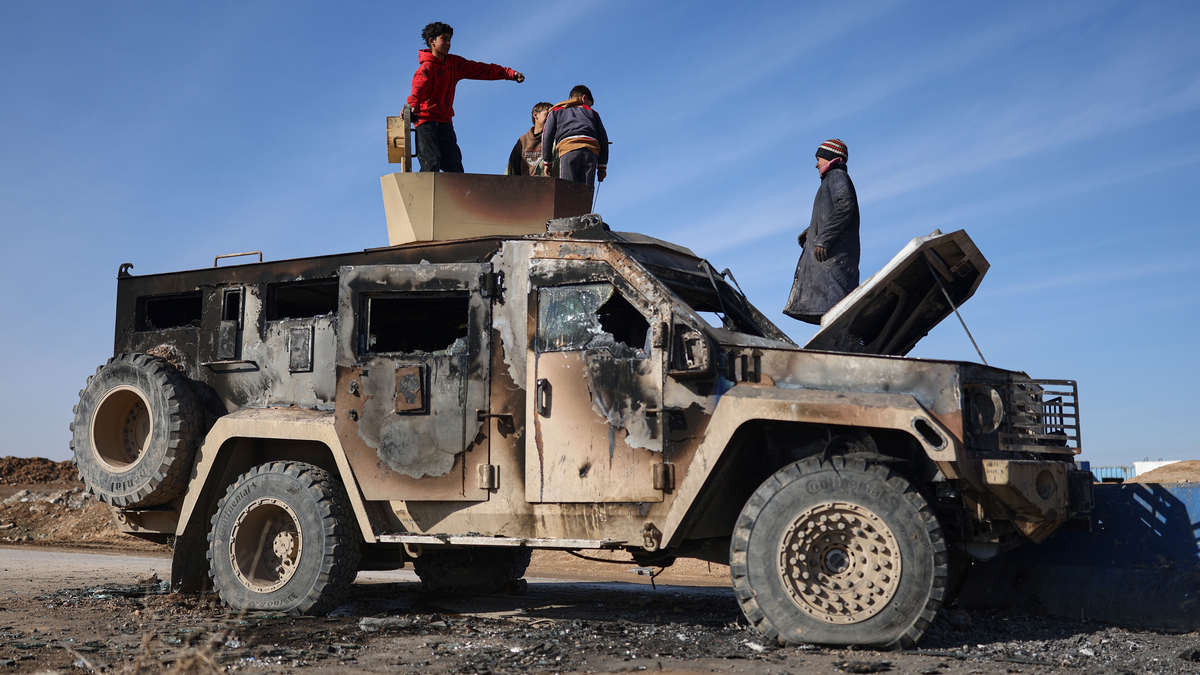
 "Local youth play atop of a damaged armored vehicle belonging to the Syrian Democratic Forces (SDF) at the site of clashes with Syrian government forces in the village of al-Hol in northeastern Syria's Hasakeh province. AP")
Islamic State group members are being transferred from Syria to Iraq by the US military.
The development comes amid fighting between Syrian government forces and Kurdish fighters in northeast Syria. Thousands of Islamic State fighters are being held in detention facilities in the region.
Syrian government forces have taken control of one detention facility where about 9,000 IS members are held. Around 120 inmates fled from Shaddadeh prison on Monday near the Iraqi border. Syrian authorities say most have since been recaptured.
Thousands remain in custody
During battles between the Kurdish-led Syrian Democratic Forces (SDF) and Islamic State over the past decade, thousands of fighters of different nationalities were captured and detained in around a dozen prisons in northeast Syria.
The US-backed forces also captured tens of thousands of mostly women and children linked to Islamic State. Most have been held in the sprawling al-Hol camp near Iraq. A smaller group is held at the Roj camp, near the point where the borders of Syria, Turkey and Iraq converge.
US Central Command said in a statement that the transfer process began on Wednesday, with 150 IS members moved from Syria to “secure locations” in Iraq so far. Up to 7,000 detainees could be transferred to Iraqi-run facilities.
The US move comes as Syrian government forces have captured wide areas previously controlled by the SDF in an offensive that took many by surprise. Forces loyal to Syrian President Ahmad al-Sharaa are now close to several detention centres and the Roj camp, after taking over al-Hol camp and Shaddadeh prison.
There have also been tensions around al-Aqtan prison in Raqqa province, now encircled by government forces. Apart from the Shaddadeh escape, no IS suspects have managed to flee from other facilities.
Quick Reads
View AllSyria’s government joined the US-led international coalition against IS in late 2025. Authorities have said they are ready to take over management of camps and prisons, vowing to remain committed to fighting extremism.
The caliphate’s legacy
When IS declared a caliphate across large parts of Syria and Iraq in 2014, it attracted extremists from around the world. From its self-declared state, the group plotted attacks globally, leaving hundreds dead from Europe and Asia to the Middle East.
IS carried out widespread atrocities in Syria and Iraq, including the enslavement of thousands of Yazidi women and girls after overrunning northern Iraq in 2014.
The group also released videos boasting of its brutality, including beheadings, amputations for alleged theft, stoning women accused of adultery, and throwing gay men from high-rise buildings.
The potential escape of detainees continues to raise fears they could rejoin IS sleeper cells that still carry out deadly attacks.
Prisons across the northeast
IS suspects are held in multiple prisons across northern and north-eastern Syria.
According to a US State Department report, an estimated 9,000 IS fighters — including 1,600 Iraqis and 1,800 from countries outside Syria and Iraq — remain in detention facilities controlled by the SDF.
The largest is Gweiran prison, now known as Panorama, in Hassakeh, which has held about 4,500 IS-linked detainees for years.
Other facilities include Shaddadeh prison, al-Aqtan prison near Raqqa (once IS’s de facto capital), Cherkin prison in Qamishli, and Derik prison near the Iraqi and Turkish borders.
IS has long vowed to free its detained members, including women and children in al-Hol and Roj camps.
An Iraqi intelligence general told The Associated Press that Iraqi authorities received the first batch of 144 detainees on Wednesday night. They will be transferred in stages by aircraft.
Speaking anonymously, the general said the transferred IS members are of various nationalities, including around 240 Tunisians and others from Tajikistan and Kazakhstan.
“They will be interrogated and then put on trial. All of them are commanders in IS and are considered highly dangerous,” he said.
He added that in previous years, 3,194 Iraqi detainees and 47 French citizens have been transferred to Iraq. Securing adequate detention facilities remains a challenge, though specific centres have been designated to hold them in high-security units.
Camps under new control
After IS’s defeat in Syria in March 2019, tens of thousands of women — many wives and widows of IS fighters — and children were taken by the SDF to al-Hol camp.
For years, the camp has been viewed as a potential breeding ground for future extremists, with IS sleeper cells carrying out intimidation and violence against women who attempted to distance themselves from the group.
Syrian troops are now in full control of al-Hol camp. At its peak in 2019, around 73,000 people lived there. Numbers have since fallen as some countries repatriated their citizens. The camp’s current population is about 24,000.
Around 2,500 people remain at Roj camp, including Shamima Begum, who travelled from Britain as a teenager to join IS nearly 11 years ago.
With inputs from agencies