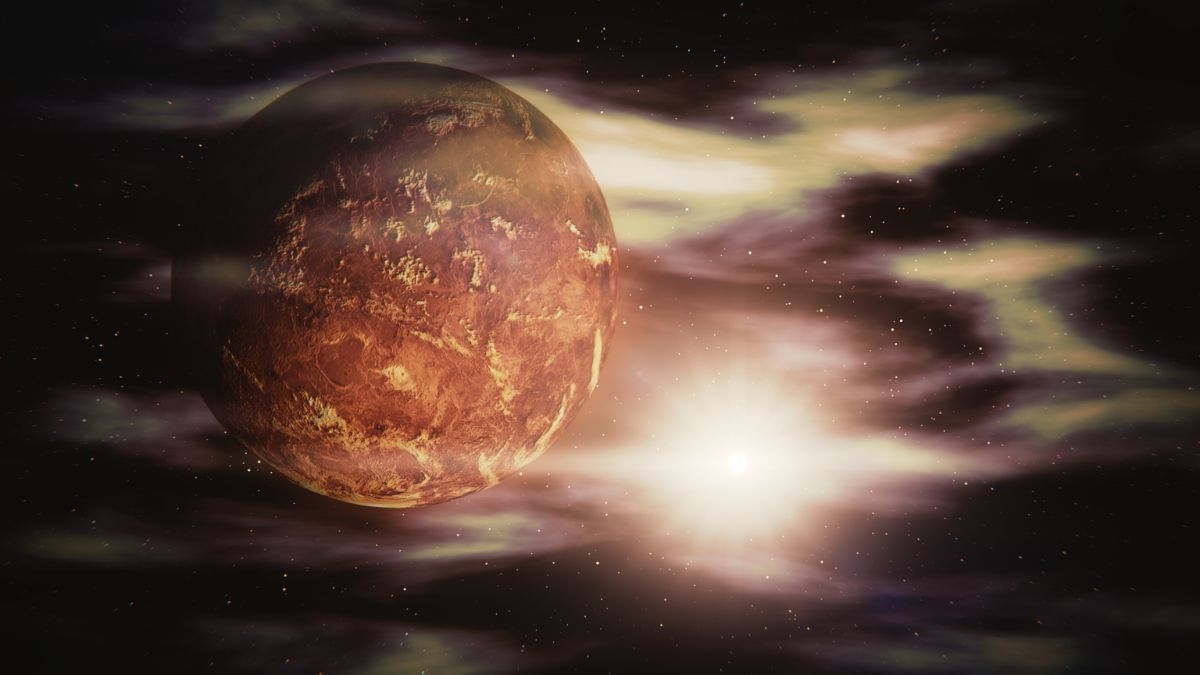
 "Venus was once believed to be covered with oceans but now has about 1,00,000 times less water than Earth. Image used for representational purposes/Pixabay")
Is there life on Venus?
Researchers say they have found evidence of phosphine in Venus’ atmosphere.
This comes as a separate team of scientists revealed that they have found data which shows the presence of ammonia.
But what happened? What does this mean?
Let’s take a closer look:
Venus
First, let’s briefly look at Venus.
Venus is the second planet from the Sun. It is the sixth biggest planet in our solar system.
The planet has also been called ‘Earth’s twin’ because of its similarities to our world.
However, unlike Earth, the planet is extremely inhospitable to life.
As per The Guardian, the planet’s surface, at a temperature of 450 degrees Celsius, gets hot enough to melt metal and zinc.
It also has an unforgiving, deadly atmosphere.
Venus’ atmosphere is over 96 per cent carbon dioxide.
Another 3.5 per cent is molecular nitrogen.
The atmosphere has tiny amounts of other gases such as carbon monoxide, sulfur dioxide, water vapour, argon, and helium.
What happened?
As per The Times of India, researchers have found evidence of phosphine in Venus’ clouds.
As per Britannica, phosphine is a colourless, flammable, and explosive gas at room temperature.
It smells like garlic or decaying fish.
It is used in several industries including factories that manufacture electronics and rat poison.
Impact Shorts
More ShortsAs per Futirism, phosphine is produced by bacteria in oxygen-starved environments.
Scientists thus refer to it as a ‘biosignature’ gas.
The team was led by Jane Graves of Cardiff University. The team observed Venus’ clouds through the James Clerk Maxwell Telescope in Hawaii.
The team published the data in the journal Nature Astronomy.
The research was presented at the national astronomy meeting in the UK’s Hull, as per The Guardian.
The team found signs of phosphine in Venus’ upper atmosphere.
Here the temperature is around 75 degrees Celsius and the pressure is akin to that on Earth’s surface.
Scientists say this area falls under the acidic cloud deck – where chemicals could trigger types of biological activity, as per The Times of India.
“Our findings suggest that when the atmosphere is bathed in sunlight the phosphine is destroyed,” Greaves told scientists, as per Futirism.com. “All that we can say is that phosphine is there. We don’t know what’s producing it. It may be chemistry that we don’t understand. Or possibly life.”
This isn’t the first time Greaves has made such a claim.
She previously did so in 2020 – to much controversy and derision of other scientists.
Meanwhile, another team found hints that the atmosphere contained ammonia.
This discovery was made through the Green Bank telescope, as per The Guardian.
On Earth, ammonia is the byproduct of industrial processes or nitrogen-converting bacteria.
“If there are any microbes in the Venus clouds, they might make certain gases that you wouldn’t expect. And ammonia came up as they could use it as a way to neutralise the acid,” Greaves told IFLScience.
“We’ve detected it slightly above the region which we think is warm enough for life. Either it hasn’t got anything to do with life or the gas is perhaps produced by something living but it drifts upwards where it’s a bit easier for us to detect," Greaves added.
What does this mean?
We don’t know yet.
Some have already offering possible explanations of how the phosphine was found.
“It could be that if Venus went through a warm, wet phase in the past then as runaway global warming took effect [life] would have evolved to survive in the only niche left to it – the clouds,” Dr Dave Clements, a reader in astrophysics at Imperial College London, was quoted as saying at the meeting by The Guardian.
“We haven’t properly sorted out the atmospheric modelling for this yet, but there are some broad lines at the level that suggest parts per million level of phosphine at around 55, 56, 57-kilometre altitude, consistent with the pioneer Venus probe data,” Clements told IFLScience.
“There are a number of weirdnesses in Venus’s atmosphere. Phosphine is just a new one that’s come along,” he added.
“Amongst the other strange things is the way that the amount of water and the amount of SO2 in the atmosphere vary over time. It’s not known why. The variations haven’t been monitored to a great extent, but it’s known that there are variations on time scales from at least days to years,” Dr Clements said.
Greaves herself has warned people not to get carried away.
“Even if we confirmed both of these [findings], it is not evidence that we have found these magic microbes and they’re living there today,” Greaves admitted.
But she still is excited about what the future could bring.
IFLScience quoted Greaves as saying, “There are other models coming along all the time, other explanations saying ‘Oh, you could get ammonia and phosphine and all sorts of other unexpected chemicals this way unrelated to life’ so we’re trying not to overstate, but yeah, it’s really exciting."
The Times of India quoted Sara Seager, a planetary scientist at MIT and a co-author of the phosphine study, as saying the team is “not claiming to have found life on Venus.”
Instead, they are extremely confident that they have found phosphine gas whose presence remains a mystery.
Seager said she hoped this data would lead to future space missions to “directly measure gases in Venus’ atmosphere and provide more definitive answers.”
The Guardian quoted professor Nikku Madhusudhan, an astrophysicist at the University of Cambridge, as saying a biosignature was needed to indicate the presence of life.
“When it comes to Venus, both of those are open questions,” he said. “If they really confirm phosphine and ammonia robustly it raises the chances of biological origin. The natural next thing will be new people will look at it and give support or counter-arguments. The story will be resolved by more data.”
“All of this is grounds for optimism. If they can demonstrate the signals are there, good for them.”
With inputs from agencies