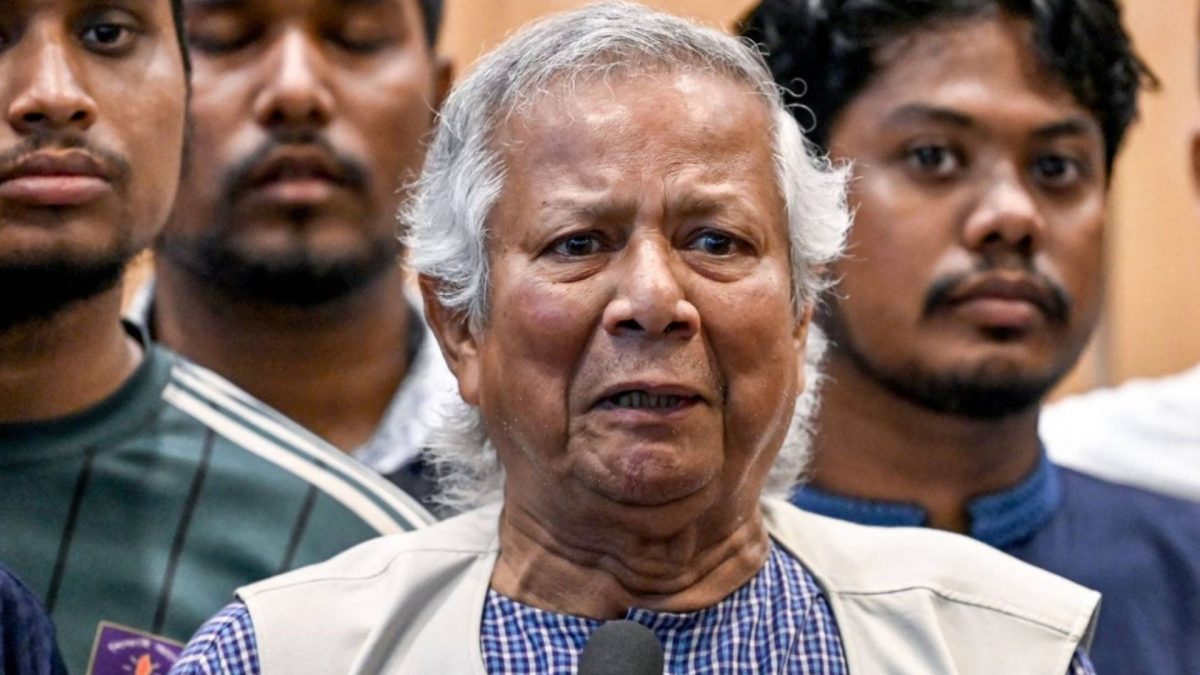
 "Muhammad Yunus is offering no concrete timeline for holding polls. Source: AFP.")
Is Muhammad Yunus preparing Bangladesh for a crisis or an election?
That’s what many are asking after recent developments in India’s neighbouring country.
Yunus, the 84-year-old Nobel laureate, took the reins of Bangladesh after Sheik Hasina fled to India in August.
Though the interim government has been in power for well over 100 days, the situation in Bangladesh only seems to have devolved.
Let’s take a closer look:
Continues to delay elections in name of ‘reforms’
Yunus has yet again talked about Bangladesh holding elections only after he has passed ‘reforms.’
Yunus, in an interview with Nikkei Asia on Wednesday_,_ claimed that the Sheikh Hasina regime “destroyed everything,”
Yunus told the Japanese newspaper, “We need comprehensive reforms in the economy, governance, bureaucracy and judiciary (before holding elections.”
Yunus in the interview said Bangladesh’s interim government has established several commissions to promote reforms in areas such as the electoral system, constitution and judiciary.
He said the government would implement full-scale reforms by January after receiving recommendations from those commissions.
“Implementing these reforms will take time, as we are essentially building a new Bangladesh from scratch,” he said.
Yunus ruled himself out from contesting the elections. “No, I’m not a politician. I’ve always stayed away from politics,” he said in the interview.
“The country’s governance structure has been completely destroyed during Hasina’s 15-year rule, and a huge task has fallen on us to rebuild it by restoring democracy, economic stability and public trust,” he said.
“Under her rule, democratic principles were entirely disregarded. She orchestrated sham elections with no voter participation for three consecutive terms, declaring herself and her party the winners unopposed and operated as a fascist ruler,” he added.
This isn’t the first time Yunus has made such remarks.
Yunus, addressing the nation 100 days after taking office, said, “I promise that we will hold the much-anticipated election once the necessary and essential reforms are complete.”
“Within a few days, the Election Commission will be formed, after which the responsibility for organising the elections will rest with them,” Yunus added.
“You will soon receive a detailed roadmap for the polls,” Yunus promised.
“Until then, I request your patience,” he said. “We aim to establish an electoral system that can be a model for generations to come. This will safeguard our nation from the recurring annual political crises. For this, I am asking for the necessary time from you.”
He also told Al Jazeera, “While the exact timeframe for the interim government’s tenure has not been determined, it should be under four years that’s for sure, it may be less.”
The frustrations within Bangladesh are growing.
Dhaka Tribune quoted BNP general secretary general Mirza Fakhrul Islam Alamgir as saying, “…I am a bit disappointed.”
“I was hoping that the Chief Adviser, with all his wisdom, would identify the problems and give an outline for the election.”
Removing Mujibur from banknotes
Ironically, Yunus’ protests about being unable to hold elections comes even as he has directed the country’s central bank to do away with the image of Sheikh Mujibur Rahman –the country’s founding president and founding father – on bank notes.
According to the paper, officials from the bank and the Ministry of Finance said the leader’s image will be removed from the current notes. Initially, the design of the four notes is being changed, and the others will be redesigned in phases, they said.
The Finance Ministry’s Finance Institute Division submitted a detailed design proposal for the new notes in September.
Bangladesh Bank is printing new notes, including in them features of the July uprising, the Dhaka Tribune reported Thursday, referring to the student-led protests that forced Hasina to flee.
According to the central bank, banknotes of Taka 20, 100, 500, and 1,000 are being printed on the instructions of the interim government.
“The new notes will not include image of ‘Bangabandhu’ Sheikh Mujibur Rahman,” the paper reported, quoting the bank.
Religious structures, Bengali traditions, and “graffiti” drawn during the July uprising will be included, it said.
“I hope the new note could be released in the market within the next six months,” it quoted Bangladesh Bank executive director Husneara Shikha as saying.
The new banknote will showcase religious structures, elements of Bengali tradition, and graffiti from the recent uprising, marking a significant departure from earlier designs that prominently featured Mujibur Rahman.
Critics viewed the change as part of the interim govt’s efforts to diminish his legacy and the movement that led to the country’s independence.
Mujibur Rahman was assassinated in a military coup on August 15, 1975.
Since the caretaker govt took over, several symbolic representations of Mujibur Rahman have been removed, including his portrait from the president’s residence. Holidays associated with him have been cancelled, and protests have seen statues toppled and murals defaced.
Caretaker govt inches close to Pakistan
Despite being a caretaker government, the Yunus regime is making consequential foreign policy decisions.
The interim government seems to be inching towards Pakistan.
It recently removed the need for Pakistani citizens to obtain a security clearance before applying for a visa.
Ironically, it was Hasina who in 2019 had decreed that all Pakistani citizens who wished to travel to Bangladesh would have to get a ‘no objection’ clearance from Bangladesh’s Security Services Division of the Ministry of Home Affairs.
The Bangladesh government announced the new policy in a letter dated December 2.
The change in visa rules isn’t the only sign of a thaw between the two nations. In November, a Pakistani freight ship from Karachi docked at Bangladesh’s southeastern Chittagong port, marking the re-establishment of direct maritime links between the two countries after 47 years.
Pakistan’s envoy to Dhaka, Syed Ahmed Maroof, speaking on the occasion said that it was “a major step” in boosting trade across the region. Moreover, the route will “promote new opportunities for businesses on both sides”.
Bangladesh in September also lifted imported restrictions on Pakistani goods. Earlier, all goods coming from Pakistan had to be offloaded onto other vessels — mostly belonging to Sri Lanka or Malaysia — before it came to Bangladesh. These vessels also required a mandatory physical check from Bangladeshi authorities.
As Mubashar Hasan, an expert on Bangladeshi politics and executive director of the Sydney Policy and Analysis Centre in Australia, told The Print, “It seems by normalising relationships with India’s arch-rival Pakistan, Bangladesh’s administration is signalling that it is not going to see South Asian politics through an Indian prism anymore. Whether in the long run, Bangladesh can continue to afford that remains to be seen as the West — specifically the US — sees South Asia through an Indian prism and the US is a vital ally for Bangladesh. Having said that, India, too, must realise its neighbourhood policy is in shambles.”
All this, of course, has raised New Delhi’s hackles.
Continues spat with India
This, even as Yunus continued Dhaka’s spat with New Delhi by saying India should extradite Hasina once her trial in the International Crimes Tribunal in Bangladesh concludes.
“Once the trial concludes and a verdict is reached, we will formally request India to hand her over,” Yunus said, adding that under an international law signed by both countries,
“India would be obligated to comply.”
“We will seek the return of the fallen autocrat Sheikh Hasina from India,” Yunus said earlier as per Al Jazeera. “I have already discussed the issue with Chief Prosecutor of the International Criminal Court Karim Khan.”
He also claimed that the Indian government’s concern about the safety of Hindus is not based on facts as much of what’s being said is “propaganda.”
This flies in the face of several reports saying that Hindus are being targeted all over Bangladesh.
Hasina, who is in India, in her first public speech accused the administration of failing to protect minorities.
According to Hindustan Times, Bangladesh’s International Crimes Tribunal has called her address “hate speech.”
The interim government has claimed that Hasina is trying to smear Yunus’ administration.
The relations between the two neighbours have deteriorated ever since her ouster with India expressing concern over Hindus and other minorities being targeted in Bangladesh.
The situation was aggravated further with the arrest of the Hindu monk Chinmoy Krishna Das .
Das, who was held at the Dhaka airport, has been accused of disrespecting the Bangladesh flag.
He has recently been denied bail.
According to Outlook, Bangladesh has recalled its heads of its missions in Kolkata and Agartala.
The outlet quoted Bangla daily Prothom Alo as reported that the acting deputy high commissioner of Bangladesh in Kolkata, Shikdar Md Ashrafur Rahman, and the assistant high commissioner in Tripura, Arifur Rahman, have been ordered to return home on an “urgent basis.
Bangladesh’s economy on the slide
All this comes even as Bangladesh’s economy continues to hurt.
In February, the Indian High Commissioner had said that New Delhi is Dhaka’s biggest export destination in Asia.
The numbers show that Bangladesh is India’s largest trading partner in Asia and its 25th largest overall.
Meanwhile, India is Bangladesh’s second-largest trading partner – after China.
According to Business Standard, bilateral trade between the two nations stands at $12.9 billion.
New Delhi currently has a trade surplus of $9.2 billion with Dhaka, as per India Today.
As per Economic Times, India’s exports to Bangladesh in the 2023 -2024 financial year were higher than its exports to the world’s leading economies like Japan, Germany and France.
India’s exports to Bangladesh fell to $11 billion in 2023-24 from $12.21 billion in 2022-23, while imports decreased to $1.84 billion from $2 billion in the same period.
This is mostly down to the volatile situation.
In August, in the aftermath of Hasina fleeing the country, reports indicated that goods trucks had halted at the border and exporters are complaining about facing disruptions due to a shortage of foreign exchange.
Talks about a potential Free Trade Agreement were also in peril.
But now, things are getting even worse.
Economic Times reported that the exports of gem and jewellery, imitation jewellery, engineering goods and oilmeals have stalled, while those sending raw cotton, cotton yarn and textiles exporters are facing a lag in getting their payments.
This despite buyers making the payments in local currency.
However, banks are having a tough time converting the Taka into dollars because of a shortage of the US currency – which is resulting in payment delays, the newspaper reported.
So what will Yunus do? Which way will he go?
That remains to be seen.
With inputs from agencies