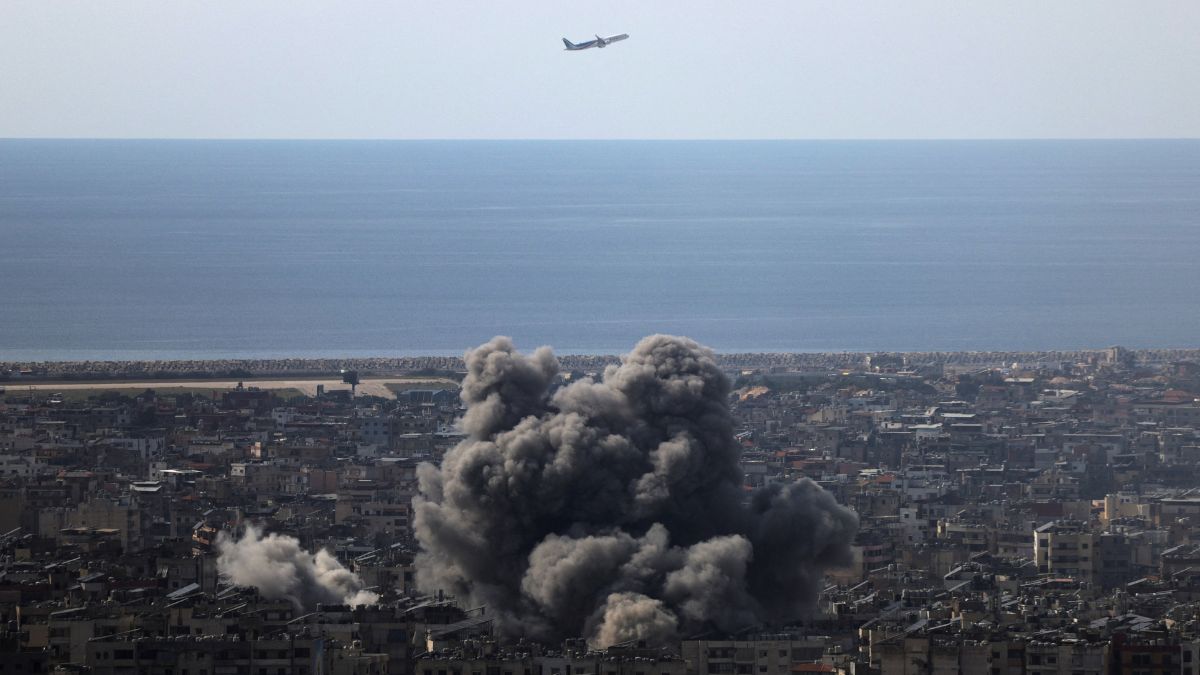
 "An airplane flies as smoke rises after an Israeli strike on Beirut's southern suburbs, following an escalation between Hezbollah and Israel amid the US-Israeli conflict with Iran, Lebanon, March 6, 2026. Reuters")
West Asia remains on the edge as the US-Israel war with Iran enters its second week on Saturday (March 7). Blasts continue to rock Tehran, while Iran has retaliated by firing missiles at Israel.
The conflict that has spilt across West Asia and even beyond does not seem to be ending anytime soon. United States President Donald Trump has ruled out a deal with Tehran except for “unconditional surrender”.
“There will be no deal with Iran except UNCONDITIONAL SURRENDER!” Trump wrote in his Truth Social post. “After that, and the selection of a GREAT & ACCEPTABLE Leader(s), we, and many of our wonderful and very brave allies and partners, will work tirelessly to bring Iran back from the brink of destruction, making it economically bigger, better, and stronger than ever before.”
As the war in Iran completes a week, where do the countries stand? We take a look.
Catch live updates on the Iran war here .
Iran
Tehran has been facing relentless bombing by Israel-US since February 28, when the joint aerial strikes by the two countries killed Iran’s Supreme Leader Ayatollah Ali Khamenei and several other top Iranian officials.
Explosions were heard and smoke billowed over western Tehran early Saturday as Israel launched a new wave of attacks on Iran, reported Associated Press (AP).
The US and Israel have been pounding Iran, targeting military capabilities, leadership and nuclear programme. The Israeli military has claimed to have destroyed 80 per cent of Iran’s air-defence systems in the first week of the war and disabled over 60 per cent of its missile launchers.
According to Israel, 50 of its warplanes had hit a bunker used by Iran’s leadership beneath the destroyed Tehran compound of Supreme Leader Khamenei.
Mehrabad airport in Tehran was struck early on Saturday, Iran’s semi-official Tasnim news agency reported.
Blasts were also reported around the Iranian city of Kermanshah, which hosts multiple missile bases.
At least 1,332 people have been killed in Iran since the US and Israel waged a war against Iran last Saturday, Iran’s UN ambassador, Amir Saeid Iravani, said, citing the Iranian Red Crescent Society.
More than 160 were earlier killed by a strike on an elementary school in Minab, some 1,100 kilometres southeast of Tehran, the state-run IRNA news agency reported.
Since the war began, the streets of Tehran, which house one crore people, have gone eerily quiet, with shops shut and many people fleeing the capital, reported ABC.
“The capital is almost dead. Most shops and shopping centres are closed and the drug stores and bakeries that are open work only a few hours during the day. Cash is also very scarce. ATMs do not have cash,” Saman, a resident of eastern Tehran, was quoted as saying.
Meanwhile, Washington Post reported that Russia is providing Iran with locations of US warships and aircraft in West Asia after Tehran’s ability to find American forces was degraded.
Israel
Israel has intensified aerial attacks against Iran and Lebanon as Tehran continues to target the Jewish country.
On Saturday, an explosion was heard in Jerusalem after air raid sirens warned of an incoming Iranian missile attack, reported AFP.
The Israel Defense Forces (IDF) said that Iran launched a round of missiles toward Israel early today, adding that its air defences were “operating to intercept the threat”.
Eleven people have been killed in Israel, including nine in Beit Shemesh, as Tehran continues retaliatory attacks to avenge Khamenei’s killing.
The US State Department has approved the sale of $151.8 million worth of munitions to Israel on Friday.
Israel has killed 217 people and wounded 798 in Lebanon, the country’s health ministry said Friday. An estimated 95,000 people have been displaced.
Israel had reportedly launched air strikes on several towns in southern Lebanon, local media reported on early Friday. It claims it struck only Hezbollah-linked targets.
Israeli strikes pounded the capital Beirut yesterday after Israeli authorities ordered an unprecedented evacuation of the city’s entire southern suburbs.
The Israeli bombing in Lebanon was the heaviest since a ceasefire in 2024 ended the last war between Israel and Hezbollah.
US
The US investigation has revealed its forces were “likely” responsible for a strike on the Iranian girls’ school in Minab that killed dozens of children on the first day of the war, two American officials told Reuters.
During the first week of the US’ Operation Epic Fury, it has hit more than 3,000 targets and damaged or destroyed over 43 Iranian ships, according to US Central Command.
A US submarine torpedoed the Iranian warship, IRIS Dena, just 44 nautical miles off (81km) southern Sri Lanka, as it was returning home from naval drills hosted by India, bringing the war close to India’s doorsteps.
US Treasury Secretary Scott Bessent warned in a television interview that the “biggest bombing campaign” of the war was still to come. The US’ explanation for the war in Iran has shifted, raising fears of an extended conflict in West Asia.
Six American soldiers were killed at an operations centre at a civilian port in Kuwait, more than 16 kilometres from the main Army base. Iran has been targeting Gulf states hosting US military installations.
West Asia
The US-Israeli war in Iran has plunged West Asia into chaos and violence. Tehran has continued its attacks on Gulf nations hosting US troops.
Explosions were reported in Dubai and Manama on Saturday. The Saudi defence ministry said it had blocked repeated missile strikes at an air base housing US military personnel and drone attacks at a major oil field.
At least two drone attacks this week have targeted Saudi Arabia’s Ras Tanura refinery.
In Manama, Bahrain’s capital, a warning siren sounded today, AFP reported. Bahrain’s interior ministry urged citizens and residents to stay calm and head to the nearest safe place.
Dubai authorities earlier reported a “minor incident” that resulted from the fall of debris following an interception.
Oman, Qatar, Syria and Bahrain have also reported attacks.
Oil prices up, markets in shock
Oil prices have touched their highest levels in years after the effective shutdown of the critical shipping lane of the Strait of Hormuz.
Crude oil prices have soared as fears mount about oil supply disruption during the war in West Asia.
The international benchmark oil contract, Brent North Sea crude, jumped to $92.69 per barrel on Friday, up 8.5 per cent for the day and nearly 30 per cent for the week.
This comes as tankers transporting oil and liquefied natural gas (LNG) have been halted through the Strait of Hormuz, through which about 20 per cent of global oil shipments normally pass.
“The market is shifting from pricing pure geopolitical risk to grappling with tangible operational disruption, as refinery shutdowns and export constraints begin to impair crude processing and regional supply flows,” JPMorgan analysts said in a report on Friday, as per Reuters.
Trump’s demand for Iran’s surrender, which further complicated any possibility of ending the war soon, sent European and US stock indexes tumbling on Friday.
India’s Sensex and the Nifty lost about 2.9 per cent each this week, the steepest weekly fall for the Nifty since February 28, and for the Sensex since December 20, 2024.
Global air travel has also been impacted as the war in West Asia has led to many airlines grounding flights to and from the region.
With inputs from agencies