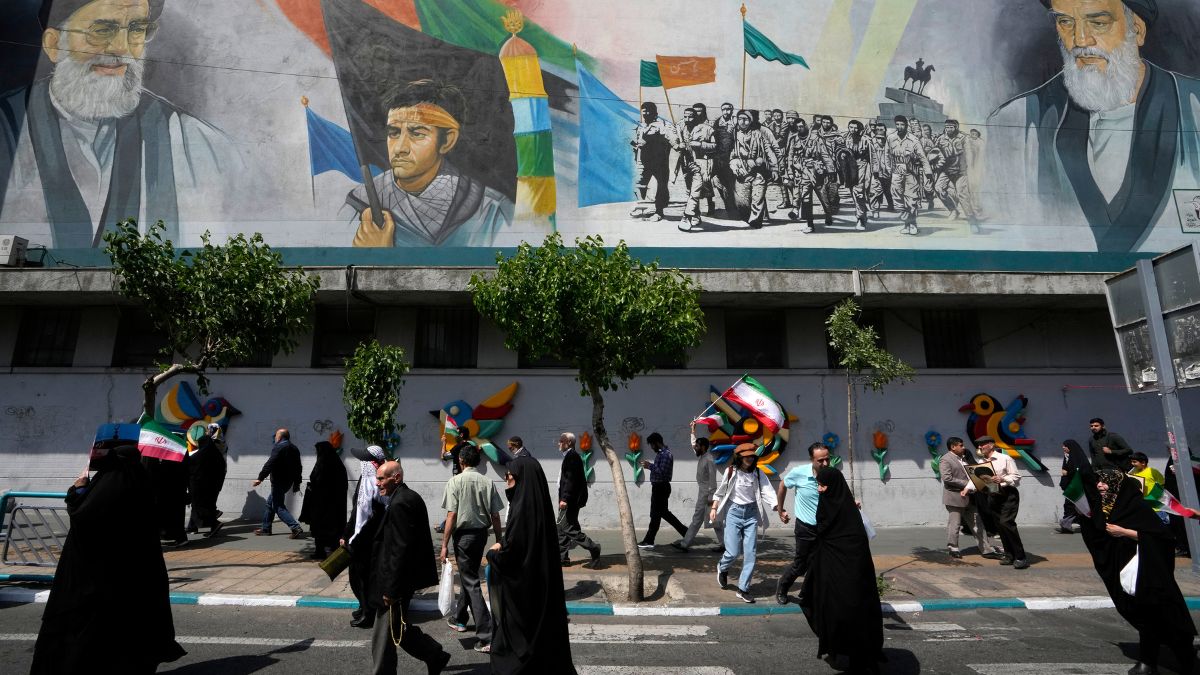
 "Iranian worshippers walk past a mural showing the late revolutionary founder Ayatollah Khomeini, right, Supreme Leader Ayatollah Ali Khamenei, left, and Basij paramilitary force, in an anti-Israeli gathering after their Friday prayer in Tehran, on 19 April 2024. AP")
Iran’s muted reaction to the Israeli military’s attack on its central province of Isfahan appears to have staved off the threat of a full-blown war between the two bitter rivals – for now. Tehran has downplayed the purported Israeli airstrike, while Israel has yet not claimed responsibility for the reported explosions over the Iranian city on Friday (19 April).
Israel’s retaliation was prompted by Iran’s first-ever direct attack on the Jewish state last weekend. Tehran was responding to an apparent Israeli airstrike on 1 April that damaged a building in Iranian embassy compound in Syria’s Damascus, killing seven Revolutionary Guards, including Iran’s most senior commander in the region.
Let’s take a closer look.
What is going on?
Iran’s military and political leaders have downplayed Israel’s Friday attack near a major air base and nuclear site in Isfahan.
Iran claimed that “mini-drones” carried out the assault, causing no damage or casualties.
Iranian foreign minister Hossein Amirabdollahian told NBC News that drones flew for a few hundred metres inside Iran before being shot down by its air defense systems. “They’re … more like toys that our children play with, not drones,” he said.
Amirabdollahian also reportedly said that no link has been established between the attack and Israel, ruling out the need to retaliate.
Iranian media reported that a small number of explosions took place over Isfahan due to air defences hitting three drones, terming the incident an attack by “infiltrators” while not naming Israel.
Impact Shorts
More ShortsHowever, according to American officials, it was a missile strike. They have hinted that Israel targeted sites like Iran’s air defence radar system, which protects the Natanz nuclear facility, BBC reported.
The United Nations’ nuclear watchdog, the International Atomic Energy Agency, said there was “no damage” to Iran’s nuclear sites.
The attack coincided with the 85th birthday of Iran’s Supreme Leader, Ayatollah Ali Khamenei.
Iranian president Ebrahim Raisi did not mention the recent incident in his Friday speeches, as per BBC.
Next response at ‘maximum level’
While Iran tried to play down Israel’s apparent strikes, it also issued a warning.
The Iranian foreign minister on Friday cautioned Israel that if it retaliates, Tehran’s next response would be at the “maximum level”.
“If Israel wants to do another adventurism and acts against the interests of Iran, our next response will be immediate and will be at the maximum level,” Amirabdollahian said, according to Reuters.
ALSO READ: Israel attacks Iran: What is the Axis of Resistance? Why is it now a concern?
Has Israel reacted?
Israel has not officially reacted to its precision strikes, which as per Associated Press (AP), hit near military and nuclear targets deep in Iran.
However, Israel’s far-right national security minister Itamar Ben Gvir described the Friday attack as “Feeble” on X.
CNN reported citing Israeli media that Gvir had pushed Israel’s war cabinet to “go crazy” over the past week, resisting the suggestions of a controlled military response.
Why was Israel’s response tempered?
Iran and Israel are arch-rivals. However, both countries understand the consequences of a full-scale war and want to avoid it.
West Asia is already reeling from Israel’s war with Hamas in Gaza after the Palestinian militant group attacked the Jewish state last October, killing 1,200 and taking hundreds of hostages to the narrow strip. Iran-backed proxies have ratcheted up attacks on Israel over its Gaza war that has reportedly killed 34,000 Palestinians.
Although Israeli prime minister Benjamin Netanyahu’s war cabinet had initially green-lit plans for a strike on Monday night on Iranian soil, they were put off at the last minute, sources told Reuters.
Israel’s allies like the United States had pressed Netanyahu’s government to make a calibrated response and not escalate tensions further.
“Israel tried to calibrate between the need to respond and a desire not to enter into a cycle of action and counter reaction that would just escalate endlessly,” Itamar Rabinovich, a former Israeli ambassador to Washington, was quoted as saying by Reuters.
Will tensions abate now?
Observers believe they might.
Iran and Israel, the regional powerhouses in West Asia, seem to be keen to de-escalate the latest flare-up.
Israel has displayed its military dominance over Tehran with its Friday strikes that Iran’s defences could not fully contain.
A regional intelligence source told CNN that Iran is unlikely to retaliate now and “that the direct state-to-state strikes between the two enemy states were over.”
Iran and Israel are expected to go back to their shadow war instead of engaging in a direct conflict. Iran might use its proxies in the region to target Israel, while Israel could launch cyber attacks and strikes against these Tehran-backed militant groups.
“Neither side is ready to jump over the brink,” Alex Vatanka, director of the Iran programme at the Middle East Institute, told AP.
“Probably we’re going to go back to the proxy war, “ he said, adding that the proxy war now came with the risk of “that sudden eruption of state-to-state war. Which we didn’t have to worry about before.”
For now, the rivals have stoked hopes that the possibility of a direct catastrophic war is over.
With inputs from agencies