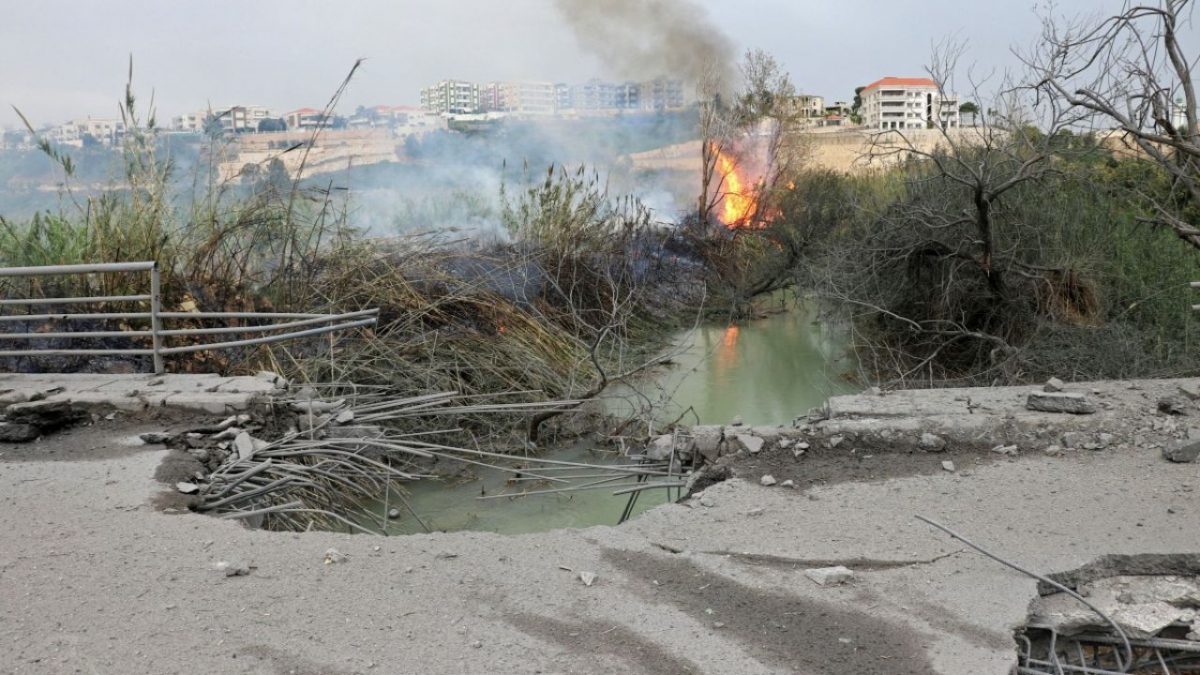
 "Israel’s defence minister Israel Katz has announced that his country will occupy territory up to the Litani River in Lebanon as a security buffer against Hezbollah’s attacks.")
The war between the US-Israel and Iran is sucking up all the oxygen.
However, in the background, another conflict is simmering in the region. Earlier in March, Israel announced it was launching an incursion into Lebanon.
Israel also launched strikes on Lebanon that left over 1,000 dead and a million displaced. Now, Israeli leaders are talking about establishing a ‘buffer zone’ in southern Lebanon. Israel’s defence minister, Israel Katz, has said his country will occupy territory up to the Litani River as a security buffer against Hezbollah’s attacks.
But why does Israel want to occupy a tenth of Lebanon?
Let’s take a closer look.
Where Lebanon fits in
While Israel and Iran have been at odds for decades , Lebanon is an important piece of the equation. This is because Tehran supports the militant group Hezbollah, which operates from Lebanon and holds great sway over the state. The two neighbours, Israel and Lebanon, have also been at each other’s throats for years.
Israel in 1978 invaded south Lebanon and set up a narrow occupation zone in an operation against Palestinian guerrillas after a militant attack near Tel Aviv. Israel backed a local Christian militia called the South Lebanon Army (SLA). Four years later, Israel invaded Lebanon all the way to Beirut in an offensive that followed tit-for-tat cross-border fire. It pulled back from central Lebanon in 1983 but retained forces in the south.
This came after Iran’s Revolutionary Guards helped form Hezbollah, which means “party of God,” in 1982 in order to fight Israeli forces. Iran also wanted to spread the Islamic Revolution within the region. Israel in 1985 established a wider occupation zone in southern Lebanon, about 15 km deep, controlling the area with the SLA.
After years of attacks, Israel finally withdrew from southern Lebanon in 2000. This brought an end to two decades of occupation by the Israeli military on Lebanon’s territory. However, this hasn’t stopped the two countries from repeatedly clashing over the years. In 2006, Hezbollah crossed the border into Israel, kidnapping two Israeli soldiers and killing others, leading to a five-week war involving heavy Israeli strikes on both Hezbollah strongholds and national infrastructure.
On October 8, 2023, Hezbollah opened fire at Israel, one day after the Hamas-led attacks on southern Israel that killed 1,200 people in Israel and led to war in Gaza, pitting Israeli forces against the Palestinian militant group. Israel responded to Hezbollah with a bombing campaign and eventually sent its ground troops into southern Lebanon again.
As per The Indian Express, a ceasefire was agreed to in 2024. This adhered to UN Resolution 1701, which was adopted to end the 2006 Lebanon war. Under these terms, Hezbollah was to disarm and withdraw to the north of the Litani. Meanwhile, Israel was to exit Lebanon. Only the Lebanese army and the UNIFIL were to be the armed groups allowed south of the Litani. However, Israel kept troops on five hilltops in southern Lebanon, and the attacks continued sporadically.
What is the situation in Lebanon?
According to The Indian Express, the Lebanese government would like to see Hezbollah tamped down . However, it cannot presently do so itself as its army is not sufficiently large. While Hezbollah remains part of the daily fabric of life, their numbers in Parliament have shrunk.
In the 2022 elections, Hezbollah won just 13 seats. However, their alliance, which includes the Amal party spearheaded by Parliament’s long-time Speaker Nabih Berri, holds 62 seats. There are growing signs of a possible thaw between Israel and Lebanon. This comes after Beirut asked to speak directly to Tel Aviv and also declared the Iranian envoy persona non grata and asked him to leave the country.
Israel earlier this month launched a fresh incursion into Lebanon. On March 4, Israel ordered all residents south of Lebanon’s Litani River to leave the area. This came just days after Hezbollah joined the US-Israeli war on Iran by firing rockets at Israel.
The river runs east from the Mediterranean about 30 kilometres north of the border with Israel. Around eight per cent of Lebanese territory lies south of the river. Israeli ground troops have set up new fortifications south of the river and destroyed homes in emptied villages. Israel views the area as a stronghold for the Iran-backed Shi’ite militia, but the south has historically been a diverse region with Christian and Sunni villages as well.
According to a piece in News18, Israel has long factored in the Litani River in its military plans. The outlet noted that pushing out Hezbollah from the area would create space between Israeli border communities and Hezbollah fighters, weapon routes and launch sites.
Katz has said the idea is “to create a defensive space and keep the threat away." He added that Israeli forces would retain control over the remaining bridges and the security zone up to the Litani River. Katz said five bridges on the Litani had been blown up because they were used by Hezbollah to ferry “terrorists and weapons".
Prime Minister Benjamin Netanyahu also chimed in, saying, “We removed the threat of a ground invasion [into Israel from Lebanon] and are further widening the buffer zone." “We are determined to change the underlying foundations of the situation in Lebanon," Netanyahu added.
Hezbollah will likely not go quietly. The group called any Israeli occupation south of the Litani an “existential threat" to the Lebanese state. Senior Hezbollah lawmaker Hassan Fadlallah said: “We have no choice but to confront this aggression and cling to the land."
What do experts say?
Speaking to The Indian Express, Sanjiv Arora, former Secretary of the MEA, India’s Ambassador to Lebanon from 2016 to 2019, and to Qatar from 2012 to 2016, called the possibility of a ground invasion by Israel into Lebanon ‘utterly catastrophic’.
“One can only hope that the international community will speak up to prevent that from happening. France, which governed Lebanon for 23 years after World War I and has since maintained a special relationship with the country, is making efforts for negotiations. More countries, including India, need to join in,” Arora said.
Arora called on India to use its ties with the Gulf nations to ‘have a say’ as well as send humanitarian aid as it has done in the past. Arora also called on the UN to hold an urgent session on Lebanon and ensure that Israel adheres to international laws.
Experts also warn that a full-scale occupation could lead to a prolonged and highly destructive conflict with Hezbollah, destabilise Lebanon further, and risk drawing in regional powers like Iran, potentially widening the war.
FAQs
1) Why does Israel want to create a buffer zone in southern Lebanon?
Israel says the buffer zone is needed to push Hezbollah fighters, weapons routes, and launch sites further away from its northern border. The aim is to create a defensive space and reduce the risk of cross-border attacks on Israeli communities.
2) Why is the Litani River important in this conflict?
The Litani River serves as a natural boundary about 30 kilometres north of Israel’s border. Under UN Resolution 1701, Hezbollah was supposed to withdraw north of the river, making it a key reference point for any proposed security arrangements or buffer zones.
3) What could happen if Israel occupies southern Lebanon again?
Experts warn that a full-scale occupation could lead to a prolonged and highly destructive conflict with Hezbollah, destabilise Lebanon further, and risk drawing in regional powers like Iran, potentially widening the war.
With inputs from agencies