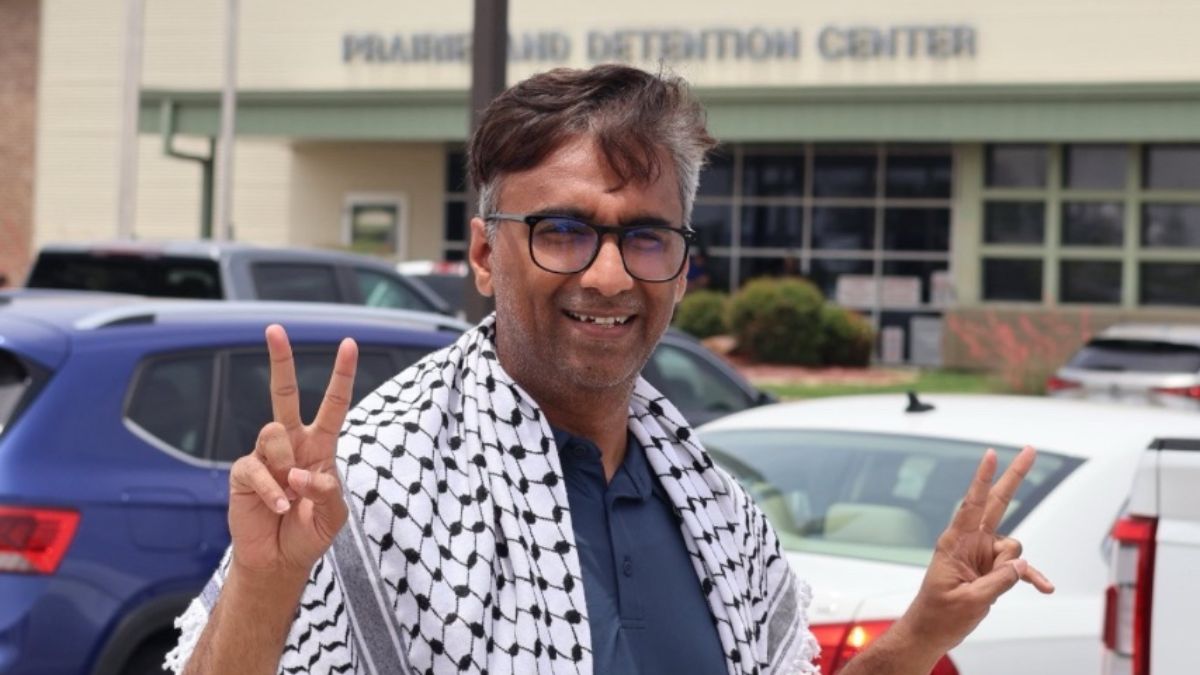
 "Since his release, he has made disturbing accounts of his time in custody, including being chained all over his body. X")
Badar Khan Suri, an Indian academic at Georgetown University, has been released from immigration custody following a court order in the United States.
He will now return to his home in Virginia and stay with his family while he awaits the result of his case against the Trump administration. He has accused the government of wrongful arrest and detention, saying it violated the First Amendment and other constitutional rights.
At the same time, Khan Suri is also going through deportation proceedings in an immigration court in Texas.
ALSO READ | Parents deported, toddler held in US: How 2-year-old Maikelys was reunited with mother in Venezuela
Since his release, he has made disturbing accounts of his time in custody, including being chained all over his body.
In this explainer, we look at what led to the arrest of the Indian academic, what he experienced during detention, and the charges made by the US government.
Let’s take a look:
What happened to Badar Khan Suri during his detention?
Speaking for the first time after being freed, he said, “There was no charge, there was nothing.”
“They made a sub human out of me.”
He said he was moved from one centre to another without any notice, and that neither he nor his family was informed about his legal representation.
Khan Suri also described the conditions during the early days of his time in ICE custody, saying he had no idea where he was being taken.
Impact Shorts
More Shorts“For the first seven, eight days, I even missed my shadow,” he said.
“It was Kafka-esqe, where they were taking me, what they were doing to me. I was chained — my ankles, my wrist, my body. Everything was chained.”
Inside the centre, Khan Suri said the facilities were unhygienic. He tried to report this to the ombudsman but said he never got a reply, NBC News said in a report.
He also worried constantly about his children.
“My eldest son is only nine, and my twins are only five. My nine-year-old knows where I am. He was going through very rough times. My wife used to tell me that he was crying. He needs support from mental health,” he said.
Despite the ordeal, he said he holds no grudge. “There is madness everywhere, but it shouldn’t be in the United States of America,” he said.
During his detention, Khan Suri was made to wear a bright red uniform, typically given to those classified as high-security inmates.
His petition said this was due to what officials claimed was his link to a “known criminal group”, reportedly referring to what the government believed were ties to Hamas, a claim he denies.
“Justice delayed is justice denied,” he told reporters after his release from the detention facility in Alvarado, near Dallas. “It took two months, but I’m extremely thankful that finally I’m free.”
ALSO READ | Why Trump is offering $1,000 to migrants to ‘self-deport’ from US
Why was Khan Suri arrested? Who is Mapheze Saleh, his wife?
He was arrested by masked, plain-clothed officers on March 17 outside his apartment complex in Arlington, Virginia. He was then flown first to Louisiana and later moved to a detention centre in Texas.
But why?
According to the Trump administration, his visa was revoked due to his social media posts and his wife’s links to Gaza. The government accused him of supporting Hamas, which is listed as a terrorist organisation by the United States.
He “has close connections to a known or suspected terrorist, who is a senior advisor to Hamas,” Tricia McLaughlin, a spokesperson for the Department of Homeland Security, said on X.
Khan Suri and his wife, Mapheze Saleh, are said to have been targeted over Saleh’s family background. Her father, Ahmed Yousef, worked with the Hamas-backed administration in Gaza for over ten years.
This, however, was before the October 7, 2023, Hamas attack on Israel, according to Suri’s legal team.
The US government claims that Khan Suri has undeniable family links to Hamas, which he “euphemistically refers to as ‘the government of Gaza.’”
However, the American Civil Liberties Union has argued that Suri barely knew Ahmed Yousef.
Speaking at a press conference, Saleh said the experience had been hard on their family, but Khan Suri remained firm in his stance.
“Badar told me, ‘If my suffering in the detention center is because I married to a Palestinian and because I spoke out against the genocide in Gaza, then I should wear it as a badge of honour,’” she said.
Saleh, originally from Gaza, is an American citizen and also a student at Georgetown. Her father, Ahmed Yousef, is a former adviser to the late Hamas leader Ismail Haniyeh.
ALSO READ | Who is Chinmay Deore, Indian student suing Trump administration over possible deportation?
In an interview with The New York Times, Ahmed Yousef said he stepped away from his role over ten years ago and has since criticised Hamas publicly.
Court records show that Suri met his father-in-law only once, in 2013, to ask for his permission to marry Saleh. Since then, they have had occasional conversations, mainly about family or academic matters.
After moving to the United States in 2023, Suri has had no direct contact with him.
What did the judge say?
US District Judge Patricia Tolliver Giles ordered the release of Khan Suri, saying he appeared to have strong constitutional grounds in his case against the Trump administration.
She also took into account his family’s situation and said she did not see him as a threat to the community.
“Speech regarding the conflict there and opposing Israel’s military campaign is likely protected political speech,” Giles said. “And thus he was likely engaging in protected speech.”
“I gave the government multiple opportunities to submit any type of filing to controvert these claims or support their opposition to these motions and they declined,” she added.
While understanding the administration’s argument on national security, Judge Giles said that “whatever deference may be appropriate, concerns of national security” do not override the judiciary.
With inputs from agencies