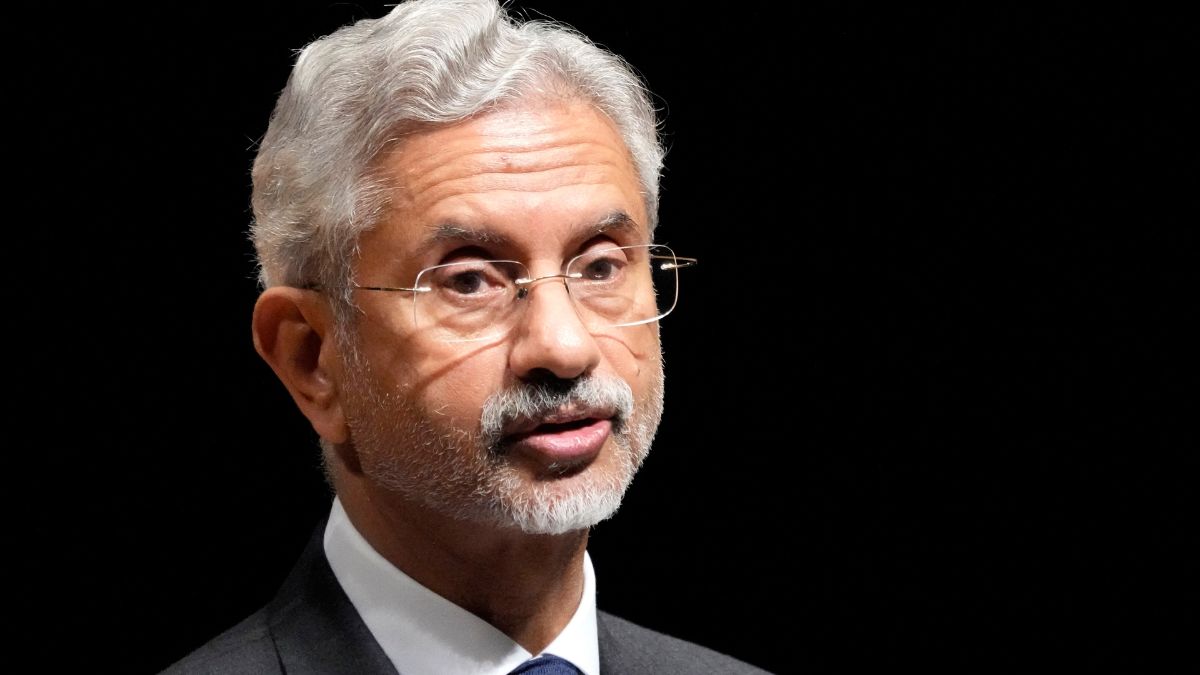
 "Jaishankar’s security breach in London: How the Khalistan movement emerged in UK")
India has strongly condemned the security breach of External Affairs Minister (EAM) S Jaishankar in London, calling on the United Kingdom to take strict action against the pro-Khalistan supporters involved in the event. The Ministry of External Affairs (MEA) on Friday (March 7) said that the incident reflects Britain’s “indifference” to intimidation and threats by the Khalistani extremist forces.
During a press briefing, MEA Spokesperson Randhir Jaiswal said India has conveyed its “deep concern” to the UK authorities about the breach in Jaishankar’s security by “UK-based separatist and extremist elements”.
“There is a larger context to the incident. It brings out both the licence accorded to such forces, as well as indifference to their intimidation, threats, and other actions aimed at impeding our legitimate diplomatic activities in the UK,” he said.
This is not the first time Khalistani supporters in the UK have expressed anti-India sentiments. Let’s take a look at the EAM’s security breach incident and the history of the separatist movement there.
What happened?
A small group of pro-Khalistan protesters gathered outside the think tank Chatham House in London on Wednesday, where EAM S Jaishankar was speaking.
They raised anti-India slogans and one protester broke the barricades when the minister was leaving. Videos posted on social media show the demonstrators waving the yellow Khalistan flags and sloganeering outside Chatham House.
A protestor broke away from the police cordon and ran towards Jaishankar’s car but was quickly apprehended.
As per a Reuters report, he stood in front of the vehicle and tore India’s flag before being removed.
The MEA denounced the incident, with spokesperson Randhir Jaiswal saying Thursday, “We condemn the provocative activities of this small group of separatists and extremists."
“We deplore the misuse of democratic freedoms by such elements. We expect the host government in such cases to fully live up to their diplomatic obligations,” he added.
The UK said it upheld the right to peaceful protest but attempts to intimidate, threaten or disrupt public events were “completely unacceptable”.
“We remain fully committed to ensuring the security of all our diplomatic visitors, in line with our international obligations,” a spokesperson for Britain’s Foreign Office said, as per Reuters.
Not a standalone incident
Khalistani supporters and extremists have for long been expressing anti-India sentiments in the UK. A report into the British government’s ‘Extremism Review’ leaked earlier this year named “Hindu nationalist extremism” and “pro-Khalistan extremism” among nine emerging threats in the UK.
In 2023, a group of Khalistan protesters breached the perimeter of the building of the Indian High Commission in London, pulled down the Indian flag and vandalised the premises.
In another incident that year, the Indian High Commissioner Vikram Doraiswami was stopped from entering a gurdwara in Glasgow during a visit to Scotland by three Khalistani extremists.
In 2015, the Indian government shared a detailed dossier with the UK on the radicalisation of the Sikh youth in the country’s gurdwaras. “Besides imparting ideological indoctrination, youth have also been imparted theoretical training to make Improvised Explosive Devices (IEDs) using common chemicals by giving live demonstrations,” the dossier alleged, according to The Daily Mail.
Sikh population in the UK
The presence of Sikhs in the UK increased in the aftermath of World War II and India’s Partition. As the war caused labour scarcity in Britain and the 1947 Partition left millions homeless in Punjab, thousands of Sikhs migrated to the European country.
Today, as many as 525,865 people identify as Sikh in the UK, as per the 2021 census. After Canada, the UK is home to the largest Sikh diasporic population in the world.
Tracing the history of Khalistan movement in the UK
It was Jagjit Singh Chohan who emerged as the global voice for a separate Sikh land – Khalistan – in the late 1960s. The dentist-turned-politician was an MLA in the Punjab Assembly from 1967 to 1969. During this period, he also served as the finance minister in the Akali government and the Deputy Speaker of the House.
After his defeat in the 1969 Assembly polls, Chohan shifted to the UK in 1970. He won supporters among the diaspora for the Khalistan movement and even made trips to Pakistan on a British passport to seek support.
During one such visit in 1971, Chohan met Pakistan President Yahya Khan, who promised him support for a separate land for Sikhs. He returned from his trip to London and condemned the alleged oppression of Sikhs in India.
Chohan even went on to publish an advertisement in The New York Times that read: “We have decided to rise and proclaim to the world that we are an undivided nation prepared to fight till the bitter end for an independent Sikh homeland in India.”
He declared himself the president of the “Republic of Khalistan”, and issued passports, postage stamps and currency. Chohan raised funds for the movement and had wealthy Sikh expatriates as his backers, reported The Guardian.
By the early 1980s, the campaign for Khalistan turned violent in Punjab with the rise of militant preacher Jarnail Singh Bhinderwale.
It was only in 1984 that the Khalistan movement gathered steam among the Sikh diaspora. “It was the military crackdown on Bhindranwale, the resulting desecration of the Sikhs’ holiest shrine [the Golden Temple in Amritsar] and its resultant, brutal repression [of militancy in Punjab], that radically altered the [diasporic] Sikhs’ attitude towards India,” political scientist Laurent Gayer wrote in The Globalization of Identity Politics: The Sikh Experience published in 2000 in the International Journal of Punjab Studies.
As per Indian Express, amid militancy in Punjab, the Sikh diaspora canvassed international support for the movement, provided a safe haven to Khalistani organisations and fugitives and rose money for the fight in India. Pro-Khalistan and anti-India messages started being preached at gurdwaras in Britain, Canada and the United States. This continues even today as Khalistanis still have a hold over some Sikh shrines.
While the Khalistan movement has hardly any place in today’s India, it continues to have a presence among a section of the diaspora.
With inputs from agencies

 "In Republic Day parade, India flies Rafale BS-022 Pakistan claimed to have shot down during Op Sindoor")
 "India, EU conclude talks on ‘mother of all deals’, formal announcement likely on Tuesday")
 "‘It’s no secret’: Russia says Ukraine must cede all of Donbas for truce as part of Putin-Trump formula")
 "Pakistan's Board of Peace dilemma: Will it disarm Hamas, attack Houthis when Trump orders a strike?")
 "In Republic Day parade, India flies Rafale BS-022 Pakistan claimed to have shot down during Op Sindoor")
 "India, EU conclude talks on ‘mother of all deals’, formal announcement likely on Tuesday")
 "‘It’s no secret’: Russia says Ukraine must cede all of Donbas for truce as part of Putin-Trump formula")
 "Pakistan's Board of Peace dilemma: Will it disarm Hamas, attack Houthis when Trump orders a strike?")