 "How India responded to Iran’s SOS call after US torpedoed warship Iris Dena")
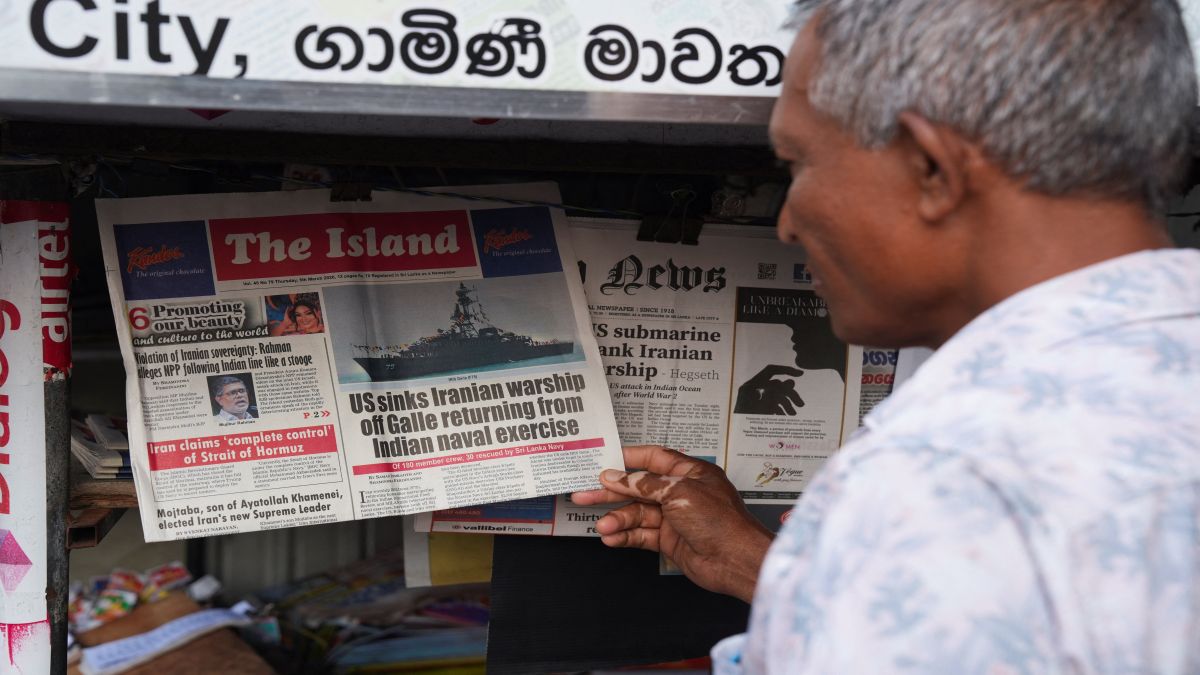
As the war rages on across West Asia, a small battle is brewing over the sinking of an Iranian naval ship, Iris Dena, by a US submarine in the Indian Ocean off Sri Lanka’s coast on Wednesday (March 4). There are many who are questioning why New Delhi didn’t offer help to the Iranian crew on the ship, stating that the vessel was “a guest of the Indian Navy”.
As the situation gets more complicated, the Indian Navy has clarified that it, in fact, had offered help to the Iris Dena. Moreover, coordination between the Indian Navy and Sri Lankan authorities continues.
- Catch live updates on the Iran-Israel war
Here’s a closer look at what happened to the Iranian vessel, Iris Dena, and how India offered assistance to it.
What happened to Iran’s Iris Dena?
On March 4, amid the Iran war, a US submarine torpedoed an Iranian warship, Iris Dena, off the coast of Sri Lanka, in international waters and far from the regime’s territory.
The vessel with 180 crew members was earlier in India participating in the multilateral Milan-2026 naval exercises, which included ships from what were described as 18 “friendly foreign countries” and aircraft from three more, including the United States.
As US Defence Secretary Pete Hegseth noted, the ship “thought it was safe in international waters”. “Instead, it was sunk by a torpedo.”
He also claimed it was “the first sinking of an enemy ship by a torpedo since World War II”. While it is the first time since 1945 that an American submarine has sunk an enemy ship this way, the United Kingdom and Pakistan have both sunk vessels using torpedoes since then.
Video released by the US Department of Defence showed a ship being struck, causing the stern to rise up before exploding.
Following the incident, Iranian Foreign Minister Abbas Araghchi accused the US Navy of committing an “atrocity at sea” in sinking the frigate and said on social media on Thursday that the United States “will come to bitterly regret” the attack.
How did Sri Lanka react to the sinking of the ship?
According to Sri Lanka’s Foreign Minister Vijitha Herath, coastguards received a distress call from the Iris Dena at 5.08 am on Wednesday. Crew members described the incident as an explosion.
“By 6 am, we dispatched a naval vessel and by 7 am the second naval vessel,” Herath added. He said Sri Lanka had an obligation to respond to the call for help because it was a signatory to the International Convention on Maritime Search and Rescue.
Sri Lankan navy spokesman Budhika Sampath also stated that rescuers didn’t spot any vessel in the region. Though the ship’s location “was beyond our waters,” Sampath said, “it was within our search and rescue region. So we were obliged to respond as per international obligations.”
Sri Lanka’s navy recovered 87 bodies and rescued 32 Iranian sailors, with President Anura Kumara Dissanayake noting in a televised address, “We are not taking sides in this conflict, but while maintaining our neutrality, we are taking action to save lives. No person should die in a war like this. Every life is equally precious.”
Why has India come under scrutiny after Iris Dena’s sinking?
As news broke of the sinking of the Iris Dena, many eyes turned to India after Iran’s foreign minister stressed that the frigate had been “a guest” of India’s Navy.
Many have said that the sinking of the Iris Dena in the Indian Ocean raises awkward and complex political, diplomatic, and military questions for India. There were also some who incorrectly stated that, as the incident occurred in the Indian Ocean, it was India’s responsibility to act.
However, it’s important to note that despite its name, the Indian Ocean is not India’s ocean. The ocean is a shared space, governed by international law. Coastal nations assert only limited claims to the ocean. Additionally, the Iris Dena was torpedoed in international waters, where India doesn’t have any jurisdiction.
What help did India offer to Iris Dena?
More importantly, the Indian Navy did offer help to the vessel after it issued a SOS call.
A day after the Iris Dena sinking, the Indian Navy stated that it launched search and rescue operations following a distress signal from the Iranian frigate Iris Dena. As per its statement, the ship was operating 20 NM West of Galle in the Search and Rescue (SAR) region under Sri Lankan responsibility.
“A distress call from Iris Dena reached the Maritime Rescue Coordination Centre (MRCC) in Colombo during the early hours of March 4,” read the naval statement.
Upon receiving the information, the Indian Navy initiated its efforts, and by around 10 am, it commenced its operations. As part of the aid provided, India deployed its long-range, anti-submarine and maritime surveillance aircraft P-8I to augment search efforts. Additionally, a second aircraft, equipped with air-droppable life rafts, remained on standby for rapid deployment if required.
By 4 pm on Wednesday, the INS Tarangini, a sailing training ship, also reached the search area to provide the necessary help. INS Ikshak, a survey vessel, sailed from Kochi to reinforce the operation. It remains in the area conducting searches for missing personnel as a humanitarian effort on behalf of the shipwrecked crew.
Government sources have also reportedly told the Hindustan Times that though the sunken ship had been a “guest of the Indian Navy”, Iris Dena did not ask for any help after war was declared on February 28. The news report said the ship and its crew were Indian guests only from February 16 to February 25. Furthermore, the vessel did not seek any help from India after that.
Was the attack on Iris Dena legal?
America’s torpedoing of the Iris Dena has also raised questions about the legality of attack. Many have wondered: was this attack lawful? And who was under an obligation to rescue survivors?
According to maritime experts, Iran’s Iris Dena was a lawful target for the US. Under the law of naval warfare, warships belonging to a state engaged in an international armed conflict are military objectives by nature. The rules say they may be lawfully targeted.
The law also states that such attacks may occur on the high seas or within the 12 nautical mile territorial waters of the states that are party to the international armed conflict (the belligerents). This means, effectively, that such an attack could happen anywhere outside the 12 nautical mile territorial waters of neutral states. If the Iranian warship was within Sri Lankan waters (that is, within 12 nautical miles of the Sri Lankan coast) at the time, the attack wouldn’t have been lawful.
But in this case, Iris Dena was reportedly operating outside Sri Lanka’s territorial waters and therefore constitutes a lawful military target.
Analyst Carl Schuster, a former director of the US Pacific Command’s Joint Intelligence Center and a retired US navy captain, told CNN that in the current state of conflict between the US and Iran, the Dena presented a threat.
There are also laws for the rescue of survivors. The Second Geneva Convention of 1949 states that parties to a conflict must – after each engagement – take all possible measures to search for and collect the shipwrecked, wounded, and sick.
However, these rules are hard for a submarine to enforce, and may instead facilitate rescue by reporting its location to other vessels or authorities.
The sinking of the Iris Dena is part of the ongoing hostilities between Iran and the US. It’s been on for a week now — with US officials offering no firm end date and Iran vowing to fight on.
With inputs from agencies

 "Iran War News Live: 'We are waiting for your ground troops,' says Iran to US, ruling out negotiations")
 "US gives India 30-day waiver to buy Russian oil amid Iran war")
 "Samson, Dube and Team India epitomise the selfless culture Rohit Sharma left behind: ‘I didn’t miss two centuries’")
 "Sensex falls over 500 points in early trade; Nifty slips below 24,650 as banking stocks drag")
 "Iran War News Live: 'We are waiting for your ground troops,' says Iran to US, ruling out negotiations")
 "US gives India 30-day waiver to buy Russian oil amid Iran war")
 "Samson, Dube and Team India epitomise the selfless culture Rohit Sharma left behind: ‘I didn’t miss two centuries’")
 "Sensex falls over 500 points in early trade; Nifty slips below 24,650 as banking stocks drag")