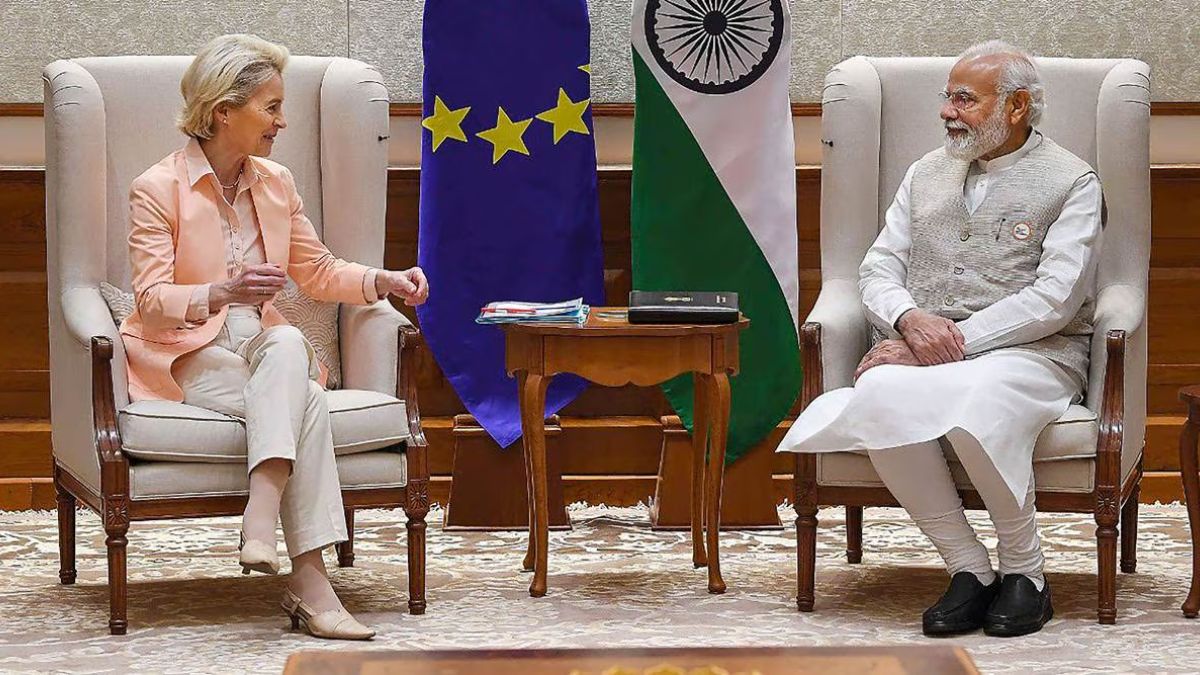
 "PM Narendra Modi with European Commission President Ursula von der Leyen in New Delhi. File image/PTI")
On Tuesday (January 27), India and the European Union are expected to finalise negotiations on the much-awaited Free Trade Agreement. Earlier, speaking at the World Economic Forum in Davos, European Commission President Ursula von der Leyen said that the two sides have reached “a pivotal moment” and are close ‘historic trade agreement’ with far-reaching implications for global commerce.
Speaking at Davos, von der Leyen said, “And right after Davos, the next weekend, I will travel to India. There is still work to do, but we are on the cusp of a historic trade agreement.” The agreement would create a combined market of around two billion people and account for nearly a quarter of global GDP.
The agreement is expected to cut tariffs on European cars and wine and create broader market opportunities for Indian electronics, textiles, and chemicals.
Here are some key elements of the trade deal.
What will be the impact of the trade deal?
Once signed and ratified by the European Parliament, a process that could stretch beyond a year, the pact could expand bilateral trade and provide a boost to Indian exports such as textiles and jewellery, hit by 50 per cent US tariffs since late August.
However, a vote by EU lawmakers earlier this week to challenge the EU-South America pact in the bloc’s top court highlights how parliamentary hurdles could delay or complicate ratification. Investment protection and geographical indications (GIs) are being negotiated separately, narrowing the FTA’s focus to goods, services, and trade rules.
Why does it matter now?
The pact would mark India’s ninth trade agreement in four years, highlighting its drive to expand market access amid rising global protectionism. For the EU, it offers a chance to diversify supply chains and tap into India’s $4.2 trillion economy while reducing dependence on China.
What are the benefits for India?
The EU is among India’s top trading partners, along with the United States and China, with total bilateral goods and services trade exceeding $190 billion in 2024/25. India exported about $76 billion in goods and $30 billion in services to the 27-nation bloc.
Average EU tariffs on Indian goods are relatively low at about 3.8 per cent, but labour-intensive sectors such as textiles and garments face duties of around 10 per cent, according to Global Trade Research Initiative, a Delhi-based think tank.
The FTA would help restore competitiveness lost after the EU began withdrawing tariff concessions under Generalised System of Preferences (GSP) in 2023, on products including garments, pharmaceuticals and machinery, and offset the impact of higher US tariffs.
What are the benefits for European Union?
EU exports to India face much higher barriers, with a weighted-average tariff of about 9.3 per cent on $60.7 billion of goods in 2024/25.
Duties are particularly steep on automobiles, auto parts, chemicals and plastics. Tariff cuts would open opportunities in cars, machinery, aircraft and chemicals, while improving access to services, procurement and investment in one of the world’s fastest-growing large markets.
Are there any sticking points in the trade deal?
Agriculture and dairy are excluded. India is resisting EU demands to eliminate tariffs on more than 95 per cent of goods, signalling closer to 90 per cent.
Autos, wine and spirits remain sensitive. India is considering phased cuts or limited quotas rather than sharp tariff reductions, citing risks to domestic manufacturing.
What are the rules?
India wants “data-secure” status under EU data rules, easier movement of professionals and relief from double social security payments.
The EU is seeking broader access to India’s financial and legal services and commitments on labour, environment and intellectual property - areas where New Delhi prefers flexibility.
What are India’s red flags?
Two major concerns are the EU’s carbon border levy, which could blunt tariff gains for Indian exporters, and high non-tariff barriers such as regulatory delays, stringent standards and certification costs.
What comes next?
Analysts say geopolitics and trade shocks have pushed both sides towards a pragmatic, executable compromise. Whether the pact delivers balanced gains will depend on how carbon levies, services mobility and non-tariff barriers are ultimately handled.
With inputs from Reuters