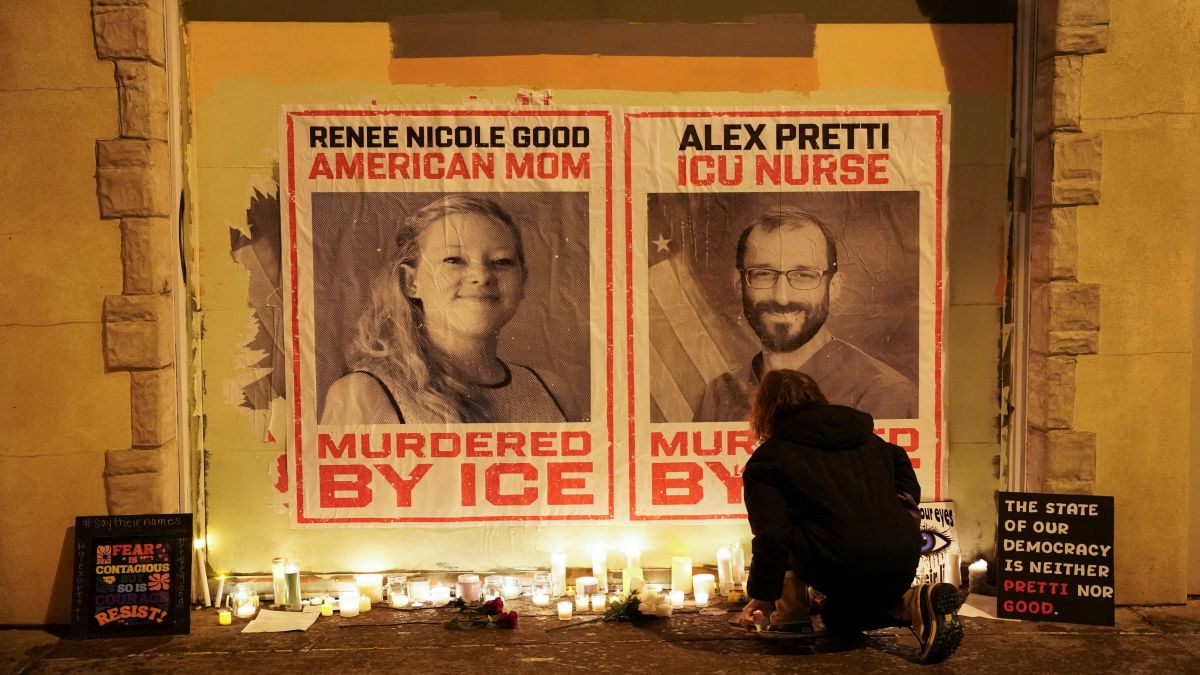
 "A person kneels near posters with images of Renee Nicole Good and Alex Pretti, after they were fatally shot in two separate incidents by federal immigration agents, following a vigil in Minneapolis, Minnesota. Reuters")
The United States is angry, nay, it’s outraged. The killings of Alex Pretti and Renee Nicole Good at the hands of federal agents has sparked anger across the country, with many demanding for the abolition of the federal agency.
In Minneapolis, where the two killings occurred, activists have called for a “nationwide day of no school, no work and no shopping” on January 30 to protest President Donald Trump’s immigration crackdown.
“The people of the Twin Cities have shown the way for the whole country – to stop [Immigration and Customs Enforcement’s] reign of terror, we need to SHUT IT DOWN,” the website for the National Shutdown campaign reads.
However, data reveals that Pretti and Good aren’t the only two who have died at the hands of ICE agents. As of date, eight people have either been killed by federal agents or have died while in Immigration and Customs Enforcement (ICE) custody in 2026 so far. In 2025, this number was the highest — 32 — since 2004.
Here are the stories of those who died as a result of Trump’s brutal immigration crackdown.
Renee Nicole Good
On January 7, 37-year-old Minneapolis resident Renee Nicole Good , a mother of three, was shot dead by ICE agents while she was in her car. It all happened after Good dropped off her six-year-old son at school when she encountered the ICE agents.
What followed was a shocking tragedy. Officials from the Trump administration maintain that Good tried to “weaponise her vehicle” to run over an officer near an ICE vehicle stuck on a snow-lined street before he opened fire. In the aftermath, she was termed a domestic terrorist, with US Vice President JD Vance alleging without evidence that she was part of a “broader left-wing network” intent on obstructing, assaulting and doxxing ICE officers.
But videos and eyewitness accounts provide a very different picture of the events that led to Good’s killing. Footage shows two federal agents trying to pull Good from a vehicle that was partially blocking a residential street. The car reverses, then pulls forward and begins to turn. A third agent steps into view, draws his gun and fires a shot, then continues firing as the vehicle moves past him.
A private autopsy later determined that Good was shot three times, in her forearm, breast and head.
Alex Pretti
Sixteen days following her death, another Minneapolis resident — Alex Pretti, an intensive care nurse at a VA hospital, was fatally shot by federal agents during an anti-ICE protest. And just like this fellow Minneapolis resident Renee Good, Pretti was 37.
At least three minutes before he was shot dead by Customs and Border Protection officers, Pretti was using his phone to record officials during an anti-ICE protest. His last words to a woman, who had been tackled to the ground and pepper-sprayed, were: “Are you OK?”
Minutes later, Pretti was pinned on the street by multiple federal agents — visibly being hit by one of them — when one of the officers can be seen leaving the struggle with what appears to be a gun.
Moments later, at least 10 shots appear to be fired within the span of five seconds. Pretti is splayed motionless on the asphalt. Videos can hear people’s shock — one of the bystanders yell, “What the f**k, they killed him. Did they f*****g kill that guy?”
Trump administration and border patrol officials immediately sought to cast Pretti, like Good, as a villain. Kristi Noem, the secretary of the Department of Homeland Security (DHS), described Pretti, a nurse, as a “domestic terrorist” without providing evidence. Meanwhile Border Patrol commander Gregory Bovino said it “looked like” Pretti “wanted to do maximum damage and massacre law enforcement”.
The administration also claimed that Pretti, who was licensed to carry a legal firearm, was attacking the ICE officers. This claim is contradicted by the video evidence, which shows Pretti filming ICE and seeking to assist fellow observers who were being hurt by the agents, with one hand holding his phone and another shielding his face from pepper spray.
Geraldo Lunas Campos
Pretti and Good are far from the only deaths linked to immigration law enforcement. There have been six other deaths tied to ICE, one of them being Geraldo Lunas Campos, a 55-year-old who died at the agency’s largest detention facility: Camp East Montana in Texas on January 3.
According to ICE’s initial statement, the father of four became disruptive while in line for medication and refused to return to his assigned dorm” and was placed in segregation. He then became distressed, according to the agency. “Medical staff responded, initiated lifesaving measures, and requested emergency medical services. Lunas was pronounced deceased by EMS,” read a statement put forth by ICE.
The authorities later changed their own story, claiming that Lunas Campos tried to kill himself.
However, an autopsy report found that Linas Campos was killed by someone. “Based on the investigative and examination findings, it is my opinion that the cause of death is asphyxia due to neck and torso compression,” Adam Gonzalez, deputy medical examiner for El Paso County, said in the report, according to The Washington Post.
Now, the matter has reached court with Linas Campos’ children filing a legal petition to block the deportation of any detainees who may have witnessed the incident, as they prepare to file a wrongful death lawsuit.
The petition cites reports alleging that guards at the facility choked and asphyxiated Campos.
Victor Manuel Diaz
On January 6, Nicaraguan immigrant Victor Manuel Diaz was arrested by immigration officers in Minneapolis and sent to Camp East Montana. Eight days later, he was declared dead in custody.
Officials claim he died of suicide, though the “official cause of his death remains under investigation”. But his family refuses to believe that Diaz would have claimed his own life. Yorlan Diaz, his brother, told _ABC New_s, “I don’t believe he took his life. He was not a criminal; he was looking for a better life and he wanted to help our mother.”
The family has also raised concerns over how the authorities are handling the investigation. Diaz’s body was transferred to William Beaumont Army Medical Centre for an autopsy, instead of the county medical examiner. “This, taking of the body and doing the autopsy report and not letting the medical examiner do it? You’re then having the fox guarding the henhouse,” Randall Kallinen, the family’s lawyer, told the local outlet KTSM.
Luis Gustavo Nunez Caceres
On January 5, Luis Gustavo Nunez Caceres passed away at a hospital in Texas. Nunez, who was 42 years old and from Honduras, was arrested by ICE on November 17. On November 25, Nunez was brought to the Joe Corley Processing Center in Conroe, Texas. According to ICE, Nunez was transported to the hospital on December 23 “for complications related to congenital heart failure.” On December 31, Nunez suffered from “multiple life-threatening medical emergencies” and was admitted into the intensive care unit.
Parady La
On January 6, 46-year-old Cambodian immigrant Parady La was arrested from outside his home in Upper Darby, Pennsylvania and transferred to the Federal Detention Centre in Philadelphia.
On January 9, while still in ICE custody, La was found unresponsive. He was given Narcan and then taken to the hospital and diagnosed with organ failures, among other conditions.
His family, however, question the care officials gave to La during his time in custody. His nephew, Michael La, said ICE’s version of the events leading to his uncle’s death “didn’t add up”. He claimed that officials informed him that La experienced fentanyl withdrawal soon after he was detained. They’re questioning why Narcan, which is used for opioid overdoses, was administered to La when he was experiencing withdrawal symptoms.
Michael said his family now has a legal team and is going to pursue legal action against FDC Philadelphia and ICE.
Luis Beltran Yanez–Cruz
A resident of the US for 20 years, 68-year-old Yanez-Cruz was arrested by ICE officials in New Jersey last November and transferred him to a detention centre in California.
On January 6, the Honduran immigrant died at the John F Kennedy memorial hospital in Indio, California, from heart-related issues, according to an ICE statement. ICE said Yanez-Cruz was put in the detention facility’s medical unit for chest pains before being sent to El Centro Regional Medical Center. He was then transported by helicopter to Indio.
His family mourn Yanez-Cruz’s loss. His daughter, Josselyn Yanez was quoted as telling northjersey.com, “As a father, he was an excellent dad. As a grandfather, the best grandfather of all. We hoped our father would get out of that place, that he would come out alive – not the way he did.”
Heber Sanchez Dominguez
The 34-year-old Mexican immigrant died at the Robert A Deyton detention cente in Lovejoy, Georgia on January 14. As per DHS, Dominguez was in ICE custody for six days and was awaiting a hearing when he was discovered “hanging by the neck and unresponsive in his sleeping quarters” about 2:05 am. Medical staff immediately attempted lifesaving measures and then transported him to a hospital, where he was pronounced dead about one hour later.
Following his demise, the Mexican consulate requested that the circumstances of the death be “clarified”. Meanwhile, Christopher Williams, executive director of Sur Legal Collaborative, expressed deep scepticism over the demise. “We are heartbroken, we are shaken, and honestly disgusted,” Williams said. “Quite frankly, ICE can’t be trusted. We would need to do a lot of investigation into the exact circumstances and even then I would question.”
With inputs from agencies