

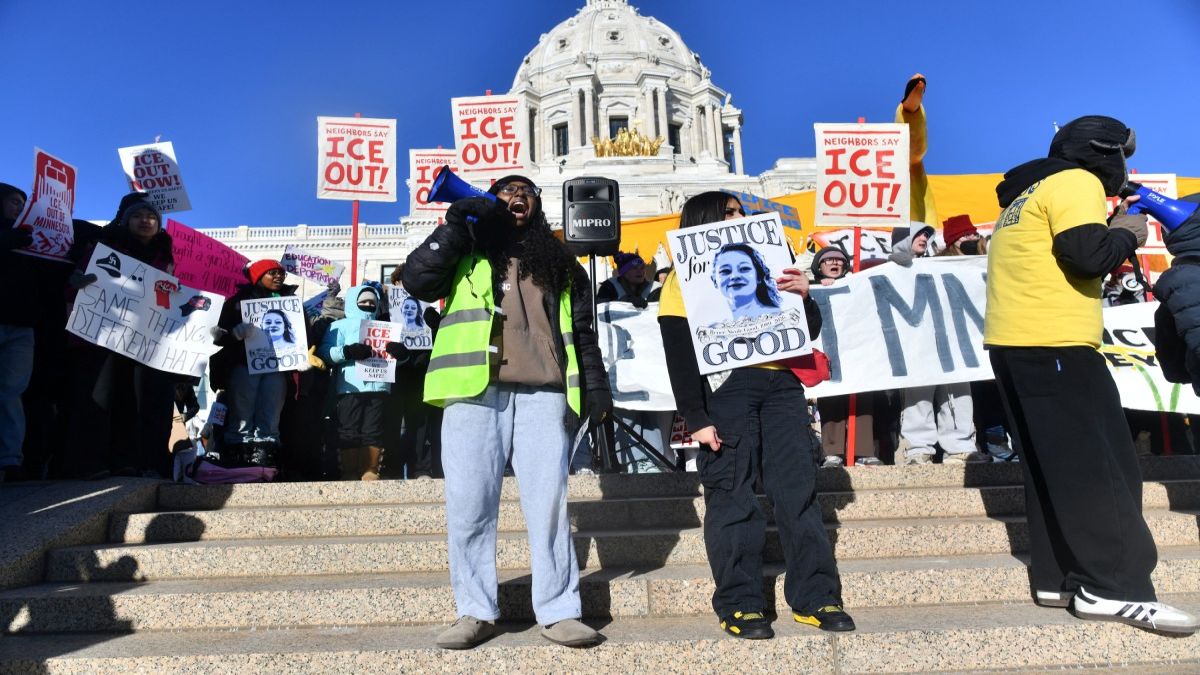
 "ICE has led to anger and protests in the US. It is our Word of the Week")
On January 7, a 37-year-old mother, Renee Nicole Good was shot and killed by a US Immigration and Customs Enforcement (ICE) agent in Minneapolis.
Since then, there’s been tumult with protests raging across various parts of the United States, demanding their removal from their cities. These protests also spilled on to the red carpet at the 83rd Golden Globe Awards held on January 11 with many Hollywood stars wearing lapel pins to protest the government agency.
Meanwhile, the Donald Trump administration remains steadfast in their support of ICE — US Vice President JD Vance slammed the media for its reporting on the issue, saying it was “an attack on the American people. The way that the media by and large has reported this story has been an absolute disgrace and it puts our law enforcement officers at risk every single day”.
Trump’s White House Press Secretary got into a feud with a journalist over the shooting, calling the reporter a “left-wing hack”. Meanwhile, the US president has threatened to invoke the rarely used Insurrection Act to quell unrest over federal immigration enforcement operations in Minneapolis.
So, as we sit back this weekend, we take a closer look at what exactly is the ICE agency and why it has caused such a stir across the United States.
The origins of ICE
ICE came into being after the Homeland Security Act was enacted in 2002, as the United States sought to grapple with the consequences of the attacks on September 11, 2001. ICE is part of the Department of Homeland Security, which began operations the same year. Previously, immigration enforcement in the US was largely handled by the Immigration and Naturalization Service (INS), which was part of the Department of Justice.
ICE’s mission is to preserve American security and public safety, mainly within US borders, by enforcing immigration laws. ICE also assists international investigations into criminal organisations and terrorist networks that threaten or seek to exploit US customs and immigration laws. It operates with a staff of over 20,000 across over 400 global offices and an annual budget of around $8 billion.
However, while ICE may sound very much like the average police department, the power that their agents hold is slightly different. ICE agents can stop, detain and arrest people they suspect of being in the US illegally.
ICE under Trump 2.0
With Donald Trump’s return to the White House last January, ICE has undergone a significant change. It has become a far more visible and fearsome force on American streets. As Mother Jones has written in one report, the second Trump presidency has taken ICE off the leash.
Dan Gividen, an immigration lawyer who acted as deputy chief counsel for ICE’s Dallas field office between 2016 and 2019, summed it up perfectly. Today, what ICE is doing is akin to running into a crowded movie theatre and yelling “fire”, he noted. “You’ve got these ICE officers that are pouring out of these vehicles, pointing guns at US citizens — people who’ve done absolutely nothing wrong — and causing chaos.”
Moreover, ICE’s use of force and firearms policy directive from 2023 states that authorised officers should only use force when “no reasonably effective, safe, and feasible alternative” is available. It also mandates that the level of force be “objectively reasonable” given the circumstances and instructs officers to “de-escalate” the situation.
But under Trump, we have seen a significant shift; ICE agents have been provided tacit approval for more aggressive tactics. It’s no wonder that 2025 was ICE’s deadliest year in two decades with 32 of them dying in ICE custody — they died of seizure and heart failure, stroke, respiratory failure, tuberculosis or suicide. Some died at ICE detention centres and field offices, others after they had been transferred to hospitals, but were still under ICE custody. In some cases, their families and lawyers have alleged, they died of neglect, after repeatedly trying and failing to get medical care.
Shooting of Renee Nicole Good and ICE protests
And ICE’s deadly turn continued in the early days of 2026 when a veteran agent, Jonathan Ross, fatally shot 37-year-old Renee Nicole Good in Minneapolis. Good, a Minneapolis mother of three, was in the driver’s seat of her Honda Pilot in the middle of a residential street when the ICE agent opened fire.
Shortly after Good’s death, Homeland Security Secretary Kristi Noem accused the woman of trying to use her vehicle to kill or harm ICE agents. She called it an “act of domestic terrorism.” Then US Vice President JD Vance opted to victim-shame, saying that ICE killing Good was “absolutely a tragedy of her own making,” while also calling Good “a victim of left-wing ideology.”
But Minneapolis Mayor Jacob Frey and state officials pushed back, blasting the actions of the officers. Minnesota Governor Tim Walz called the shooting “totally predictable” and “totally avoidable.”
“This was an agent recklessly using power that resulted in somebody dying,” Frey said. He demanded ICE “get the f**k out of Minneapolis.”
Videos from the scene of the incident also exposed the reality of what happened to Good. Visuals show the 37-year-old backing up her SUV slightly, and then turning the steering sharply toward the right, away from the officers. She then accelerates and appears to clip the officer with her vehicle before he opens fire, according to one video. A separate video with a different angle doesn’t capture that possible contact. Instead, the officer is seen moving away from the front of the vehicle and toward the driver’s side.
Soon after, nationwide protests took place with demonstrators calling for ICE to be removed from American cities. Demonstrators carried signs and shouted “ICE out now!”
And on Sunday, January 11, along side designer gowns and custom-made suits, some Hollywood celebrities donned pins protesting ICE on the red carpet of the 83rd Golden Globe Awards. Personalities such as Mark Ruffalo Natasha Lyonne, and Wanda Sykes were seen wearing anti-ICE lapel pins on the red carpet. Some pins were labeled “ICE OUT” and others “BE GOOD,” in reference to Renee Nicole Good.
Ruffalo even said, ““We’ve got, literally, storm troopers running around terrorising, and as much as I love all this, I don’t know if I can pretend like this crazy stuff isn’t happening. We have a president who says the laws of the world don’t apply to him and we can rely on his morality, but he has no morality, so where does that leave us? Where does that leave the world?”
Such is the anger that Minneapolis has continuously seen demonstrations since Good was shot, which resulted with a federal officer shooting a man in the leg after an attempted traffic stop in Minneapolis on Wednesday night.
This has prompted US President Donald Trump issuing a threat to invoke the Insurrection Act. “If the corrupt politicians of Minnesota don’t obey the law and stop the professional agitators and insurrectionists from attacking the oatriots of ICE, who are only trying to do their job, I will institute the Insurrection Act, which many presidents have done before me, and quickly put an end to the travesty that is taking place in that once great state,” Trump wrote in a post on Truth Social.
We don’t know what happens next in this chapter, but it’s for these very reasons that ICE is our word of the week.

 "Operation Hawkeye Strike in Syria: US says killed terrorist linked to Palmyra attack")
 "Exclusive | How Jodhpur Polo became the 'Mecca' of Indian polo")
 "Iran's Khamenei admits for the first time that thousands killed in ongoing anti-government protests")
 "'Greenland is already great': Almost 10% of island's population hit streets against Trump")
 "Operation Hawkeye Strike in Syria: US says killed terrorist linked to Palmyra attack")
 "Exclusive | How Jodhpur Polo became the 'Mecca' of Indian polo")
 "Iran's Khamenei admits for the first time that thousands killed in ongoing anti-government protests")
 "'Greenland is already great': Almost 10% of island's population hit streets against Trump")



