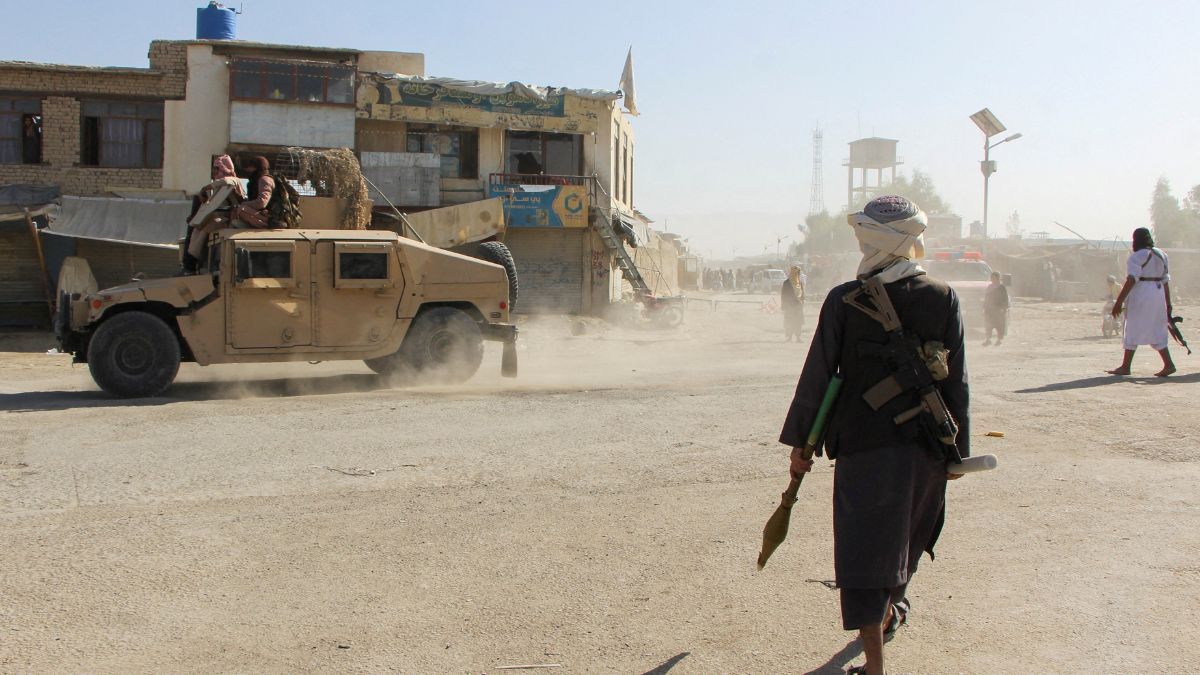
 "How Taliban's new criminal code legalises slavery, grants clerics immunity")
The Taliban’s new criminal code in Afghanistan is spurring outrage.
Among other things, the code has legalised slavery and granted clerics, or the mullahs, legal immunity. The Taliban, which lost power in Afghanistan after the US invasion in 2001, took over the country following the fall of the Hamid Karzai government in 2021.
The Taliban have imposed a slew of restrictions since taking back power. Critics have accused the group of “weaponising” the legal and judicial system against women and girls. The Taliban earlier suspended the 2004 constitution and laws protecting the rights of women and girls.
The Taliban also dismissed all judges under the previous US-backed government, including approximately 270 women, replacing them with men who share their extreme Islamic views, lack legal training and hand down decisions based on edicts issued by the Taliban.
But what do we know about the new criminal code?
Let’s take a closer look.
Key features of new criminal code
The Taliban has issued the “Criminal Procedure Code for Courts” (De Mahakumu Jazaai Osulnama) on January 4. The document, comprising three parts, 10 chapters and 119 articles, was approved by the Taliban’s supreme leader Hibatullah Akhundzada earlier this month. It is meant to serve as a guide for judicial processes in Afghanistan.
Article 9 of the code segregates Afghan society into four classes:
Mullahs
Tribal elders
Middle class
Lower class
Under this system, the punishment for crimes will be handed out according to the social status of the accused. Mullahs who commit crimes will be ‘subjected to advice’, while elites will be summoned and given advice; the middle class can be imprisoned, while the lower class can be imprisoned and flogged.
This essentially gives mullahs, or religious scholars, immunity from the judicial and legal system. The Hasht-e Subh English, an independent Afghan daily, quoted former Afghan Ambassador to Austria Manizha Bakhtari as saying this in effect created “unequal legal classes where upper classes escape punishment through advice and warnings, while lower classes face the full force of discretionary punishment”.
Legalises slavery
Article 15 of the code essentially legitimises slavery in Afghanistan. The text, which uses the term ‘ghulam’ (slave), reads: “In the case of any crime for which a ‘hadd’ (prescribed punishment) has not been specified, ta’zir (discretionary punishment) is ruled, whether the criminal is free or a slave.”
Slavery has been banned under international law.
Paragraph 5 of Article 4 states that while fixed punishments (hudud) will be undertaken by an “Imam”, ta’zir punishments may be carried out by a “husband” or “master”. Hudud refers to acts punishable under Islamic law for crimes against God.
Violence against children
Article 30 of the code forbids only certain forms of physical violence that result in “bone fractures” or “tearing of the skin”. It does not bar other forms of physical, psychological or sexual violence against children. Article 48 says a father may punish his 10-year-old son for actions such as neglecting prayers.
‘Right to punish’
Article 4, Clause 6 of the code allows citizens to personally punish individuals if they witness a “sin” being committed.
“Any Muslim who sees a person committing a sin has the right to punish them,” the code states.
“Anyone who witnesses or becomes aware of subversive meetings by opponents of the system but fails to inform the relevant authorities is considered a criminal and shall be sentenced to two years in prison,” the code adds.
Article 59 of the Taliban criminal code criminalises “dancing” and “watching dance”. Under Article 13, the code allows “places of immorality” to be destroyed. This could include barbershops and beauty salons. It also bars “gatherings of immorality” without properly defining what this means.
Discriminates against minorities
The code also recognises followers of the Hanafi school as Muslims. It labels followers of all other sects as “heretics”.
Article 8 of the code defines followers of sects and beliefs outside Sunni Islam as “innovators”. It also mandates a two-year prison sentence for “mockery or ridicule of Islamic rulings”.
Under Article 26, followers of the Hanafi school are not permitted to leave their sect. They are to be given a two-year prison term if they do so.
Rights groups slam Taliban
The Supreme Council of National Resistance for the Salvation of Afghanistan condemned the document as “far worse than the Middle Ages”.
The Afghanistan Women’s Justice Movement slammed it as “the legalisation of brutality” that entrenches gender apartheid. Former National Directorate of Security chief Rahmatullah Nabil said it showed “politicised religion and rigid interpretations offer no future for Afghanistan”.
“It is a document proclaiming the conviction of all citizens,” ex-Afghanistan Attorney General Mohammad Farid Hamidi wrote on X.
Human rights organisation Rawadari has said that the code contravenes international human rights standards, including equality before the law, presumption of innocence, prohibition of torture and fair trial rights. It depends on confessions and testimony for proof, lacks provisions for defence lawyers or the right to remain silent, and allows broad discretionary punishments (ta’zir), Rawadari added.
Richard Bennett, the UN Special Rapporteur on human rights in Afghanistan, called the development “deeply troubling”.
Bennett, who was appointed by the Geneva-based UN Human Rights Council, previously wrote in a report that women have virtually no rights in Afghanistan.
“Today, there are no women judges or prosecutors and no officially registered female lawyers, leaving women and girls with fewer safe channels to report abuse or seek redress,” he wrote. “Coupled with a lack of female officials in the police and other institutions, the result is widespread underreporting of violence and discrimination against women and girls.”
Bennett said access to justice for girls “is further undermined by the dismantling of key legal safeguards and institutions protecting the rights of children”, including juvenile courts and juvenile rehabilitation centres.
With inputs from agencies

 "India–EU FTA to benefit Rs 6.4 lakh crore exports across key states and sectors, says Piyush Goyal")
 "Will reset in Indo-Canada ties be complete with Carney's visit?")
 "The good and the not-so-good part of India-EU trade talks")
 "Kristi Noem faces public and political wrath over Alex Pretti's shooting")
 "India–EU FTA to benefit Rs 6.4 lakh crore exports across key states and sectors, says Piyush Goyal")
 "Will reset in Indo-Canada ties be complete with Carney's visit?")
 "The good and the not-so-good part of India-EU trade talks")
 "Kristi Noem faces public and political wrath over Alex Pretti's shooting")