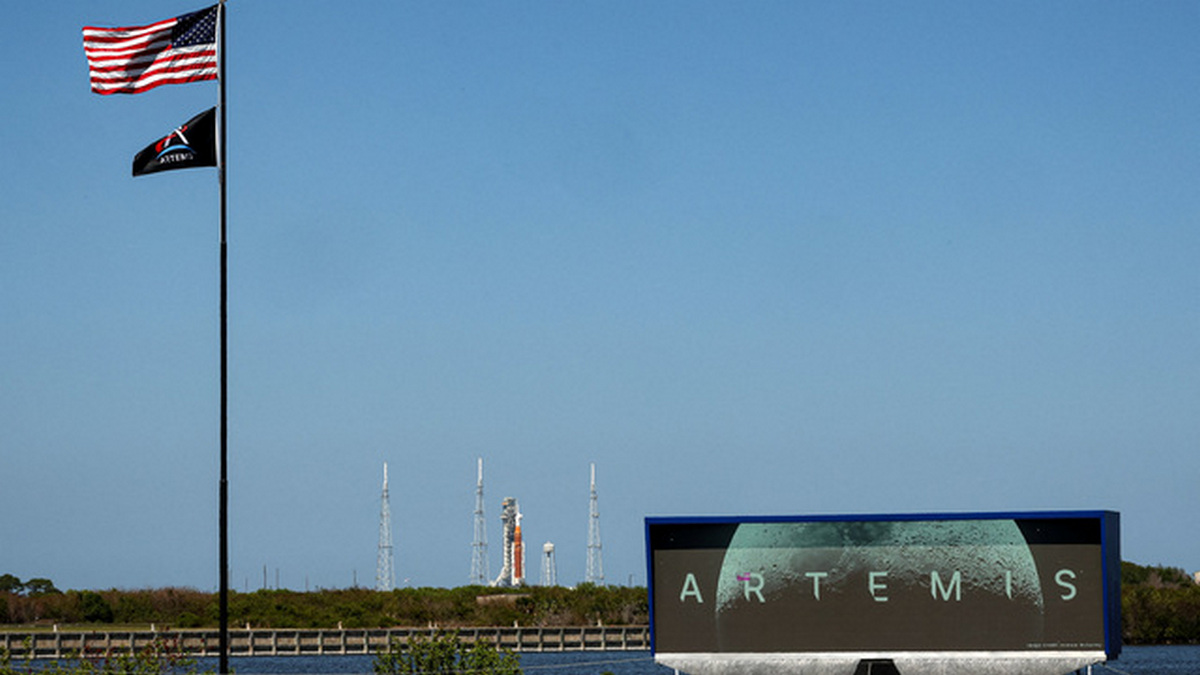
 "How Nasa plans to send astronauts around the Moon and what will they do over 10 days")
National Aeronautics and Space Administration (Nasa) is set to launch its Artemis II Moon Mission on Wednesday (April 1).
According to reports, there is an 80 per cent chance of favourable weather at Florida’s Kennedy Space Center, from where the astronauts will take off.
This marks Nasa’s first crewed mission towards the Moon in over five decades. The four-member crew will undertake a voyage of 10 days, orbit the Moon and then touch down in the Pacific. Nasa previously launched the unmanned Artemis I Moon mission in 2022.
But how does NASA plan to send the astronauts around the Moon? What will they do over 10 days?
Let’s take a closer look.
How Nasa plans to send astronauts around Moon
First, let’s take a brief look at the crew.
The Artemis II crew comprises Nasa commander Reid Wiseman, pilot Victor Glover and mission specialist Christina Koch. Jeremy Hansen from the Canadian Space Agency, another mission specialist, will join them. The crew were chosen for this mission way back in 2023.
Interestingly, Glover will become the first Black astronaut to visit the lunar environment and the first Black astronaut to venture beyond low Earth orbit (LEO). Koch similarly will also become the first woman to do so.
According to Live Science, Nasa is aiming at a two-hour launch window that opens around 4 am Indian Standard Time on Wednesday. The launch window goes from April 1 to April 9. After that, the next launch window is on April 30. That will also be Nasa’s final chance to launch the rocket if it is to keep to its schedule.
The crew will be launched on the Orion spacecraft atop the 322-feet-tall Space Launch Systems (SLS) rocket. The SLS, the most powerful such rocket ever, has been built by Boeing and Northrop Grumman. The craft and crew will then slingshot around the Moon, which was previously done during the Artemis I mission as well as by the Apollo 13 crew.
The Orion capsule, built by Lockheed Martin, will be fully pressurised and equipped with potable water, oxygen, and nitrogen storage systems for the crew. According to Business Today, the goal of Artemis I was to test the rocket and unmanned capsule’s integrity. The idea behind this mission is to test both the SLS rocket and Orion’s life support systems, as well as its performance in deep space. It will also lay the groundwork for Nasa’s ultimate plan, which is to return humans to the Moon under the Artemis III programme.
What they will do over 10 days
To begin with, Artemis II pilot Victor Glover will take over the craft around three and a half hours after launch. Glover will then test Orion’s manual thrusters and manoeuvrability. According to BBC, this includes practising steering and lining up the spacecraft.
The astronauts will then head to the ‘dark side’ of the Moon, around 402,000 kilometres from Earth. This is 2,400 km farther than the Apollo 13 astronauts, who hold this record, went. Meanwhile, the crew will be out of radio transmission for up to 50 minutes.
Here, the crew will test Orion’s life support, propulsion, power and navigation systems. They will take their own medical data as well as take images of deep space, which they will then send back to Earth. All this will provide critical data for the upcoming Artemis III and Artemis IV missions, the latter of which is slated to make a Moon landing in 2028. The crew will then make a loop around the far side of the Moon and use gravity to bring them back towards Earth without a secondary engine burn.
According to Live Science, Nasa thinks the crew will hit a re-entry peak speed of 40,200 kilometres per hour, which would beat the record currently held by the Apollo 10 astronauts. Now, after Orion passes through the Earth’s atmosphere, a protective shield will be disposed of and parachutes will be deployed. The capsule will then settle down in the Pacific Ocean near California. Five orange airbags will inflate around the top of the spacecraft and flip the capsule into an upright position to allow the crew to leave. Recovery teams will then collect the crew.
The US, China and the new Moon race
The US remains the only country to have put humans on another celestial body with its six lunar landings of the Apollo programme, driven by competition with the former Soviet Union.
US officials have more recently focused on China, a formidable technological rival that has made steady progress in its own Moon programme in recent years with a string of robotic lunar landings and a 2030 goal to put its own crew on the surface.
Koch, the Artemis II mission specialist, on Sunday said the Moon is a “witness plate” to the solar system’s formation, and a stepping stone to Mars, “where we might have the most likelihood of finding evidence of past life.”
“Many, many countries have recognised the value that there is in exploring further into the solar system, to the Moon and on to Mars,” she told reporters. “They recognise that not only can we gain all these extremely tangible benefits, but that we have the opportunity to answer the question that could be the question of our lifetime, which is, are we alone?”
“Answering that question starts at the Moon,” she said. “The question is not should we go, but should we lead, or should we follow?”
Artemis III, planned for 2027, will involve the Orion capsule docking in Earth’s orbit with NASA’s two lunar landers — the Blue Moon system from Jeff Bezos’ Blue Origin and Starship from Elon Musk’s SpaceX. The delicate tag-up will demonstrate how the landers will pick up astronauts before heading for the Moon’s surface.
That mission was added to the programme in February by NASA’s new administrator, Jared Isaacman, a billionaire private astronaut who has more broadly shaken up the programme with new objectives. His decision pushed the programme’s first crewed lunar landing to Artemis IV.
FAQs
1) What is the Artemis II mission?
Artemis II is Nasa’s first crewed mission to orbit the Moon in over five decades and is part of its broader plan to return humans to the lunar surface.
2) How long will the Artemis II mission last?
The mission will last approximately 10 days, during which astronauts will orbit the Moon and conduct various tests.
3) Why is Artemis II important?
It will test critical systems like life support, propulsion, and navigation, laying the groundwork for future Moon landings under the Artemis programme.
With inputs from agencies


 "Iran War Live Updates: Israel vows to raze all homes near Lebanon border, extend control to Litani River")
 "IndiGo’s big move: Who is its new CEO Willie Walsh and can he steer the airline through turbulence?")
 "‘Go, get your own oil’: Trump targets UK over Iran stand, says ‘won’t be there to help you anymore’")
 "'Upcoming days will be decisive': Pete Hegseth says Iran has limited options, pushes for deal")
 "Iran War Live Updates: Israel vows to raze all homes near Lebanon border, extend control to Litani River")
 "IndiGo’s big move: Who is its new CEO Willie Walsh and can he steer the airline through turbulence?")
 "‘Go, get your own oil’: Trump targets UK over Iran stand, says ‘won’t be there to help you anymore’")
 "'Upcoming days will be decisive': Pete Hegseth says Iran has limited options, pushes for deal")