

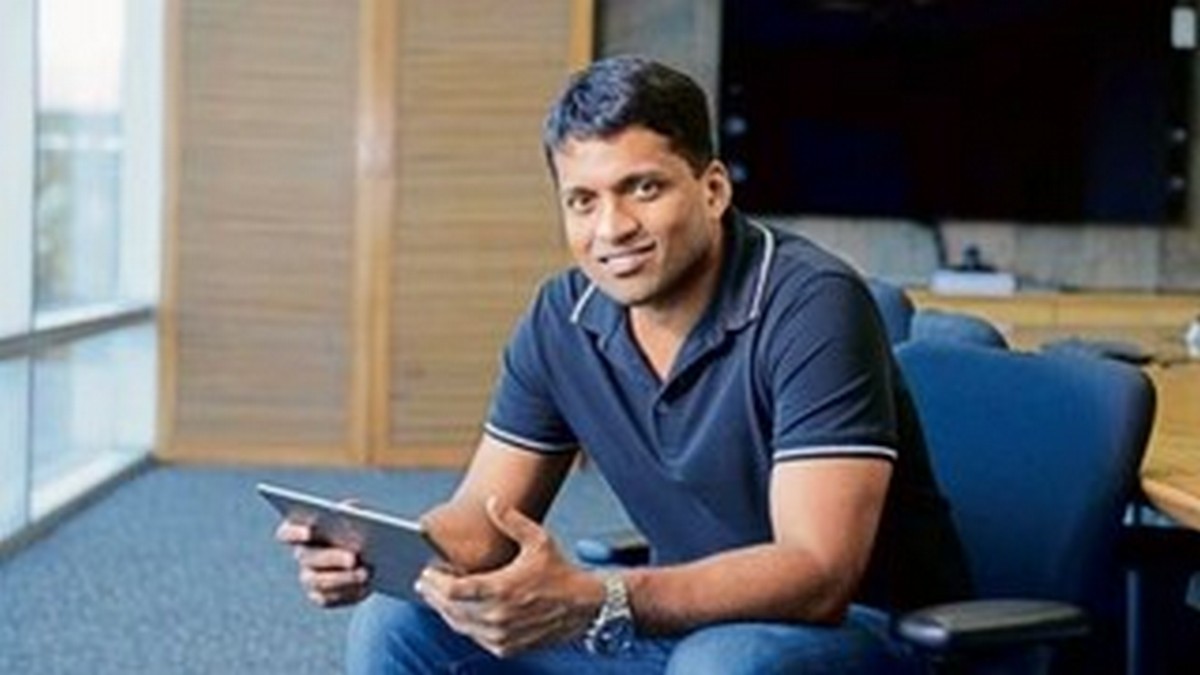
 "How Byju Raveendran lost control of the ed tech firm that bears his name")
The founder of Byju’s has lost control of his ed tech firm.
Byju’s is facing insolvency proceedings after failing to pay the BCCI.
The Bengaluru bench of the National Company Law Tribunal (NCLT) on Tuesday allowed bankruptcy proceedings against the firm and appointed an interim resolution professional, suspending the company’s board of directors and freezing its assets.
Though Byju’s has vowed to fight the bankruptcy case, many think the end is near for the company that was once India’s most valuable start-up.
Byju Raveendran, the founder of the firm and former billionaire, will now report to a resolution professional.
NCLT has appointed Pankaj Srivastava as the interim resolution professional.
It has been a long fall for Raveendran.
But how did Raveendran lose control of the firm that bears his name?
Let’s take a closer look:
The boom
First, let’s take a brief look at its rise.
As per New Indian Express, Raveendran is the son of physics and maths teachers from Kerala’s Azhikode village.
“As soon as he entered a room, the enthusiasm among students was palpable. Even though some of us questioned the effectiveness of his mass teaching methods, he won us over with his sheer intelligence,” a former student told the newspaper.
“He (Raveendran) hated the conventional classroom set-up, which he found dull and unimaginative. He promised to change that one day by inculcating a passion for learning,” he added.
Impact Shorts
More ShortsAs per Indian Express, Raveendran earned a BTech from a government engineering college in Kannur.
He first worked at a shipping company and then founded a coaching business.
Raveendran founded Byju’s in 2015.
The company’s success was immediate and explosive.
As per New Indian Express, more than two million students in July of that year signed up for the app.
This after the company raised $25 million in funding in a Series B round led by Sequoia Capital.
It was also cited as a case study at Harvard Business School.
By 2018, Byju’s had become a unicorn – a private company that has a valuation over $1 billion – and had signed up Shah Rukh Khan as brand ambassador.
“Many started believing in his infallibility. I think Raveendran too, believed he was impervious to failure. I remember one of the board members saying he possessed the Midas Touch,” a former acquaintance told the newspaper.
As per The Times of India, the firm came into its own during the COVID-19 pandemic.
As per New Indian Express, the company’s ‘Live Classes’ on its app were a big hit.
The firm also aggressively expanded – buying WhiteHat Jr for $300 million in 2020 and Toppr for $150 million in 2021.
It also raised nearly $4.2 billion in funding from UBS and Abu Dhabi’s sovereign fund.
By now, the firm had the weight of heavyweights such as Sequoia Capital India, Chan-Zuckerberg Initiative, Silver Lake, BlackRock, Qatar Investment Authority and others.
It had also signed up football superstar Lionel Messi as its global ambassador.
At its height, the company was worth an estimated $22 billion.
But the bad times were fast-approaching.
The bust
As per Indian Express, Byju’s growth came to a screeching halt as the world returned to normal.
The easing of pandemic restrictions, geopolitical conflict and interest rate increases left the ed tech sector reeling.
The company laid of thousands of employees in 2023 after the demand for online tutoring dropped.
This included 1,000 employees in June alone, as per CNBC.
By June 2023, the firm had to lay off 1,000 employees, as per CNBC.
Auditor Deloitte and three prominent board members severed ties with the Bengaluru-headquartered firm – raising questions about the company’s financial health and governance practices.
As per CNBC, the company in November 2023 filed its financials for 2022.
The results were terrible – the company showed an operating loss of around $290 million for its education business.
Byju’s also missed a December 2023 deadline it had set for its 2023 financials, as per Economic Times.
Raveendran last year even reportedly mortgaged his homes to pay his staff.
In February, a group of Byju’s investors including Prosus and Peak XV voted to oust Raveendran.
Byju’s has called the move ‘invalid.’
The BCCI, the richest and most powerful sports body in India, has also taken Byju’s to court.
As per Economic Times, the firm had in 2019 signed a contract with the BCCI to sponsor its jerseys.
The BCCI then took the company to court for non-payment of $19 million between October 2022 and March 2023.
In Feburary, the company’s US unit Alpha filed for Chapter 11 bankruptcy proceedings in a Delaware court.
Byju’s Alpha unit listed its assets in the range of $500 million to $1 billion, according to a court filing, which showed estimated creditors in the range of $100 million to $199 million.
The firm has also been negotiating the repayment of a $1.2 billion term loan in the last few months.
Byju’s has seen its valuation completely collapse.
This after BlackRock, the world’s largest asset manager and an investor in the firm, pegged its valuation at around $1 billion, as per Economic Times.
That’s a 95 per cent reduction since its $22 billion peak in October 2022.
Prosus, another investior in Byju’s, pegged its valuation at under $3 billion.
Prosus has since written off its entire 9.6 per cent stake in Byju’s for the financial year 2024.
In March, Raveendran said the company cannot to pay staff because it can’t access recently raised funds due to a legal dispute with some of its investors.
“I regret to inform you that we will still be unable to process your salaries. Last month we faced challenges due to a lack of capital and now we are experiencing a delay despite having funds,” Raveendran said.
In April, the company hit the headlines for laying hundreds of employees off – over the phone.
The firm has also been under the scanner of Indian authorities over alleged violations of the country’s foreign exchange laws.
Sources told Reuters that Byju’s will challenge insolvency proceedings initiated against it in an attempt to block the process this week.
Delhi-based lawyer Bishwajit Dubey said Byju’s controlling shareholders can either appeal the insolvency initiation legally or quickly settle the dispute with the cricket board to resolve the matter.
While Byju’s said it is hopeful of reaching “an amicable settlement” with the Board of Control for Cricket in India (BCCI), sources said the company plans to challenge the order before the appellate tribunal, NCLAT.
When contacted, a Byju’s spokesperson said: “As we have always maintained, we wish to reach an amicable settlement with BCCI and we are confident that, despite this order, a settlement can be reached. In the meantime, our lawyers are reviewing the order and will take necessary steps to protect the company’s interests.”
They say the chances of a full-fledged revival are slim and that many lessons can be learned from the collapse of Byju.
“The fate of Byju’s is a great lesson for India’s start-up economy,” Vidhyashankar Sathyamurthi, technology policy fellow with think-tank The Pacific Forum and former executive director at Grant Thornton India told The Times of India. “It’s also a cautionary tale of investors’ greed and the ambitions of a founder.”
With inputs from agencies

 "Russian drones over Poland: Trump’s tepid reaction a wake-up call for Nato?")
 "As Russia pushes east, Ukraine faces mounting pressure to defend its heartland")
 "Why Mossad was not on board with Israel’s strike on Hamas in Qatar")
 "Turkey: Erdogan's police arrest opposition mayor Hasan Mutlu, dozens officials in corruption probe")
 "Russian drones over Poland: Trump’s tepid reaction a wake-up call for Nato?")
 "As Russia pushes east, Ukraine faces mounting pressure to defend its heartland")
 "Why Mossad was not on board with Israel’s strike on Hamas in Qatar")
 "Turkey: Erdogan's police arrest opposition mayor Hasan Mutlu, dozens officials in corruption probe")



