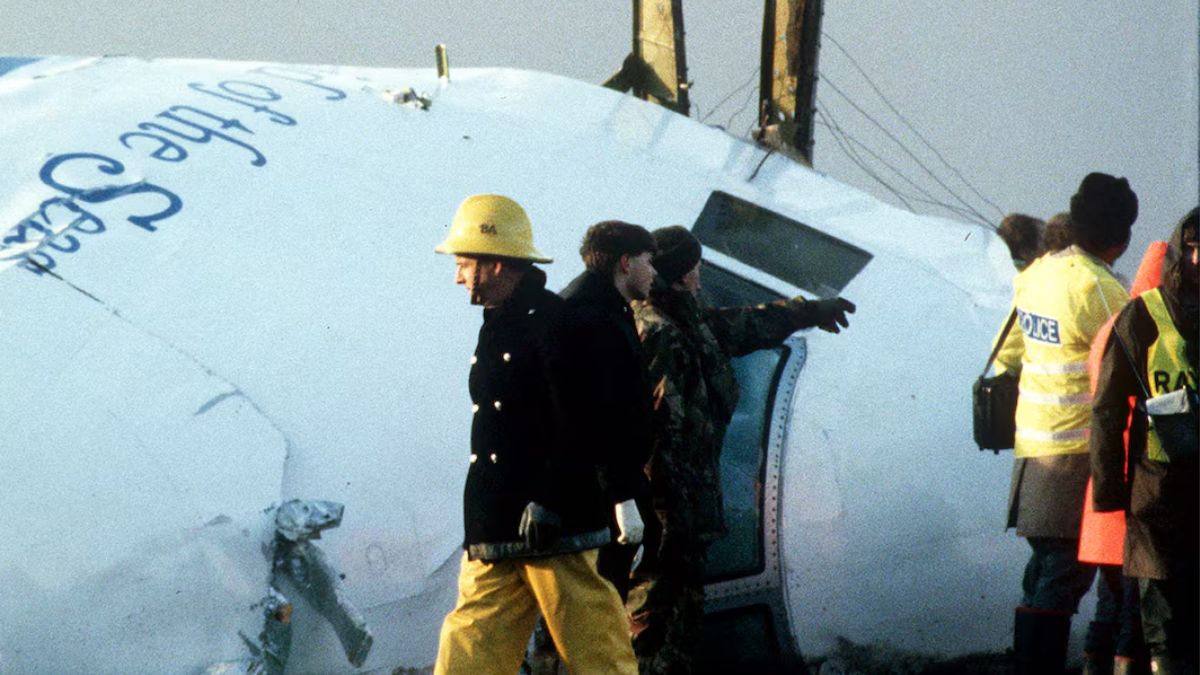
 "Pan Am Flight 103 bombing. Reuters")
It was a few days before Christmas, and residents of the Scottish town of Lockerbie were preparing for the holidays. However, everything changed in the blink of an eye after Pan Am Flight 103 exploded over the town. The devastating crash shattered the village and captured the attention of the world.
The mid-air explosion, caused by a bombing, killed all 243 passengers and 16 crew members aboard, as well as 11 Lockerbie residents on the ground.
In this edition of Firstpost’s ongoing series of History Today, we recall the heart-wrenching incident that occurred on this very day and more.
Pan Am Flight 103 explodes over Lockerbie
For Lockerbie, December 21, 1988, turned into a nightmare. A loud explosion caused the aircraft, Pan Am Flight 103, flying overhead, to rain down debris and fire on the town. Flight 103 departed from London’s Heathrow Airport on a flight to New York. Among the 243 passengers were 189 Americans. The explosion caused the 747 to split into two pieces and crash down on Lockerbie.
Amid the wreckage, investigators discovered fragments of a bomb. According to History.com, the device was hidden inside an audio cassette player and detonated in the cargo area when the plane was at an altitude of 31,000 feet.
A piece of plastic was the key to unravelling the mystery. Analysis traced this plastic back to a suitcase manufactured by a company in Malta, which ultimately pointed towards Libya. The US and the UK imposed economic sanctions on Libya.
In 1991, after a joint probe by British authorities and the FBI, Abdel Basset Ali al-Megrahi and Lamen Khalifa Fhimah, Libyan intelligence agents and nationals, were indicted for murder.
Western nations demanded that Libya hand over the two suspects. However, Libya rejected the demand. In 1999, Libya agreed to turn over the two suspects to Scotland for trial in the Netherlands. In 2001, Abdel Basset Ali al-Megrahi was convicted and sentenced to life, and Fhimah was acquitted.
Quick Reads
View AllIn 2003, Libya accepted responsibility for the bombing but did not express remorse.
James Naismith invents basketball
In 1891, James Naismith, a Canadian-born teacher, worked at a YMCA International Training School in Massachusetts. Due to the chilling Massachusetts cold, students could not play outside. James wanted to create a game that students could play indoors. However, he was unaware that he was going to invent basketball.
One day, he asked: what if there was a game where players had to throw a ball into a goal? He then asked the school janitor for two wooden boxes to use as goals. However, the janitor could not get his hands on any boxes. Instead, he brought two baskets.
James then nailed the peach baskets to the balcony railings in the school gym. With the baskets and the ball ready, James jotted down 13 simple rules for his new game. Back then, each team had nine players.
Naismith once said, “The invention of basketball was not an accident. It was developed to meet a need.”
Nepal becomes independent
On this day, Nepal and Britain signed the Treaty of Friendship of 1923, marking the first formal recognition of the sovereignty and independence of Nepal. It took place in Singha Durbar, Kathmandu.
The then Prime Minister of Nepal, Chandra Shamsher, wanted Britain to officially recognise Nepal as an independent nation. He knew that the old Sugauli Treaty limited Nepal’s freedom. In 1921, when the Prince of Wales, who later became King Edward VIII, visited Kathmandu, Shamsher spoke about the idea of a new peace treaty. The negotiations continued for over a year, and it was finally signed on December 21, 1923.
After the conclusion of the 1923 treaty, the nation began making contact with other nations. According to reports, Nepal was the first South Asian country to establish an embassy in London. Nepal also established diplomatic relations with the United States in 1946.
With inputs from agencies