

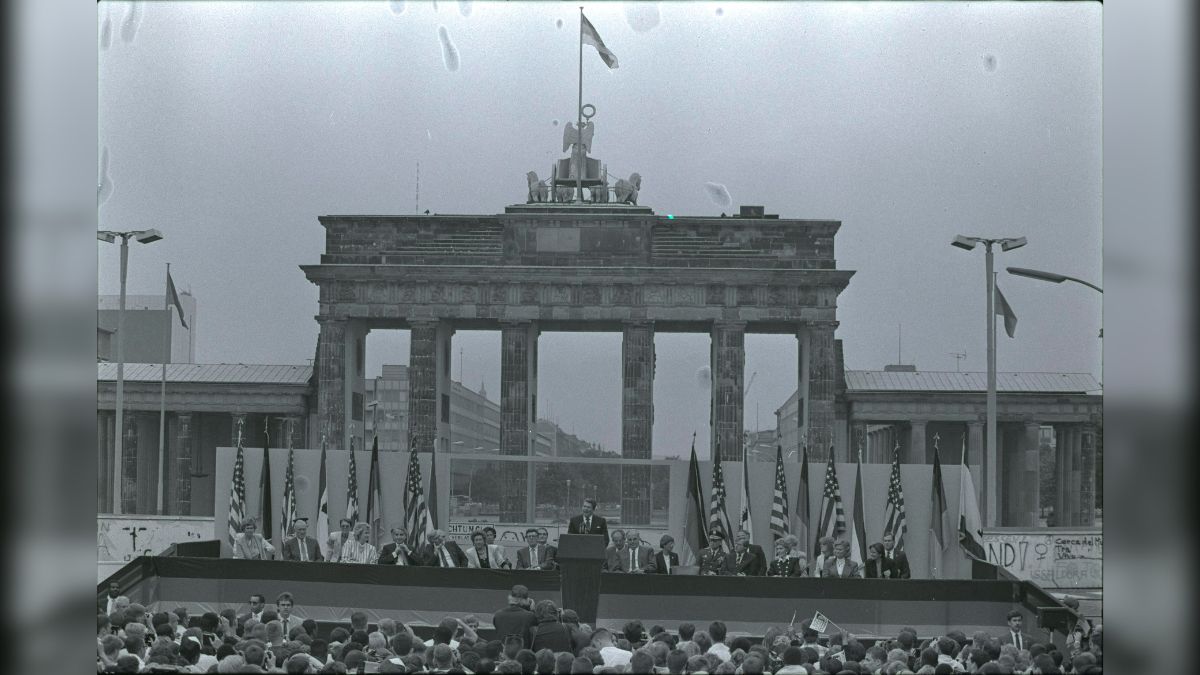
 "History Today: When Ronald Reagan famously entreated Soviet Leader Gorbachev to 'tear down this wall'")
On this day in history — June 12 — United States President Reagan delivered his iconic “Tear down this wall!” speech in Berlin, Anne Frank received the diary that would become her legacy, and the first ride of a two-wheeled vehicle was recorded.
As part of its History Today series, Firstpost revisits these pivotal moments.
“Mr. Gorbachev, tear down this wall!”
Standing before the solemn grandeur of the Brandenburg Gate on June 12, 1987, US President Ronald Reagan delivered one of the most iconic speeches of the Cold War era.
With tens of thousands watching on both sides of the Iron Curtain, Reagan boldly addressed Soviet leader Mikhail Gorbachev: “Mr. Gorbachev, tear down this wall!”
This symbolic plea reverberated across the world and later became a defining moment in the collapse of Soviet-dominated Eastern Europe
Following World War II, the Allied powers divided Germany into zones, eventually crystallising into West Germany (Allied-administered) and East Germany (Soviet-controlled).
In August 1961, East Germany fortified its border, encasing West Berlin with walls, barbed wire, and guard towers to stem the mass exodus of citizens fleeing to the West — 2.5 million had left before the barricade went up.
By 1987, Soviet General Secretary Mikhail Gorbachev had initiated glasnost (openness) and perestroika (restructuring), but East German leaders resisted these reforms.
Reagan’s visit to Berlin during the city’s 750th anniversary — and shortly after attending the Venice G7 summit — culminated at the Berlin Wall, where he seized an opportunity to send a dramatic message to the Soviet leadership .
Reagan began by acknowledging the fear and division permeating Europe, pledging support for freedom while affirming Western resolve.
He acknowledged Soviet gestures toward reform but cautioned they might be mere token measures — “Are these the beginnings of profound changes… or token gestures?”
At the heart of the address, standing before the wall with the Brandenburg Gate behind him, Reagan made his historic demand: “General Secretary Gorbachev, if you seek peace, if you seek prosperity… come here to this gate! Mr. Gorbachev, open this gate! Mr. Gorbachev, tear down this wall!”
He stated that the wall represented not just a German division, but a scar on humanity and a challenge to freedom worldwide.
Immediate reactions were mixed. Western media found the speech bold yet impractical; the Soviet news agency TASS branded it provocative and bellicose.
Gorbachev privately noted the rhetoric but described Reagan later as “cooperative and courageous.”
American officials, including those at the State Department and National Security Council, had initially cautioned Reagan against making such a direct demand, worried it could undermine ongoing detente.
Reagan’s speech proved more transformative in hindsight. It resonated deeply with Berliners and freedom advocates worldwide, embedding itself in popular culture and political discourse.
Less than three years later, on November 9, 1989, the Berlin Wall fell — opening a path to German reunification and the eventual end of the Cold War .
Reagan’s words came to symbolise a shift in global geopolitics — affirming that powerful rhetoric, backed by political will, can challenge authoritarian barriers and inspire change.
Today, the speech is remembered as a powerful challenge to tyranny and a testament to the persuasive power of words. Reagan’s demand remains inscribed on the Brandenburger Tor memorial, a permanent reminder of a pivotal moment that changed the course of history.
Anne Frank receives a diary
On June 12, 1942, Anne Frank turned thirteen and received a red-and-white checkered diary — her beloved “Kitty” — as a birthday gift from her parents in Amsterdam.
Anne began writing that day, documenting everyday thoughts, challenges and aspirations. Within weeks, she and her family went into hiding in a secret annex to escape Nazi persecution.
Her diary became a poignant chronicle of life under threat, reflecting both fear and enduring hope.
Posthumously published as The Diary of a Young Girl in 1947, Anne’s words now echo worldwide as a powerful testament to resilience amid atrocity.
First ride of a two-wheeler
On June 12, 1817, German inventor Karl Friedrich Christian Ludwig Freiherr von Drais von Sauerbronn embarked on a groundbreaking journey in Mannheim, riding his Laufmaschine — or “running machine” — for approximately seven kilometres to the Schwetzinger Relaishaus and back.
This pedal-less, steerable two-wheeler, propelled by foot, is widely regarded as the precursor to the modern bicycle.
The entire round trip took him just over an hour — half the time required on foot — ushering in a new era in personal transport.
Despite early bans on pavements and road use, the Laufmaschine marked a monumental leap in mobility and engineering ingenuity, eventually evolving into today’s bicycles.
Also Watch:
With inputs from agencies

 "Russian drones over Poland: Trump’s tepid reaction a wake-up call for Nato?")
 "As Russia pushes east, Ukraine faces mounting pressure to defend its heartland")
 "Why Mossad was not on board with Israel’s strike on Hamas in Qatar")
 "Turkey: Erdogan's police arrest opposition mayor Hasan Mutlu, dozens officials in corruption probe")
 "Russian drones over Poland: Trump’s tepid reaction a wake-up call for Nato?")
 "As Russia pushes east, Ukraine faces mounting pressure to defend its heartland")
 "Why Mossad was not on board with Israel’s strike on Hamas in Qatar")
 "Turkey: Erdogan's police arrest opposition mayor Hasan Mutlu, dozens officials in corruption probe")



