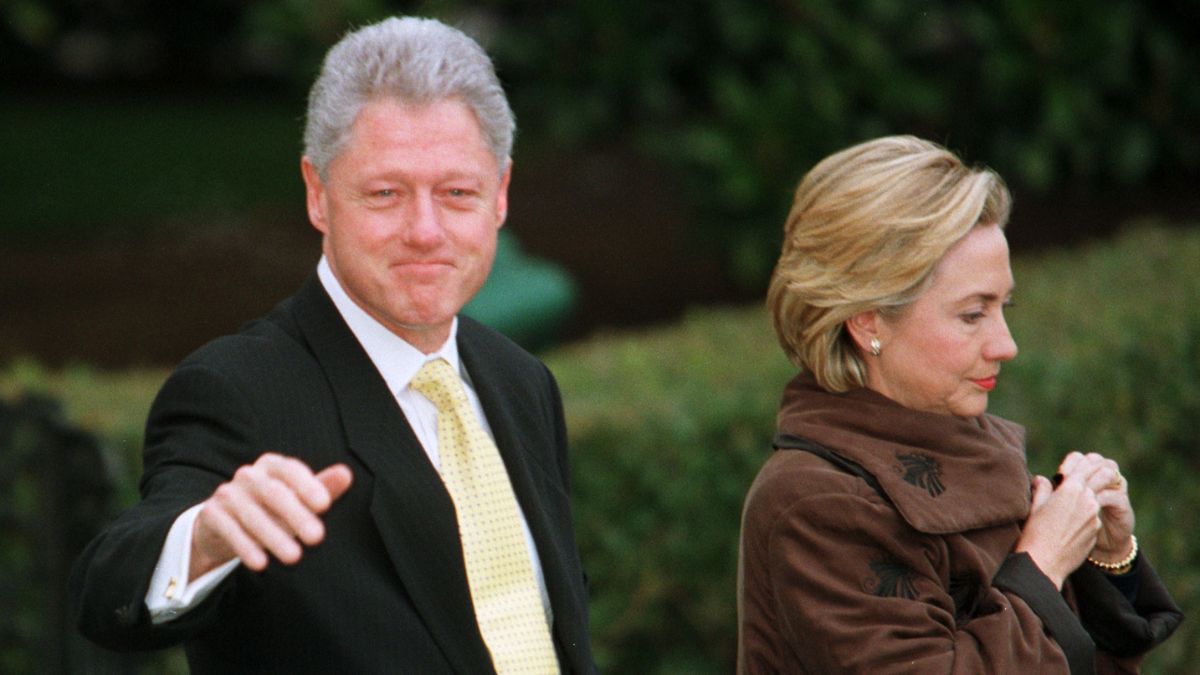
 "US President Bill Clinton waves to reporters as he and first lady Hillary Clinton depart the White House, January 20, 1999. File Image/Reuters")
On December 19, 1998, the United States witnessed a rare constitutional moment when President Bill Clinton was impeached by the House of Representatives.
Decades earlier, Adolf Hitler consolidated military power by taking direct command of Germany’s army during World War II.
In Asia, Britain and China reached a landmark agreement in 1984 to return Hong Kong to Chinese sovereignty.
And in 1843, Charles Dickens published A Christmas Carol, a work that reshaped the spirit and social meaning of Christmas across generations.
We take a brief look at these events as part of Firstpost’s ongoing History Today series.
Bill Clinton is impeached
On December 19, 1998, the United States House of Representatives impeached President Bill Clinton, making him only the second president in American history — after Andrew Johnson in 1868 — to be impeached.
The impeachment stemmed from allegations that Clinton had lied under oath and obstructed justice in connection with his relationship with White House intern Monica Lewinsky.
Though Clinton would later be acquitted by the Senate, the impeachment marked one of the most consequential political crises in modern American history.
The impeachment was the culmination of a series of investigations that initially had nothing to do with Lewinsky.
Independent Counsel Kenneth Starr had been appointed in the mid-1990s to investigate the Whitewater real estate controversy involving Clinton and First Lady Hillary Clinton.
Over time, the scope of Starr’s investigation expanded to include other allegations, including Paula Jones’ sexual harassment lawsuit against Clinton.
It was during the Jones case that Clinton was questioned under oath about any inappropriate relationships with government employees. In January 1998, reports emerged that Clinton had engaged in a sexual relationship with Monica Lewinsky.
Clinton publicly denied the allegations, famously stating that he “did not have sexual relations with that woman.” Evidence later contradicted this claim.
In September 1998, Kenneth Starr submitted a report to Congress outlining 11 possible grounds for impeachment.
The Starr Report alleged that Clinton had committed perjury before a grand jury, perjury in the Paula Jones deposition, obstruction of justice, witness tampering, and abuse of power. The report, which included explicit details, was made public.
While Clinton admitted to having an inappropriate relationship with Lewinsky, he maintained that his statements were legally accurate and denied any criminal wrongdoing. Nonetheless, the House Judiciary Committee moved forward with impeachment proceedings.
On December 19, 1998, the Republican-controlled House voted on four articles of impeachment:
Perjury before a grand jury – approved
Obstruction of justice – approved
Perjury in the Paula Jones deposition – rejected
Abuse of power – rejected
The approval of the first two articles formally impeached Clinton. The votes largely followed party lines, showcasing the deep partisan rift in Washington.
Despite the gravity of impeachment, public opinion remained surprisingly supportive of Clinton.
Throughout the scandal, his approval ratings remained high, driven in part by strong economic performance, low unemployment, and budget surpluses.
Many Americans viewed the impeachment as excessive or politically motivated, while others argued it was necessary to uphold the rule of law.
The 1998 midterm elections, held weeks before the impeachment vote, resulted in losses for the Republican Party — an unusual outcome for a party out of power.
The impeachment moved to the Senate in January 1999, where Chief Justice William Rehnquist presided over the trial. Senators served as jurors, and House impeachment managers presented the prosecution case.
On February 12, 1999, the Senate voted to acquit Clinton on both charges. Neither article reached the required two-thirds majority for conviction.
Clinton completed his second term, remaining in office until January 2001.
The Clinton impeachment also set a modern precedent for impeachment proceedings, shaping how future cases — including those involving incumbent US President Donald Trump — would be interpreted and conducted.
Hitler takes over the German Army
On December 19, 1941, Adolf Hitler assumed direct command of the German armed forces, removing Field Marshal Walther von Brauchitsch as commander-in-chief of the army.
This decision came at a critical moment during World War II, shortly after Germany’s invasion of the Soviet Union had stalled and following the United States’ entry into the war.
Hitler’s move concentrated military and political authority in his own hands, bypassing professional military leadership.
From this point onward, strategic decisions were increasingly shaped by ideology rather than military pragmatism. Hitler issued rigid orders forbidding retreats, even when tactical withdrawals might have saved German forces.
Historians widely regard this centralisation of command as a major factor in Germany’s eventual defeat. The decision deepened internal dissent within the Wehrmacht and eroded the army’s operational flexibility.
Britain returns Hong Kong to China
On December 19, 1984, Britain and China signed the Sino-British Joint Declaration, formalising the agreement that Hong Kong would be returned to Chinese sovereignty in 1997.
The agreement ended over 150 years of British colonial rule and established the framework for Hong Kong’s future under the “one country, two systems” principle.
Under the declaration, China committed to preserving Hong Kong’s capitalist system, legal autonomy, and civil liberties for 50 years after the handover. The deal was registered with the United Nations, giving it international standing.
At the time, the agreement was seen as a pragmatic compromise that balanced sovereignty with stability. In later decades, tensions over Beijing’s interpretation of the agreement would fuel political unrest in Hong Kong.
“A Christmas Carol” is published
On December 19, 1843, Charles Dickens published A Christmas Carol, a novella that would become one of the most enduring works of English literature.
Written in response to social inequality and poverty in Victorian Britain, the story follows Ebenezer Scrooge’s moral transformation after encounters with three Christmas spirits.
The book was an immediate success, selling out its first print run within days.
Beyond its literary impact, A Christmas Carol reshaped cultural perceptions of Christmas, emphasising generosity, compassion, and social responsibility.
Dickens’ work influenced charitable practices and helped revive Christmas traditions that persist today. More than a century later, the novella remains a staple of global culture, adapted into countless films, plays, and retellings.
Also Watch:
With inputs from agencies