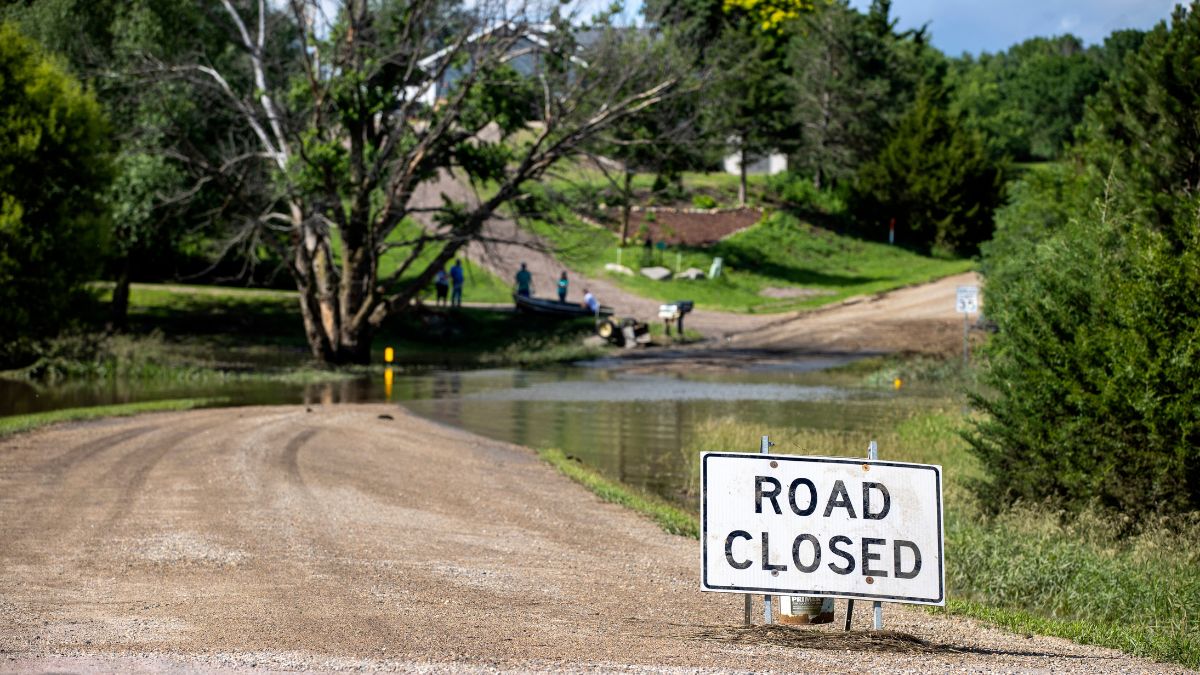
 "A road is closed off due to flooding caused by heavy rainfall, 22 June, 2024, in Lincoln County, South Dakota, USA. AP")
Millions in the United States are experiencing extreme weather conditions, with a severe heatwave affecting large parts of the country while devastating floods have struck the Midwest. In northwest Iowa, 13 rivers flooded the area, forcing entire neighbourhoods and at least one town to evacuate.
The town of Spencer imposed a curfew for the second consecutive night after floodwaters surpassed the record set in 1953. “When the flood gauge is underwater, it’s really high,” said Eric Tigges of Clay County emergency management at a news conference.
Iowa state Governor Kim Reynolds declared a disaster for 21 counties in northern Iowa, including Sioux County. National Guard troops assisted with water rescues and transporting needed medications lost in the flooding. “Businesses are shuttered. Main streets have been impacted,” Reynolds stated. “Hospitals, nursing homes, and other care facilities were evacuated. Cities are without power, and some are without drinkable water.”
Catastrophic flooding in South Dakota
South Dakota is also grappling with severe flooding. Governor Kristi Noem declared an emergency in the southeastern part of the state, where several highways were closed due to floodwaters.
Areas south of Sioux Falls received an estimated 10 to 15 inches of rain over three days. “I want to remind everybody to remember the power of water and the flow of water, and to stay away from flooded areas,” Noem warned.
Emergency management officials issued a voluntary evacuation order for Dakota Dunes, a community near the Nebraska and Iowa borders, reported AP.
John Remus, water management division chief for the US Army Corps of Engineers, indicated that minor to moderate flooding was expected along the Missouri River. “As long as the levees hold, we’re not expecting any major impacts,” Remus said.
Impact Shorts
More ShortsHeatwave across east US
While the Midwest battles flooding, the rest of the country is enduring a relentless heatwave. From the mid-Atlantic to Maine, the Great Lakes region, and the West Coast, temperatures soared, breaking records in several areas.
“It’s more important for people who are going to be outside to stay hydrated, because heat, humidity, and low winds can be dangerous,” AP quoted Bruce Thoren, a National Weather Service meteorologist in Oklahoma.
In Washington, DC, Baltimore, and Philadelphia, record heat was recorded over the weekend.
Last year, the US experienced the most heatwaves since 1936, with excessive heat contributing to over 2,300 deaths. “Heat exhaustion is a real thing. And so we want our residents to be safe from extreme heat,” Thennie Freeman, director of the Washington, DC, Department of Parks and Recreation told CBS News.
Heatwave impacts infrastructure and health
The heatwave has caused significant disruptions. In Michigan, utility crews worked tirelessly to restore power to thousands of customers after severe storms knocked out power amid the heatwave.
“They are working in very, very tough conditions,” Brian Calka, vice president of distribution operations for DTE Energy told AP. The heatwave has also led to the first heat-related deaths of the year in Idaho, where two people in their 60s died.
New York City health officials reported a 500% increase in heat-related emergency room visits.
In Texas, Governor Greg Abbott issued a disaster declaration for 51 counties after Tropical Storm Alberto caused significant flooding. New Mexico requested federal assistance after wildfires forced evacuations. The climate group World Weather Attribution stated that the southern heatwave in late May was 35 times more likely due to climate change and 2.5°F hotter.
Rare tornado threats and flash flooding concerns
The US National Weather Service warned of the potential for rare tornadoes in the Northeast. Tornadoes struck Wisconsin, leveling the historic Apple Grove Lutheran Church. “The good news is we are all safe,” Pastor Dan Bohlman of Apple Grove Lutheran said on the church website.
Widespread showers and thunderstorms sparked flash flooding in parts of New England and the Great Lakes. In northern Minnesota, floodwaters prompted road closures and significant damage. “Instead of 10,000 lakes, Minnesota is, I don’t know, 150,000 lakes at this point,” joked farmer Owen Gohlke to CBS News.
In south-central Minnesota, excessive rain ended a three-year drought but flooded fields and killed crops. In New Mexico and Nevada, “monsoon-like conditions” prompted evacuations. Up to 2 inches of rain fell with additional rainfall expected. Flash flooding caused multiple road closures in Las Vegas.
Also Read | Climate hypocrisy: West’s moral high ground and its failure to deliver
“We’ve had so much rain here,” said Rock Valley Mayor Kevin Van Otterloo. “Our ground just cannot take anymore.” With both floods and heatwaves predicted to persist, the US is facing an unprecedented challenge and is bracing itself for ongoing disruptions while attempting to prioritise safety and preparedness in the face of these natural disasters.
With inputs from agencies