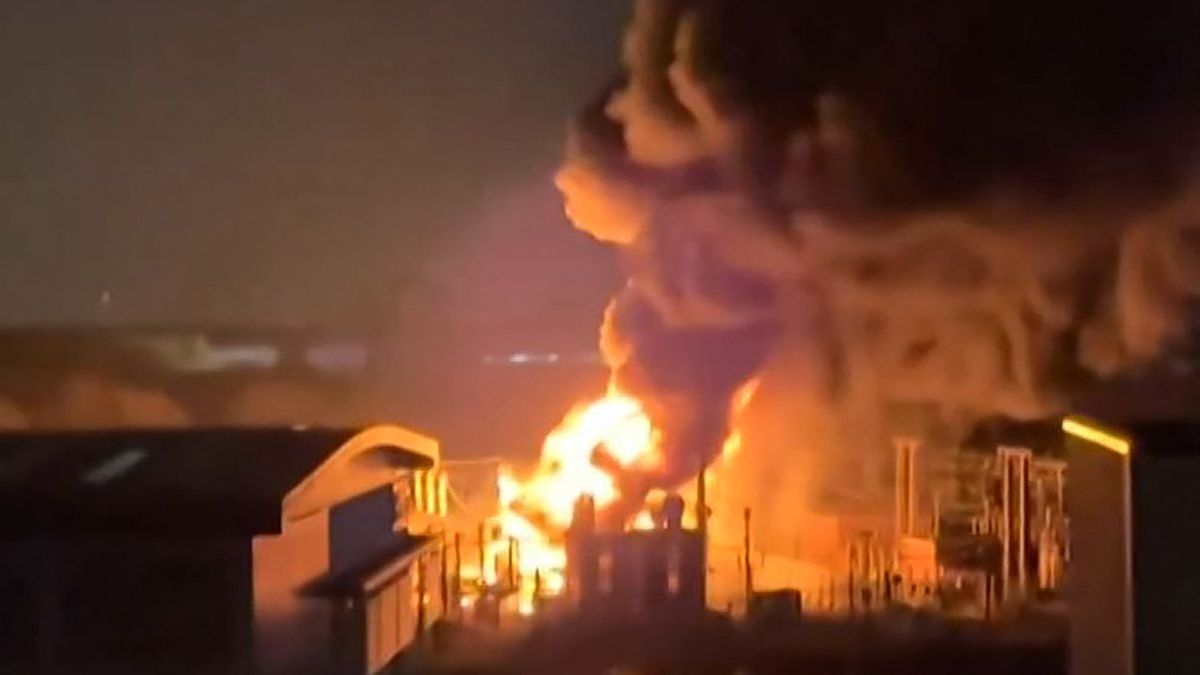
 "This frame grab taken from a UGC video shot and posted on X on March 21, 2025 by @chrisjbrogan shows smoke billowing from a fire at a neighborhood electrical substation supplying power to Heathrow Airport in Hayes, west London. File Image/AFP")
United Kingdom’s Heathrow Airport was cautioned about the resilience of its power supply just days before a fire at an electrical substation led to a shutdown , affecting nearly 300,000 passengers.
Nigel Wicking, chief executive of the Heathrow Airline Operators’ Committee (HAOC), testified before a Commons committee that he had raised concerns regarding vulnerabilities in the airport’s power infrastructure.
Wicking, on Wednesday, highlighted that incidents of wire and cable theft had already caused temporary outages in critical runway lighting systems before the fire, prompting him to seek clarity on the airport’s overall resilience.
He first voiced these concerns to the Team Heathrow director on March 15 and escalated them to Heathrow’s chief operating officer and chief customer officer on March 19 — just two days before the fire broke out at the North Hyde substation.
“We should actually have the best service, we should have the best infrastructure,” Wicking stated, stating the expectation for Heathrow to maintain top-tier operational stability given its status as the world’s most expensive airport in terms of passenger charges.
What happened at the time?
On the night of 20 March, a fire erupted in a transformer within the North Hyde electrical substation, which supplies Heathrow. By the early hours of 21 March, red warning lights signalled a loss of power across a third of the airport, heavily impacting Terminal 2 and multiple central systems.
Heathrow’s chief executive, Thomas Woldbye, explained the sequence of events, stating, “In our operations centre, you would have seen all the red lights go, that the systems were powering down.” “We had no information as to why.”
“We then had a slightly later stage call from the fire department that the substation was on fire,” he said.
Authorities soon confirmed that the fire had caused extensive damage, knocking out power and disrupting thousands of flights. Over 1,400 flights were either cancelled or diverted , with aircraft rerouted as far as mainland Europe and even back to India.
National Grid’s president for UK electricity transmission, Alice Delahunty, described the incident as “a very rare and serious event,” highlighting the unusual nature of a fire strong enough to disable multiple transformers.
Scottish & Southern Electricity Networks (SSEN) later confirmed that Heathrow had access to two alternative power intakes but noted that the airport’s internal configuration dictated how those power sources were utilised.
Who took the decision to close?
As chaos unfolded, Heathrow leadership made the decision to close the airport entirely. Woldbye justified the move, arguing that safety considerations took precedence. “It became quite clear we could not operate the airport safely quite early in this process, and that is why we closed the airport,” he said.
He added that keeping the airport open without sufficient power would have led to thousands of stranded passengers in high-risk situations, with critical systems such as CCTV and fire surveillance non-operational.
“Just because the lights were on doesn’t mean all the systems were working,” he clarified.
Despite these explanations, Wicking and airline representatives criticised Heathrow’s handling of the situation. He argued that Terminal 5 could have resumed operations by mid-morning on 21 March, a full 12 hours before it was eventually reopened.
He further claimed that Border Force was prepared to process passengers manually, allowing some flights to land and mitigating widespread travel disruption.
The financial consequences of the shutdown were substantial, with Wicking estimating airline losses between £60 million and £100 million.
Additionally, the airport and surrounding businesses, particularly those in West London, suffered economic damage, and the reputational impact on Heathrow was significant. Passengers, some of whom missed crucial personal events such as weddings and funerals, faced immense frustration.
Wasn’t Heathrow ready for crisis?
The outage raised serious concerns about Heathrow’s electrical resilience and its ability to prevent similar crises in the future. Heathrow currently pays £135 million for its power supply, and Woldbye maintained that the existing system, which includes backup transformers and three separate power lines, was supposed to be “resilient.”
He argued that upgrading to a completely fail-proof electrical setup would be prohibitively expensive, estimating costs at over £1 billion.
Despite Woldbye’s assertions, airline representatives remained unconvinced. “The resilience should have been there in the first place,” Wicking said, rejecting the notion that airlines should bear the financial burden for enhancements to the power infrastructure.
As part of its response, Heathrow has commissioned an independent review of the incident, led by former UK transport secretary Ruth Kelly. This inquiry will assess what went wrong and recommend steps to prevent similar occurrences in the future.
The fire and subsequent shutdown have prompted a broader discussion about Heathrow’s infrastructure and its ability to handle unexpected crises.
The UK government’s plan for Heathrow’s expansion, including a third runway, further complicates the issue. Woldbye confirmed that the airport would require double its current power capacity to support the expansion — raising questions about its ability to handle future demand.
With inputs from agencies