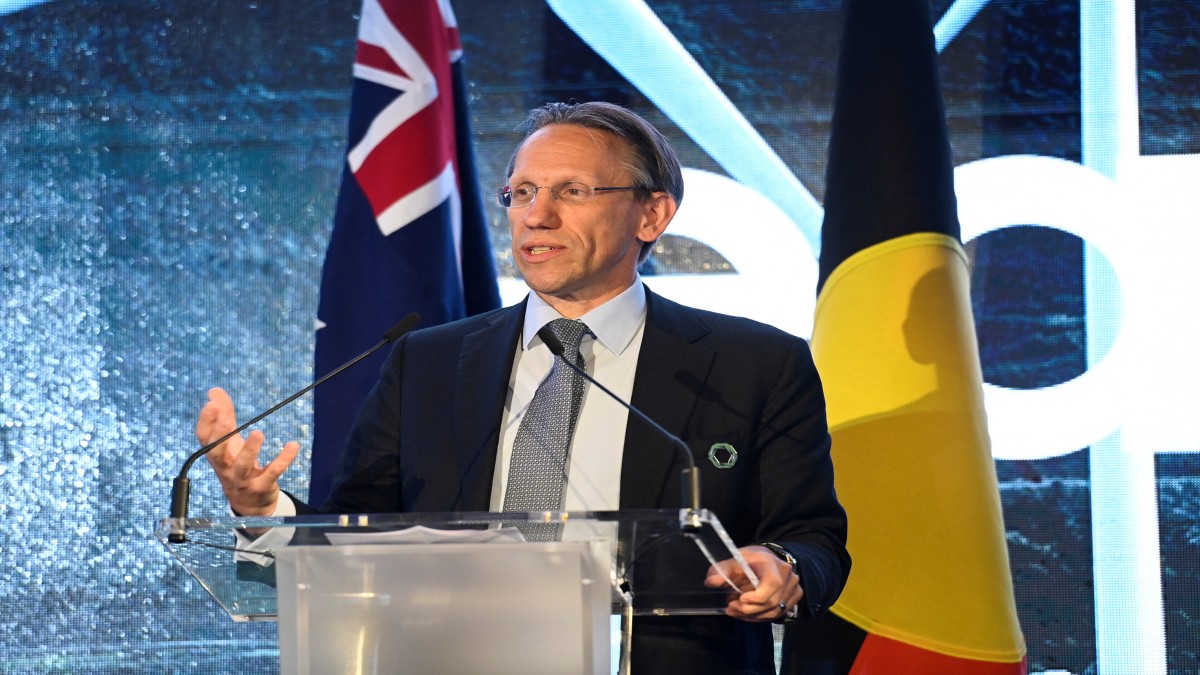
 "Joerg Kukies, a top official in the German chancellery and deputy finance minister, is the next German finance minister after Christian Lindner was fired. Reuters")
Germany’s centre-left Chancellor Olaf Scholz fired Finance Minister Christian Lindner on Wednesday, signalling the collapse of the ruling three-party coalition.
The move comes after weeks of disputes among the coalition partners over ways to boost the country’s ailing economy.
Scholz has now replaced his finance minister with the current state secretary in the chancellery, Joerg Kukies.
Here’s all we know about him.
Who is Joerg Kukies?
Germany’s new Finance Minister, Joerg Kukies, is a former investment banker who has long been one of Chancellor Olaf Scholz’s closest advisers.
The 56-year-old entered politics in 2018 when Scholz was finance minister under Angela Merkel. Within his centre-left Social Democratic Party (SPD), the move had created a great deal of distress. The Handelsblatt Business Daily described his surprise switch from banking to politics as “a real bombshell.”
Despite the significant wage drop, he kept his job and, when Scholz was appointed chancellor, changed to economic adviser.
He concentrated on European, financial, and economic issues while serving as state secretary at the Federal Chancellery. At the G20 and G7 summits, he has also represented Scholz.
In the early 1990s, he also briefly served as the leader of the party’s youth wing in Rhineland-Palatinate. He left his position to study economics, eventually earning a Master’s degree at Harvard University and a Doctorate in Chicago.
Before entering politics, Kukies had been associated with the investment bank for over 17 years. In 2014, he became a joint CEO of Goldman Sachs AG and managing director of the Frankfurt branch, overseeing the bank’s business in Germany and Austria.
Kukies was primarily responsible for securities trading and “derivative financial product solutions,” he told the magazine Wirtschaftswoche at the time.
Kukies oversaw the Economic Stabilisation Fund during the COVID-19 epidemic, which provided federal guarantees on loans and recapitalisation steps to keep businesses feasible. Additionally, he served as the chief negotiator for the German airline Lufthansa’s brief nationalisation.
Impact Shorts
More ShortsHowever, his reputation was damaged during the Wirecard scandal, Germany’s most notorious accounting fraud case. After Wirecard collapsed into insolvency in 2020, it emerged that the company’s disgraced CEO Markus Braun had met Kukies at the finance ministry in November 2019 — leading to calls for his resignation.
The broader case prompted an overhaul of Germany’s finance watchdog BaFin, heavily criticised for ignoring early warnings about Wirecard.
What are his new responsibilities?
With Lindner’s FDP party out of government, Scholz is hoping to hold on to power until next year as the head of a minority coalition consisting of his SPD and the Greens.
Analysts predict that the government’s lack of a majority will limit Kukies’ options as finance minister.
The 2025 budget, the focus of months of contentious discussions before to the coalition’s dissolution, is unlikely to be passed by a minority administration.
Regular funding will continue, though, and there will not be any form of government shutdown as a result.
Opposition parties may also be able to support less contentious policies and urgent spending choices, like increasing funding for Ukraine.
The first person to protest Kukies’ selection on Thursday was Sahra Wagenknecht, a far-left opposition lawmaker from Germany.
She claimed that it spoke “a lot about the state of the SPD” that the Social Democrats of all parties had assigned a former Goldman Sachs banker to draft the federal budget.
Why was the previous FM fired?
Scholz fired Finance Minister Christian Lindner after weeks of disputes among the coalition partners over ways to boost the country’s ailing economy.
He said he would seek a vote of confidence in January that he said might lead to early elections that otherwise would be due next September.
“I feel compelled to take this step to prevent damage to our country. We need an effective government that has the strength to make the necessary decisions for our country,” Scholz said.
Lindner, from the pro-business Free Democrats, had rejected tax increases or changes to Germany’s strict self-imposed limits on running up debt.
Scholz’s Social Democrats and the environmental Greens, who are also part of the coalition, wanted to see massive state investment and rejected the Free Democrats’ proposals to cut welfare programmes.
Lindner responded to his dismissal by accusing Scholz of failing “to recognise the need for a new economic awakening in our country. He has played down the economic concerns of the citizens.”
He said the chancellor’s proposals to reenergize the economy were “dull, unambitious and make no contribution to overcoming the fundamental weakness of our country’s growth.”
Scholz said about Lindner that “he has broken my trust too often. He even unilaterally cancelled the agreement on the budget. After we had already agreed on it in long negotiations. There is no basis of trust for further cooperation. Serious government work is not possible like this.”
Snap election pressure?
Following the latest developments, Scholz said he would seek the vote of confidence in Germany’s Bundestag or parliament on January 15, which opens the door for an early federal election by the end of March next year.
An electoral vote was originally scheduled to be held in the fall of 2025.
He says this would “allow the members of the Bundestag to decide whether to clear the way for early elections.”
The election could then “take place by the end of March at the latest, in compliance with the deadlines set out in constitution.”
Germany’s economy is expected to shrink in 2024 for the second year in a row, or at best stagnate, battered by external shocks and home-grown problems including red tape and a shortage of skilled labour.
Scholz’s centre-left Social Democrats, Vice Chancellor Robert Habeck’s environmentalist, left-leaning Greens and Lindner’s pro-business Free Democrats — a party that in recent decades has mostly allied with conservatives — set out in 2021 to form an ambitious, progressive coalition straddling ideological divisions that would modernise Germany.
The government can point to achievements: preventing an energy crunch after Russia cut off its gas supplies to Germany, initiating the modernization of the military and a series of social reforms. But the impression it has left with many Germans is of deepening dysfunction.
Ahead of the vote of confidence in January, Scholz said he would reach out to opposition leader Friedrich Merz of the center-right Christian Democrats to confer on possible ways of strengthening the economy and defense.
With inputs from agencies