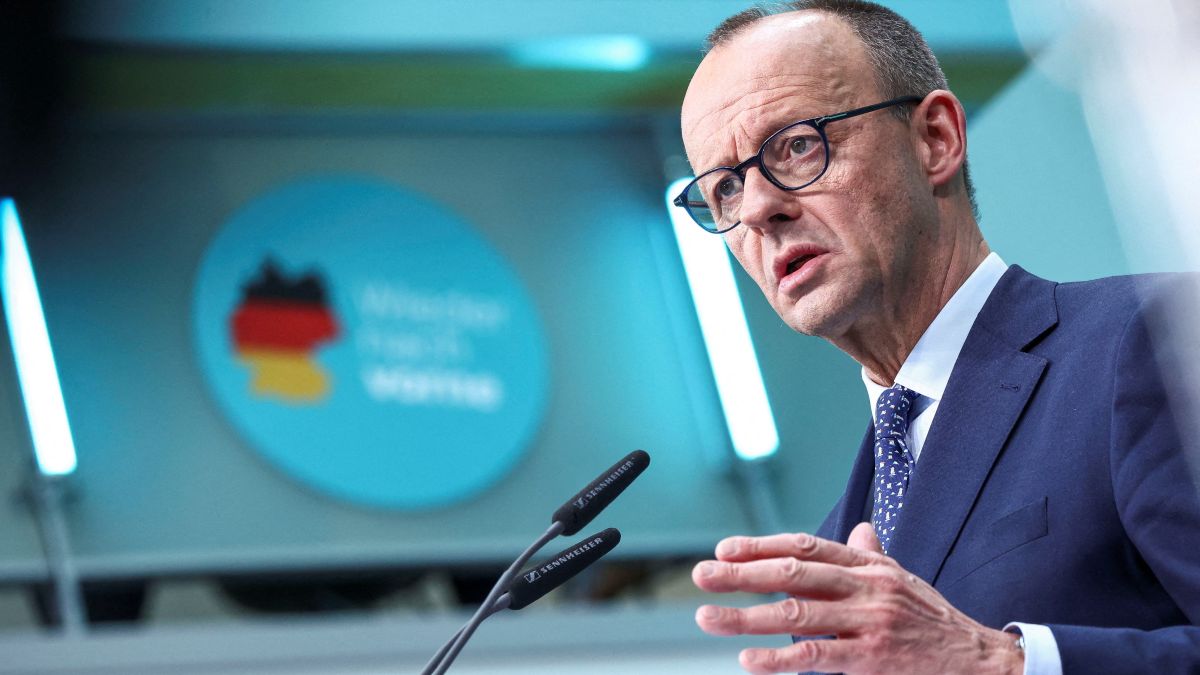
 "Germany to spend big on defence, infrastructure: Why this fiscal bazooka is significant")
Germany has made history.
The Bundestag, or Lower House of Parliament, passed a historic spending package doing away with years of austerity.
Germany is now set to invest extensively in the military and infrastructure – and also release an aid package for Ukraine.
The development comes in the backdrop of the ongoing war between Kyiv and Moscow.
But what happened? And what does it mean?
Let’s take a closer look
What happened?
As per Politico, 513 lawmakers in the 720-member Bundestag – over two-thirds – voted for the new bill.
Meanwhile, 207 voted against the bill. There were no abstentions.
Conservative leader Friedrich Merz of the Christian Democratic Union (CDU), who is likely to be the next German chancellor, had come out in favour of the package.
He received help from the Social Democratic Party (SPD) of outgoing Chancellor Olaf Scholz and the Greens.
The CDU and SPD are currently in negotiations to form a centrist government following last month’s elections.
The CDU had emerged as the largest party, while the far-right Alternative for Germany ( AfD) came second.
As per BBC, the new law allows Germany to spend big on defence and infrastructure by sidestepping its strict rules on debt.
It also creates a $547 billion infrastructure fund and sets aside $3.3 billion extra in aid for Ukraine.
The bill also allows Germany’s 16 federal states to borrow 0.35 per cent of their GDP.
However, it must be noted that the Bundesrat, or the Upper House of Parliament, still needs to approve the bill by a two-thirds majority.
That vote is slated to be held on Friday.
Senior officials of the conservatives and the Social Democrats have said they expect the upper house to pass the legislation.
The main hurdle to passage there appeared to fall on Monday when the Bavarian Free Voters agreed to back the plans.
The conservatives and SPD wanted to pass the legislation through the outgoing parliament for fear it could be blocked by an enlarged contingent of far-right and far-left lawmakers in the next Bundestag starting March 25.
The (AfD) and the far-left Die Linke – both of whom have oppose the plans – would have the numbers needed to block the bill in the new Parliament.
Merz has justified the tight timetable with the rapidly changing geopolitical situation.
To secure the necessary two-thirds majority in parliament, they CDU to integrate last-minute demands from the Greens party into their proposal.
What does it mean?
The significance of this move cannot be overstated.
Germany has been traditionally allergic to accumulating debt and spending heavily on the military.
This is both as a result of the 2008 financial crisis and Germany’s discomfort and acknowledgement of its Nazi past.
As per BBC, Germany in the aftermath of the global financial crisis installed what is known as a debt-brake under the then Angela Merkel government.
Under the constitution, Germany capped new borrowing at 0.35 per cent of the country’s GDP.
Now, Germany can borrow all it wants and needs to spend on improving its defences.
The development comes as Germany and other European nations have been under pressure to shore up their defences in the face of hostile Russia and shifts in US policy under President Donald Trump, which European leaders fear could leave the continent exposed.
Recent weeks have brought new urgency to efforts to further strengthen Germany’s long-neglected military. The outgoing government created a special $109 billion fund to modernise it, which also helped Berlin meet the current NATO target of spending two per cent of GDP on defence.
But that pot will be used up in 2027, and doubts have grown recently about the Trump administration’s commitment to European allies.
Politico quoted Merz as saying “such debt can only be justified under very specific circumstances.”
“The circumstances are determined above all by [Vladimir] Putin’s war of aggression against Europe.”
Merz said Germany had been lulled into a ‘false sense of security’ over the past decade.
“The decision we are taking today… can be nothing less than the first major step towards a new European defence community,” Merz said.
He said countries that are “not members of the European Union” such as Britain and Norway would be included in this bloc.
The Social Democrats’ co-leader, Lars Klingbeil, said that “Europe stands today next to an aggressive Russia on one side and an unpredictable United States of America on the other side.” He said he favors doing everything to maintain “indispensable” trans-Atlantic cooperation, but “we must now do our homework in Europe — we must become stronger, we must take care of our own security.”
Outgoing Foreign Minister Annalena Baerbock said the plans were a “strong signal that Germany is serious about its own security, about the security of Ukraine and about the security of Europe.”
But critics, including within his own party, accuse Merz of “voter fraud” for promising spending restraint during the campaign only to announce the shift in fiscal policy just days after winning.
The Telegraph quoted Greens parliamentary co-leader Britta Haßelmann as slamming Merz for “rejecting every idea regarding reforming the ‘debt-brake’” in the past, “with such arrogance and populism it made one sick.”
However, she said her party was “glad we’re making this decision” given the current political and economic situation.
The Telegraph quoted AfD leader Alice Weidel as calling the bill “election fraud worse than anything I’ve ever seen in the history of the Federal Republic of Germany.”
Weidel had moved Germany’s highest court in hopes of stopping the package.
However, Germany’s highest court rejected several bids to block the meeting of the outgoing parliament.
“A politician’s greatest asset is credibility and with this embarrassing action, dear Merz, you have already squandered yours completely,” Alternative for Germany co-leader Tino Chrupalla said. “Voters feel cheated by you, and rightly.”
“It’s excellent news because it sends a very clear message, very clear message also to Europe that Germany is determined to invest massively in defence,” said EU Commission president Ursula von der Leyen.
Speaking alongside her in Copenhagen, Danish Prime Minister Mette Frederiksen said: “as a neighbouring country it’s fantastic news because we need a strong Europe.”
Meanwhile, the bill also provides hundreds of billions for infrastructure and policies to combat climate change.
The German media has called the bill a ‘fiscal bazooka.’
Move boosts euro, excites economists
The move, which comes after years of contraction in Europe’s largest economy, have already given a fillip to euro zone yields, the euro currency and European shares.
Economists too have hailed the move.
“In our view, this is a historic fiscal regime shift, arguably the largest since German reunification,” said Robin Winkler, Chief German Economist at Deutsche Bank Research.
“Yet, as with reunification, a fiscal expansion does not guarantee success: the next government will need to deliver structural reforms to turn this fiscal package into sustainable growth.”
The massive funding boost represents “a fiscal sea change for Germany,” wrote Holger Schmieding of Berenberg Bank.
He added that Merz and his team “are rising to the challenges which Germany is facing in times of almost unprecedented geopolitical upheaval for Europe”.
The prospects of a borrowing bonanza lifted German investor morale by more than expected in March, the ZEW economic research institute said on Tuesday.
The construction sector can look forward to a boost from the fund to overhaul Germany’s creaking infrastructure while the defence industry also stands to gain.
“The prospect of a fiscal bazooka is causing expectations to skyrocket,” said Alexander Krueger, chief economist at the private bank, Hauck Aufhaeuser Lampe.
However, economists warned that further reforms such as cutting bureaucracy are needed to ensure sustainable growth.
Fitch Ratings agency also warned on Tuesday Germany’s coveted AAA rating could come under pressure in the longer run if its vast spending effort is not offset by consolidation measures, or fails to produce a lasting improvement in economic growth.
With inputs from agencies


 "'PM Modi a fantastic man... we're going to have a good deal': Trump tells Moneycontrol | Watch")
 "Is Canada preparing for a US invasion as Trump unsettles allies? Report says...")
 "‘Rules-based order is fading’: When Carney responded to Trump challenge in Davos | Full text")
 "Davos 2026 Live Updates: Trump says he won’t use force to take Greenland, warns Europe is ‘not heading in the right direction’")
 "'PM Modi a fantastic man... we're going to have a good deal': Trump tells Moneycontrol | Watch")
 "Is Canada preparing for a US invasion as Trump unsettles allies? Report says...")
 "‘Rules-based order is fading’: When Carney responded to Trump challenge in Davos | Full text")
 "Davos 2026 Live Updates: Trump says he won’t use force to take Greenland, warns Europe is ‘not heading in the right direction’")