

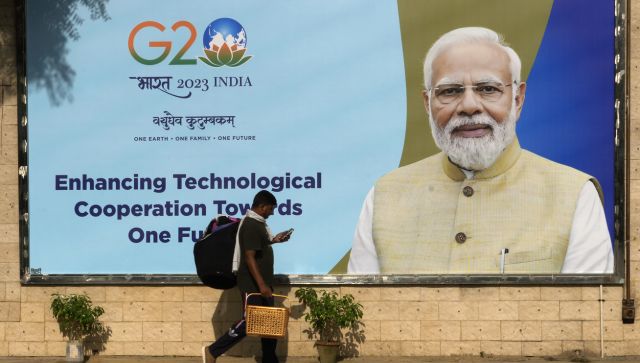
 "India vs Bharat: How attempts to change country's name in the past failed")
A heated debate has erupted in India after the Group of 20 (G20) invites for a dinner party referred to President Droupadi Murmu, as “President of Bharat.” This has triggered speculations about whether the Central government was mulling dropping ‘India’ and only keeping ‘Bharat’. While the Bharatiya Janata Party (BJP) is cheering the use of ‘Bharat’ on the invites, the Opposition INDIA bloc has denounced the move. Amid the political row that started on Tuesday (5 September), Union minister Anurag Thakur dismissed the talks of renaming the country to ‘Bharat’ as “rumours”, reported Indian Express. The row further spiralled after BJP’s Sambit Patra shared a picture of a note on the Prime Minister’s visit to Indonesia for the 20th ASEAN-India Summit and the 18th East Asia Summit showed Narendra Modi as the ‘Prime Minister of Bharat’.
‘The Prime Minister Of Bharat’ pic.twitter.com/lHozUHSoC4
— Sambit Patra (@sambitswaraj) September 5, 2023
Recently, Rashtriya Swayamsevak Sangh (RSS) chief Mohan Bhagwat advocated using Bharat instead of India. However, this is not the first time that bids for calling the country ‘Bharat’ have come to light. The matter has reached the Supreme Court at least thrice in recent years. Let’s look at what happened when attempts were made to change India’s name before. Tracing the history The Constituent Assembly adopted the draft Article 1 of the Constitution on 18 September 1949.
Article 1 mentions: “India, that is Bharat, shall be a Union of States.”
But before this Article was adopted, there were several arguments among the framers of the Constitution over the name of the country. As per Indian Express, Hari Vishnu Kamath, a member of the Forward Bloc, had moved an amendment to the first article calling for the use of a “much happier expression” that “
Bharat , or, in the English language, India, shall, be and such.” Seth Govind Das, representing the Central Provinces and Berar, suggested: “Bharat known as India also in foreign countries”. Hargovind Pant, representing the hill districts of the United Provinces, claimed that the people of Northern India “wanted Bharatvarsha and nothing else”, noted the English daily. However, all these proposals were turned down by the drafting committee formed under the chairmanship of BR Ambedkar. Besides Article 1, the Constitution, originally drafted in English, does not mention ‘Bharat’ in other provisions. Other attempts The contention over the name of the country has come up several times even after India’s Constitution was drafted. In 2004, the then Uttar Pradesh chief minister Mulayam Singh Yadav moved a resolution in the state Assembly that proposed amending the Constitution to say “Bharat, that is India,” instead of “India, that is Bharat.” This resolution was unanimously adopted after the Opposition BJP staged a walkout before it was passed, reported Indian Express. [caption id=“attachment_13084382” align=“alignnone” width=“640”] The row over the country’s name has erupted before India hosts the G20 summit in the weekend in New Delhi. PTI file Photo[/caption] According to Times of India (TOI), Yadav’s Samajwadi Party (SP) had said in its manifesto before the 2004 Lok Sabha elections that “India should become Bharat”. A retired IAS member and journalist V Sundaram propagated the use of ‘Bharat’ in place of ‘India’ in an article in 2005. Congress’ Shantaram Naik moved a bill in Rajya Sabha in 2012 on similar lines. “‘India’ denotes a territorial concept, whereas ‘Bharat’ signifies much more than the mere territories of India. When we praise our country we say, “Bharat Mata Ki Jai” and not “India ki Jai”,” he said at the time, as per Indian Express. ALSO READ:
Will India become Bharat? A look at other countries that changed their names and why What has the Supreme Court said? The Narendra Modi-led Central government rejected the need for renaming the country in 2015. In its response to the Supreme Court on a PIL that sought the name change, the Centre said that there was “no change in circumstances since the Constituent Assembly debated the issue to warrant a review,” as per the Indian Express report. The affidavit by the Ministry of Home Affairs (MHA) pointed out that the Constituent Assembly broadly discussed the issues regarding the country’s name while drafting the Constitution and clauses in Article 1 were adopted unanimously. It also noted that the term ‘Bharat’ was not a part of the original draft of the Constitution. It was during the debates that the Constituent Assembly took into consideration different names such as Bharat, Bharatbhumi, Bharatvarsh, India that is Bharat, and Bharat that is India, the newspaper report added citing the Centre’s response to the apex court at the time. The apex court then refused to entertain the plea. In 2016, the matter of India’s renaming again reached the top court. A PIL was filed by Niranjan Bhatwal from Maharashtra seeking to use ‘Bharat’ instead of ‘India’ for all purposes. The then Chief Justice of India (CJI) TS Thakur told Bhatwal that it was his choice to call the country India or Bharat, adding that no authority, state, or court had the power to tell the citizens what to call their own country. “Bharat or India? If you want to call it Bharat, go right ahead. Someone wants to call it India, let him call it India,” a bench of Chief Justice T S Thakur and Justice UU Lalit, both retired now, told the petitioner, as per news agency PTI. Dismissing the PIL, the apex court said “will not interfere”. In June 2020, a similar PIL came before CJI SA Bobde. The petitioner, a Delhi-based businessman, sought to remove ‘India’ from Article 1, arguing that there should be “uniformity” about the country’s name. “The removal of the English name though appears symbolic, will instill a sense of pride in our own nationality, especially for the future generations to come. Infact, the word India being replaced with Bharat would justify the hard fought freedom by our ancestors,” the plea argued, noted Economic Times (ET). The petitioner claimed there was a “strong wave” in favour of renaming the country to ‘Bharat’ or ‘Hindustan’. Chief Justice Bobde responded by saying: “Bharat and India are both names given in the Constitution. India is already called ‘Bharat’ in the Constitution”. Although he dismissed the petition, the then CJI recommended transforming the plea into a representation and forwarding it to the Centre, particularly the MHA, noted The Hindu. With inputs from agencies

 "Russian drones over Poland: Trump’s tepid reaction a wake-up call for Nato?")
 "As Russia pushes east, Ukraine faces mounting pressure to defend its heartland")
 "Why Mossad was not on board with Israel’s strike on Hamas in Qatar")
 "Turkey: Erdogan's police arrest opposition mayor Hasan Mutlu, dozens officials in corruption probe")
 "Russian drones over Poland: Trump’s tepid reaction a wake-up call for Nato?")
 "As Russia pushes east, Ukraine faces mounting pressure to defend its heartland")
 "Why Mossad was not on board with Israel’s strike on Hamas in Qatar")
 "Turkey: Erdogan's police arrest opposition mayor Hasan Mutlu, dozens officials in corruption probe")



