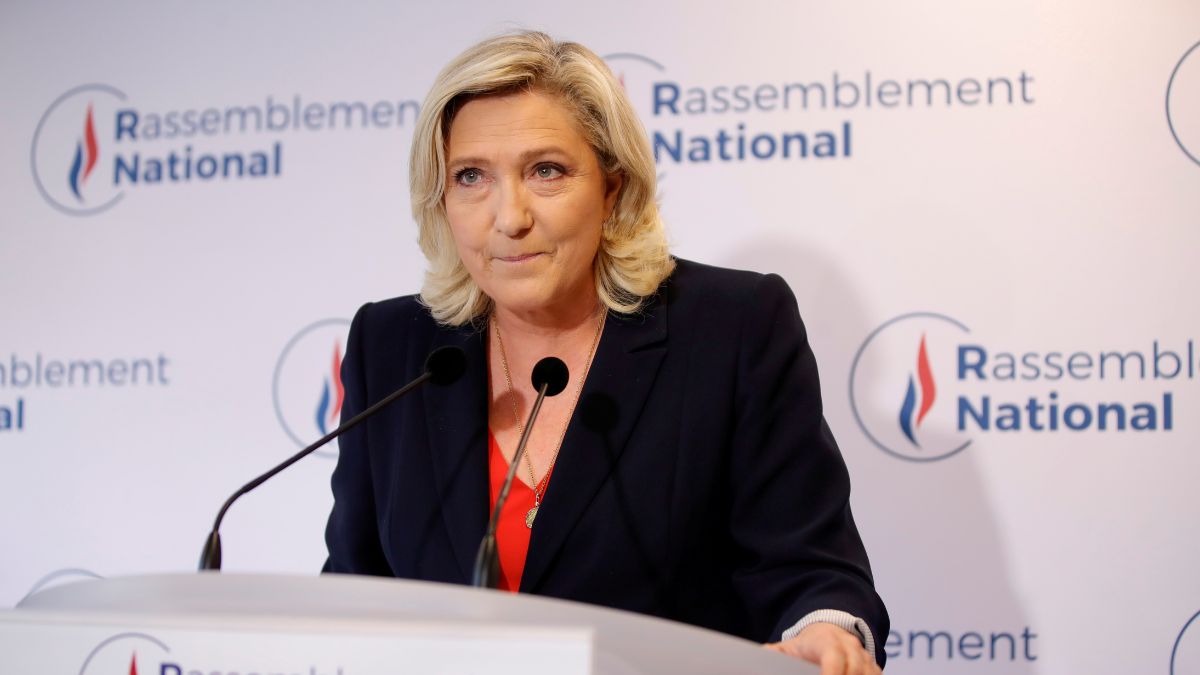
 "Marine Le Pen's National Rally party is known to be anti-immigration, anti-Islam, and pro-Putin. Reuters")
French president Emmanuel Macron called for snap elections following a significant defeat in the European Parliament elections. The far-right Rassemblement National (National Rally) party, led by Marine Le Pen, is expected to win the elections, though likely falling short of a full majority,
France faces the prospect of a political landscape shift that could see the far-right influence domestic policies more directly.
We take a deep dive into the National Rally’s stand on issues like immigration, its closeness with Russia, rising appeal among young voters, and whether they can take control of France after the snap elections.
The inception and evolution of National Rally
The National Rally (RN) was founded in 1972 as the National Front (Front National, FN) by Jean-Marie Le Pen. The party emerged from the fringes of French politics, advocating a blend of nationalist, anti-immigration, and anti-establishment positions. Under Jean-Marie Le Pen, the party was known for its xenophobic and often openly racist rhetoric, which included Holocaust denial and vehement opposition to immigration.
Marine Le Pen, Jean-Marie’s daughter, took over the party leadership in 2011 and initiated a process of “de-demonisation” to do away with the party’s fascist image and broaden its appeal. She rebranded the FN as the National Rally in 2018, distancing the party from its extremist roots and attempting to present it as a legitimate alternative to the mainstream political establishment.
Under her leadership, the RN has maintained its nationalist and anti-immigration stance but has softened its rhetoric, focusing more on populist themes such as economic protectionism and national sovereignty.
Impact Shorts
More ShortsAnti-immigration policies
The National Rally continues to hold stringent views on immigration. Marine Le Pen has called for the abolition of birthright citizenship and stricter policies to combat illegal immigration.
The party advocates for a significant reduction in immigration, tighter border controls, and the prioritization of French nationals in employment and social services, according to a 2024 research paper titled “Populism on the verge of power: the goal‑oriented mainstreaming of the French Rassemblement National”.
Despite efforts to rebrand, the RN’s policies on immigration still reflect a nationalist and exclusionary stance. The party’s platform includes proposals for “national preference” in jobs and housing, and the suspension of legal immigration from non-European countries. While the RN has toned down the overtly xenophobic language of the past, its core ideology remains centered on preserving French identity and culture against perceived threats from immigration.
Ties with Putin and Kremlin
The National Rally has well-documented connections with the Kremlin. In 2013, the party received a loan of 9.4 million euros from a Russian bank, a move that has drawn scrutiny and criticism from political opponents and observers. Marine Le Pen has consistently expressed admiration for Russian President Vladimir Putin, praising his nationalist rhetoric and strongman approach to governance.
A parliamentary inquiry in 2023 revealed that the RN had acted as a communication channel for Russian interests, particularly in supporting Moscow’s annexation of Crimea. “I absolutely don’t believe that there was an illegal annexation of Crimea. There was a referendum, the inhabitants wished to rejoin Russia,” she told BFMTV in 2017.
Le Pen’s alignment with Russian positions has raised concerns about the party’s foreign policy orientation and its potential impact on France’s relations with the European Union (EU) and the North-Atlantic Treaty Organisation (NATO).
EU-sceptic party
The National Rally used to be anti-EU. However, following the Brexit debacle, it no longer wants to quit the EU. Still, it does want French exceptions to the laws of the bloc. It no longer wants to quit the Schengen free travel area yet wants a “dual border” for France and the EU involving systematic checks.
Progressive ideals and movements
Despite its far-right orientation, National Rally has made overtures towards some progressive ideals, particularly in the realms of environmentalism and feminism. The party has incorporated environmental conservation into its platform, framing it as part of a broader commitment to protect the French homeland. This approach has helped the RN appeal to a segment of environmentally conscious voters who may not traditionally align with far-right politics.
Marine Le Pen has also sought to position herself as an advocate for women’s rights, merging it with the anti-Islam rhetoric of the party. She has often criticised the patriarchal elements of Islam and has spoken of promoting gender equality within a nationalist framework.
A 2022 poll indicated that a significant portion of the French population viewed Le Pen as more feminist than Macron.
Attracting the young voter base
The National Rally’s voter base has traditionally comprised working-class individuals, small business owners, and rural populations who feel disenfranchised by the mainstream political establishment. However, under Marine Le Pen and her protege, the party’s young rising star Jordan Bardella, the party has broadened its appeal to include younger voters, highly educated people, and high-income professionals.
Bardella, who is expected to be the party’s candidate for Prime Minister in the upcoming elections, has played a crucial role in modernising the party’s image and expanding its reach. He has attracted younger, urban voters who are disillusioned with the traditional parties and are drawn to the National Rally’s populist message, according to The Guardian. This shift has been instrumental in the party’s recent electoral successes and its growing influence in French politics.
Past electoral record
The National Rally has made significant electoral gains in recent years. In the 2012 presidential election, Marine Le Pen garnered 17.9 per cent of the vote, a historic high for the party. She advanced to the second round in both the 2017 and 2022 presidential elections, securing 33 per cent and over 40 per cent of the vote, respectively. The results were seen to reflect the party’s growing appeal and the increasing polarisation of French politics.
National Rally’s chance of taking control of France
If the National Rally wins the upcoming legislative elections, to be held on June 30 and July 7, it wouldn’t lead to the ouster of President Macron from office. However, he would need to appoint a new prime minister, possibly, from the National Rally.
Bardella, who will be the party’s candidate for prime minister, according to comments given by RN deputy chairman Sebastien Chenu to RTL Radio, is likely to get the post.
In such a scenario, France would enter a period of cohabitation, where the president and the prime minister come from opposing parties. Macron would end up retaining control over foreign policy and defence, while the National Rally would influence domestic policy through the new prime minister, according to Al Jazeera. Cohabitation could lead to significant policy clashes, particularly on issues like immigration, economic regulation, and relations with the European Union.
With inputs from agencies