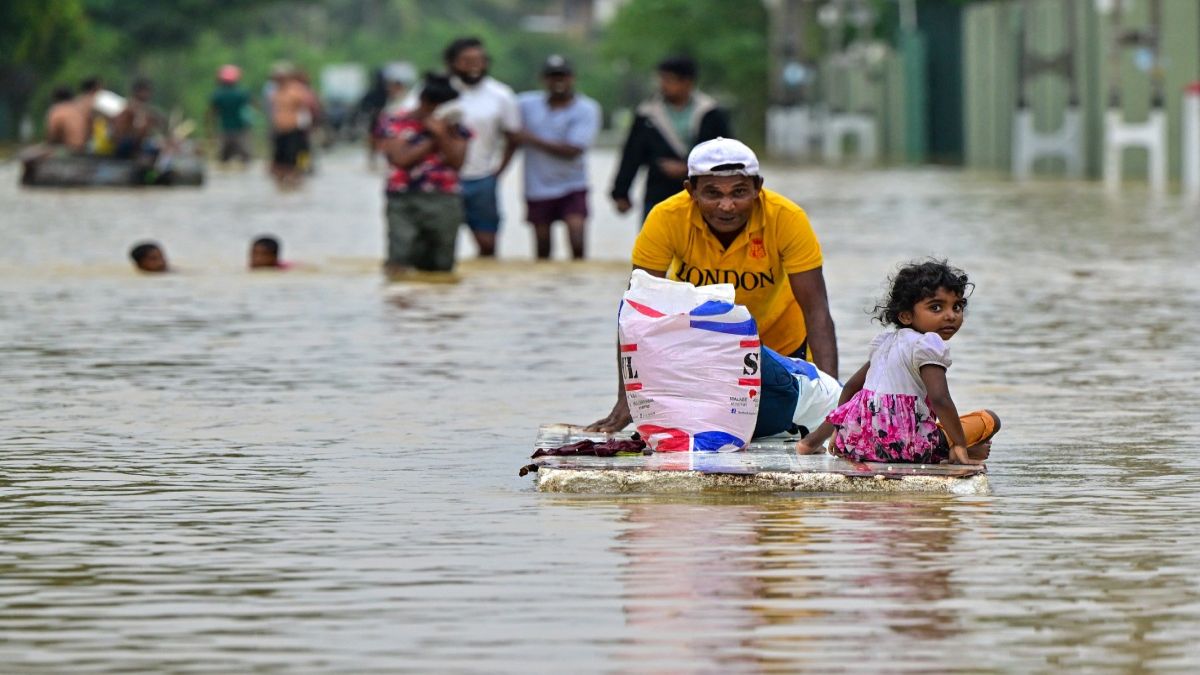
 "A man pushes a makeshift raft along a flooded street after heavy rainfall in Ambatale on the outskirts of Colombo. Sri Lanka has made an appeal for international assistance as the death toll from heavy rains and floods triggered by Cyclone Ditwah have risen substantially. AFP")
Indonesia, Sri Lanka, Thailand, Vietnam and Malaysia… What do these countries have in common? Currently, these five nations are struggling to keep afloat, quite literally, as a band of cyclones and extreme monsoonal weather has hit them.
At last count, the death toll has risen to over 1,000 with authorities racing against time to clear debris and find hundreds of missing people. Such is the severity of the situation that Sri Lanka has declared an emergency with the other countries calling in their military to help victims of devastating flooding.
As these nations grapple with the extreme weather and the devastation, we get you the latest from the ground.
How did the flooding begin in these countries?
Meteorologists say the current weather extremes in Southeast Asia could stem from the interaction of two active systems: Typhoon Koto in the Philippines and Cyclone Senyar forming in the Malacca Strait. As per the Indonesian meteorology agency, the formation of Senyar in the Strait of Malacca was “rare”.
“Indonesia’s location near the equator theoretically makes it less prone to the formation or passage of tropical cyclones,” the agency’s Andri Ramdhani said. However, in the past five years, several tropical cyclones have moved towards Indonesia and had significant impacts, Ramdhani added.
In Sri Lanka, Cyclone Ditwah triggered mud slides and flooding, causing unprecedented devastation with President Anura Dissanayake saying, “We are facing the largest and most challenging natural disaster in our history.”
Is climate change to blame for the situation?
Many weather experts note that while it’s not definitive is climate change made these storms worse, there’s increasing amount of data that points to the same. They note that as the world’s oceans and warm at an accelerating rate due to the rise in greenhouse gases from burning fossil fuels, tropical cyclones are expected to become more intense. This is because cyclones get their energy from warm oceans. The warmer the ocean, the more fuel for the storm.
The warming atmosphere is supercharging the global water cycle, and peak rainfall rates are increasing. When more rain falls in a short time, flash flooding becomes more likely.
What’s the latest from the flood-affected countries?
But just how much death and devastation has the floods brought to Southeast Asia? What are the governments doing to cope with the destruction caused by the extreme weather situation?
According to officials, the death toll from the devastating floods across the Asian nations has surpassed 1,000, with authorities adding that it will only climb further. Official data already reveals that over four million people have been impacted by the floods, with nearly three million in southern Thailand and 1.1 million in western Indonesia.
In Indonesia
The death toll in Indonesia has reached 442 with hundreds more missing. Nearly 300,000 people have been displaced and nearly 3,000 houses damaged, including 827 that were flattened or swept away. . The toll is the deadliest in a natural disaster in Indonesia since a massive 2018 earthquake and subsequent tsunami killed more than 2,000 people in Sulawesi.
Visuals circulating on social media show just how devastating the floods have been. Maulidin, a 41-year-old resident of North Aceh, fled her home with her family when she woke to the sound of flooding. “My house is already destroyed, all my belongings are ruined, and mud is inside,” she told AFP.
Rescuers are struggling to reach stranded residents with local media footage showing people using rubber boats to evacuate those trapped.
In Sumatra, the situation has resulted in some residents resorting to stealing food and water in order to survive. Videos on social media showed people running past barricades, flooded roads and broken glass to get their hands on food, medicine and gas. Some were seen wading through waist-deep floodwaters to reach the convenience stores.
On Monday, Indonesia’s President Prabowo Subianto said of the situation, “The worst has passed, hopefully.” The government’s “priority now is how to immediately send the necessary aid”, with particular focus on several isolated villages, he added.
Prabowo has come under increasing pressure to declare a national emergency in response to flooding and landslides. But he is yet to do so.
In Thailand
As of Sunday, the death toll in Thailand had risen to 170 as a result of the worst flooding in a decade. Songkhla Province had the highest number of fatalities at 131. Hat Yai, the largest city in Songkhla, received 372 millimetre of rain on November 21, its highest single-day tally in 300 years, amid days of heavy downpours.
Amphorn Kaeophengkro, a resident of Hat Yai, told Reuters that for many like her, they had no time to escape. She and her family of eight spent a whopping 48 hours perched atop a table, washing machine and on a window frame. “We weren’t thinking about anything else except surviving,” the 44-year-old told Reuters, as her family began to clean their dwelling after the water had receded.
“Sometimes we sat at the edge of the window and had to lift our legs to avoid keeping them too deep in the water.”
As the waters, recede, authorities have been working to deliver aid and clear the damage. The Thai military deployed its aircraft carrier, HTMS Chakri Naurbet, along with drones, helicopters, and convoys of trucks to deliver food, medicine, and dinghies to survivors, many of whom have been trapped for days on rooftops. The government has also issued a public appeal for boats and jet skis to help aid survivors.
However, there’s a growing anger over the flood response, with two local officials even been suspended over their alleged failures.
In Malaysia and Vietnam
Across the border, in Malaysia, the toll from the flooding is lesser — two people have died — but the devastation from Cyclone Senyar is severe. Widespread flooding has swamped large parts of northern Perlis, forcing tens of thousands into temporary shelters.
Vietnam, too, is struggling as a result of tropical storm Koto. Heavy rains have lashed the country’s middle belt in recent weeks, flooding historic sites and popular holiday destinations and causing hundreds of millions of dollars in damage.
As of now, two vessels have sank in the rough seas, a fishing boat in Khanh Hoa province and a smaller raft in Lam Dong, according to the environment ministry. It said a total of three people were killed and authorities were still searching for a fourth.
In Sri Lanka
India’s neighbour, Sri Lanka, has announced a state of emergency after floods and landslides were triggered by Cyclone Ditwah. The country’s disaster agency said on Sunday that a whopping 334 people have died with nearly 400 still missing.
Cyclone Ditwah is the worst natural disaster to hit the country in two decades, with officials saying the extent of damage in the worst-affected central region was only just being revealed as relief workers cleared roads blocked by fallen trees and mudslides.
Selvi, a 46-year-old resident of Colombo’s Wennawatte suburb, fled her home with four bags of clothes and other possessions. “My house is completely flooded. I don’t know where to go, but I hope there is some safe shelter where I can take my family,” she told AFP.
Such is the situation in Sri Lanka that Colombo has called for international aid and is using military helicopters to reach people stranded by flooding and landslides. In Ma Oya, just north of the capital, Hasitha Wijewardena said he was struggling to clean up after the floods.
“The water has gone down, but the house is now full of mud,” he told local reporters, appealing for military help to clean up.
India has already responded to Sri Lanka’s aid request, sending planeloads of relief supplies, while an Indian warship already in Colombo on a previously planned goodwill visit donated its rations to help victims.
Prime Minister Narendra Modi expressed his condolences over the deaths in Sri Lanka and said New Delhi was ready to send more aid. “We stand ready to provide more aid and assistance as the situation evolves,” Modi said on X.
While the waters have now receded from these areas, it will take a long, long time for these countries to rebuild.
With inputs from agencies