Firstpost
  • Video Shows
    Vantage Firstpost America Firstpost Africa First Sports
  • World
    US News
  • Explainers
  • News
    India Opinion Cricket Tech Entertainment Sports Health Photostories
  • Lifestyle
  • India-EU Summit
Trending Donald Trump Narendra Modi Elon Musk United States Joe Biden

Sections

  • Home
  • Live TV
  • Videos
  • Shows
  • World
  • Entertainment
  • India
  • Explainers
  • Opinion
  • Sports
  • Cricket
  • Lifestyle
  • Health
  • Tech/Auto
  • Web Stories
  • Business
  • Impact Shorts

Shows

  • Vantage
  • Firstpost America
  • Firstpost Africa
  • First Sports
  • Fast and Factual
  • Between The Lines
  • Flashback
  • Live TV

Events

  • Putin in India
  • Bihar Election
  • Raisina Dialogue
  • Independence Day
  • Champions Trophy
  • Delhi Elections 2025
  • Budget 2025
  • Firstpost Defence Summit
Trending:
  • Minneapolis Shooting
  • Republic Day 2026
  • Carney-Macron-Davos
  • Operation Sindoor
  • Scotland accepts ICC invite
  • Border 2 review
fp-logo
First glimpse of Sun’s south pole captured: Why this is a big deal
Whatsapp Facebook Twitter
Trending

Sections

  • Home
  • Live TV
  • Videos
  • Shows
  • World
  • Entertainment
  • India
  • Explainers
  • Opinion
  • Sports
  • Cricket
  • Lifestyle
  • Health
  • Tech/Auto
  • Web Stories
  • Business
  • Impact Shorts

Shows

  • Vantage
  • Firstpost America
  • Firstpost Africa
  • First Sports
  • Fast and Factual
  • Between The Lines
  • Flashback
  • Live TV

Events

  • Putin in India
  • Bihar Election
  • Raisina Dialogue
  • Independence Day
  • Champions Trophy
  • Delhi Elections 2025
  • Budget 2025
  • Firstpost Defence Summit

First glimpse of Sun’s south pole captured: Why this is a big deal

FP Explainers • June 12, 2025, 14:56:50 IST
Whatsapp Facebook Twitter

On Wednesday, the European Space Agency (ESA) released images captured by three instruments on board the Solar Orbiter. Taken from a distance of around 40 million miles (roughly 65 million kilometres), the photos reveal a detailed view of the Sun’s south pole. Notably, Solar Orbiter is a joint mission between ESA and Nasa. According to Prof Carole Mundell, ESA’s Director of Science, these are the closest and most detailed images of the Sun ever recorded. Scientists hope the visuals will deepen our understanding of how the Sun works

Advertisement
Subscribe Join Us
+ Follow us On Google
Choose
Firstpost on Google
First glimpse of Sun’s south pole captured: Why this is a big deal
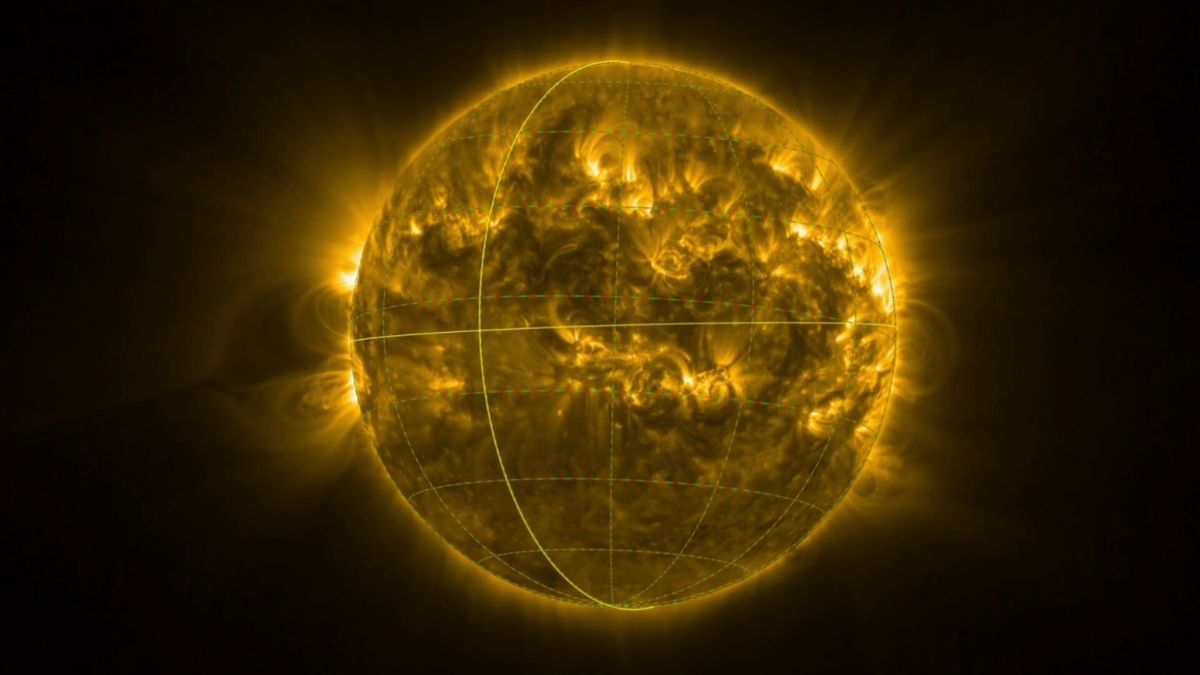
These latest pictures could help experts understand how the Sun shifts between calm phases and violent solar storms. Image: ESA

For the first time ever, scientists have managed to capture clear images of the Sun’s north and south poles.

On Wednesday, the European Space Agency (ESA) shared photos taken in March by three instruments aboard the Solar Orbiter. These images show the Sun’s south pole from a distance of about 40 million miles (around 65 million kilometres).

Notably, Solar Orbiter was launched in 2020 from Florida. It is a joint mission between ESA and the American space agency, Nasa.

STORY CONTINUES BELOW THIS AD

ALSO READ | 2 delays in 2 days: What’s happening with Shubhanshu Shukla’s Axiom-4 mission?

These latest pictures could help experts understand how the Sun shifts between calm phases and violent solar storms.

More from Explainers
How 2 European satellites created the first artificial solar eclipse How 2 European satellites created the first artificial solar eclipse 2 delays in 2 days: What’s happening with Shubhanshu Shukla’s Axiom-4 mission? 2 delays in 2 days: What’s happening with Shubhanshu Shukla’s Axiom-4 mission?

But why does this matter? What do the images actually reveal? And how will they support future research?

We will answer these questions in the explainer.

First-ever images of Sun’s poles revealed

Until now, all views of the Sun have come from a single angle, looking straight at its equator from the same plane where Earth and most other planets orbit, known as the ecliptic plane.

But in February, Solar Orbiter performed a slingshot manoeuvre around Venus, helping it move out of that plane and view the Sun from around 17 degrees below the solar equator. More such flybys are planned in future, which could allow views from more than 30 degrees.

Quick Reads

View All
How your takeaway coffee is leaking microplastics into your body

How your takeaway coffee is leaking microplastics into your body

Explained: From princes to President, the tradition of 21-gun salute at R-Day parade

Explained: From princes to President, the tradition of 21-gun salute at R-Day parade

On Wednesday, the European Space Agency released images taken in March using three instruments onboard the Solar Orbiter.

These images show the Sun’s south pole from a distance of around 40 million miles (65 million kilometres), captured during a period of peak solar activity. Images of the north pole are still being sent back by the spacecraft.

STORY CONTINUES BELOW THIS AD

Prof Carole Mundell, Director of Science at ESA, said, “Today we reveal humankind’s first-ever views of the Sun’s pole.

The Sun is our nearest star, giver of life and potential disruptor of modern space and ground power systems, so it is imperative that we understand how it works and learn to predict its behaviour. These new unique views from our Solar Orbiter mission are the beginning of a new era of solar science.”

According to Prof. Mundell, these are the closest and most detailed images ever taken of the Sun, and they will help researchers better understand how our star functions.

Eight views of the sun’s south pole released by the Solar Orbiter spacecraft. Image: ESA

ALSO READ | Soviet-era spacecraft likely to crash back to Earth this week: Should you be worried?

Explained: Why these images matter

The Sun is huge, about 865,000 miles (1.4 million kilometres) across, making it over 100 times wider than Earth.

Hamish Reid, a solar physicist at University College London’s Mullard Space Science Laboratory and UK co-lead for the Solar Orbiter’s Extreme Ultraviolet Imager, told Reuters that while Earth has clear north and south poles, the Solar Orbiter has detected both polarities of magnetic fields currently present at the Sun’s south pole.

STORY CONTINUES BELOW THIS AD

“The data that Solar Orbiter obtains during the coming years will help modellers in predicting the solar cycle. This is important for us on Earth because the sun’s activity causes solar flares and coronal mass ejections, which can result in radio communication blackouts, destabilise our power grids, but also drive the sensational auroras,” he said.

Lucie Green from University College London, who was involved in developing the Solar Orbiter, told New Scientist that studying magnetic fields at the Sun’s south pole could improve our understanding of the solar cycle. This cycle tends to rise and fall in intensity roughly every 11 years.

🌞 See the Sun from a whole new angle.

For the first time, our Solar Orbiter mission has captured close-up images of the Sun’s mysterious poles, regions long hidden from our view.

In 2025, Solar Orbiter gave us a first-ever look at the Sun’s south pole.

Remarkably, it… pic.twitter.com/EhyYxtDyaR

— European Space Agency (@esa) June 11, 2025
STORY CONTINUES BELOW THIS AD

Notably, scientists already know that the Sun enters a calm phase when its magnetic fields are well organised, with set north and south poles.

During this time, the Sun is less likely to erupt violently. But as the poles switch places every 11 years, the magnetic fields become more tangled and unstable.

This turbulent phase causes the Sun to try and settle the disorder, leading to solar storms, with fragments of the Sun being flung towards Earth. These storms can interfere with satellites and electricity grids, though they also trigger stunning auroras in the sky.

The Solar Orbiter has also captured some images of the Sun’s north pole, but ESA is still waiting for the data to be sent back to Earth.


STORY CONTINUES BELOW THIS AD
Follow Firstpost on Google. Get insightful explainers, sharp opinions, and in-depth latest news on everything from geopolitics and diplomacy to World News. Stay informed with the latest perspectives only on Firstpost.
Tags
Space and Astronomy
  • Home
  • Explainers
  • First glimpse of Sun’s south pole captured: Why this is a big deal
End of Article
Latest News
Find us on YouTube
Subscribe
  • Home
  • Explainers
  • First glimpse of Sun’s south pole captured: Why this is a big deal
End of Article

Quick Reads

How your takeaway coffee is leaking microplastics into your body

How your takeaway coffee is leaking microplastics into your body

A study found takeaway coffee cups can release thousands to millions of microplastic particles into drinks, especially when hot beverages are used. Paper cups with plastic linings shed fewer microplastics than fully plastic cups, but both release more particles at higher temperatures. Switching to reusable cups made of stainless steel, ceramic, or glass is recommended to reduce microplastic exposure from hot drinks.

More Quick Reads

Top Stories

'Indian food, our pride': $200k settlement in Palak Paneer case a moral victory against racism in the west

'Indian food, our pride': $200k settlement in Palak Paneer case a moral victory against racism in the west

India’s air dominance in Operation Sindoor forced Pakistan to seek ceasefire, European report says

India’s air dominance in Operation Sindoor forced Pakistan to seek ceasefire, European report says

How Pakistan’s support may have led Bangladesh towards a very costly mistake

How Pakistan’s support may have led Bangladesh towards a very costly mistake

India vs New Zealand Live Score 3rd T20: Abhishek slams second fastest 50 by an Indian in T20Is

India vs New Zealand Live Score 3rd T20: Abhishek slams second fastest 50 by an Indian in T20Is

'Indian food, our pride': $200k settlement in Palak Paneer case a moral victory against racism in the west

'Indian food, our pride': $200k settlement in Palak Paneer case a moral victory against racism in the west

India’s air dominance in Operation Sindoor forced Pakistan to seek ceasefire, European report says

India’s air dominance in Operation Sindoor forced Pakistan to seek ceasefire, European report says

How Pakistan’s support may have led Bangladesh towards a very costly mistake

How Pakistan’s support may have led Bangladesh towards a very costly mistake

India vs New Zealand Live Score 3rd T20: Abhishek slams second fastest 50 by an Indian in T20Is

India vs New Zealand Live Score 3rd T20: Abhishek slams second fastest 50 by an Indian in T20Is

Top Shows

Vantage Firstpost America Firstpost Africa First Sports
Enjoying the news?

Get the latest stories delivered straight to your inbox.

Subscribe
Latest News About Firstpost
Most Searched Categories
  • Web Stories
  • World
  • India
  • Explainers
  • Opinion
  • Sports
  • Cricket
  • Tech/Auto
  • Entertainment
  • Photostories
  • Lifestyle
NETWORK18 SITES
  • News18
  • Money Control
  • CNBC TV18
  • Forbes India
  • Advertise with us
  • Sitemap
Firstpost Logo

is on YouTube

Subscribe Now

Copyright @ 2024. Firstpost - All Rights Reserved

About Us Contact Us Privacy Policy Cookie Policy Terms Of Use
Home Video Quick Reads Shorts Live TV