 "F-47: The ‘most devastating plane’ that Trump spoke of at Davos")
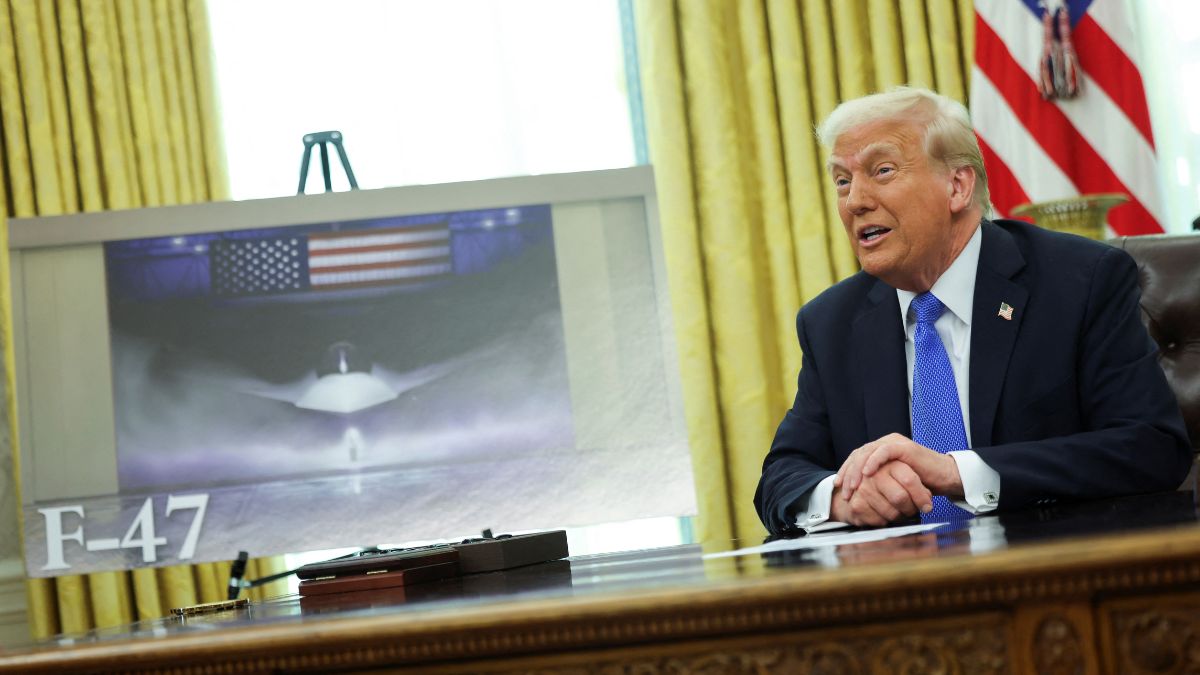
United States President Donald Trump’s speech at the World Economic Forum (WEF) in Davos, Switzerland, on Wednesday (January 21) was much anticipated. Besides his push for acquiring Greenland, he also mentioned the US Air Force’s most advanced fighter jet — the F-47.
Describing it as the “most devastating plane”, Trump wondered why the aircraft had been dubbed 47. “They say it’s [the F-47] the most devastating plane, fighter jet ever. They called it 47. If I don’t like it, I’m going to take the 47 off it. I wonder why they called it 47? What to think about. But if I don’t like it, I’m going to take that 47 off," he said.
The US president used the example of the F-47 to highlight the American military having the “best equipment”.
Here’s what we know about the US’ most advanced fighter jet.
Features of F-47
The US military has kept the design of the F-47 under wraps. However, reports say the “sixth-generation” aircraft boasts stealth capabilities to reduce its visibility to radar.
The stealth combat jet has canard foreplanes, which offer improved manoeuvrability and stability, including at high angles of attack, especially for delta-wing aircraft, reported TWZ.
The aircraft may also feature a broad, shovel-like nose, which could house a very large radar array and a large bubble canopy.
The F-47 will reportedly have a speed of Mach 2+, more than twice the speed of sound. The fighter jet is likely to have a combat radius of over 1,000 nautical miles.
It could integrate seamlessly with a new generation of unmanned Collaborative Combat Aircraft (CCAs) — drone wingmen designed to extend sensors, carry weapons, and absorb risks, as per Aerospace Global News.
Quick Reads
View AllThe aircraft, which is likely to be designed for long-range combat, includes highly advanced sensors and engines. It resembles Boeing’s X-45 combat drone and Bird of Prey, a single-seat stealth demonstrator.
Part of the US Air Force’s Next Generation Air Dominance (NGAD) initiative, it is expected to boast new jet engines, weapons, electronic warfare suites, sensors, networking ecosystems, battle management capabilities, and much more.
The US president has described the high-speed stealth aircraft as the “most lethal aircraft ever built”.
What’s in a name?
Last March, Trump had said that the US military had selected the number 47, which he described as a “beautiful number”, for the aircraft. He is the 45th and 47th President of the US.
“The generals picked that title,” he said.
But the name is more than just a nod to Trump. The F-47’s name has roots in an iconic World War II fighter plane: the P-47, nicknamed “Thunderbolt”.
Also, the number pays tribute to the founding year of our incredible @usairforce, while also recognizing the 47th @POTUS’s pivotal support for the development of the world’s FIRST sixth-generation fighter (2/2). https://t.co/wjBynCSejr
— General Ken Wilsbach (@OfficialCSAF) March 21, 2025
The aircraft was in service for years in the US and globally, with its “P” for “Pursuit” prefix later phased out and replaced with F-47.
The “47” also refers to 1947, the year the US Air Force was established as an independent service. It was previously a part of the US Army.
When is F-47’s first flight?
Boeing is building the US Air Force’s most advanced fighter jet. In March, Trump said he was “thrilled to announce” he had awarded the multi-billion dollar contract for the fighter jet to Boeing.
Describing the aircraft as “the world’s first sixth-generation fighter jet,” he said he could not share the per-tail cost because it would reveal “some of the technology and some of the size of the plane.”
“America’s enemies will never see it coming,” he said at the time.
The F-47 is in the production stage, with the US eyeing to procure at least 185 jets.
The US Air Force confirmed last year that the initial prototype is being built and the first flight is targeted for 2028.
It also admitted delays to a separate Next Generation Adaptive Propulsion programme, which is developing advanced jet engines that could power the F-47 and other aircraft in the future.
With inputs from agencies


 "Trump officially launches ‘Board of Peace in Davos with 19 founding members")
 "The irony of being Pakistan: To pay $1 bn for Trump’s ‘Board of Peace’ seat while seeking $2.2 bn UAE aid")
 "What is the sonic weapon that Trump admitted to using in Maduro raid in Venezuela?")
 "J&K: 10 soldiers killed, 10 injured after Army vehicle falls into gorge in Bhaderwah area")
 "Trump officially launches ‘Board of Peace in Davos with 19 founding members")
 "The irony of being Pakistan: To pay $1 bn for Trump’s ‘Board of Peace’ seat while seeking $2.2 bn UAE aid")
 "What is the sonic weapon that Trump admitted to using in Maduro raid in Venezuela?")
 "J&K: 10 soldiers killed, 10 injured after Army vehicle falls into gorge in Bhaderwah area")