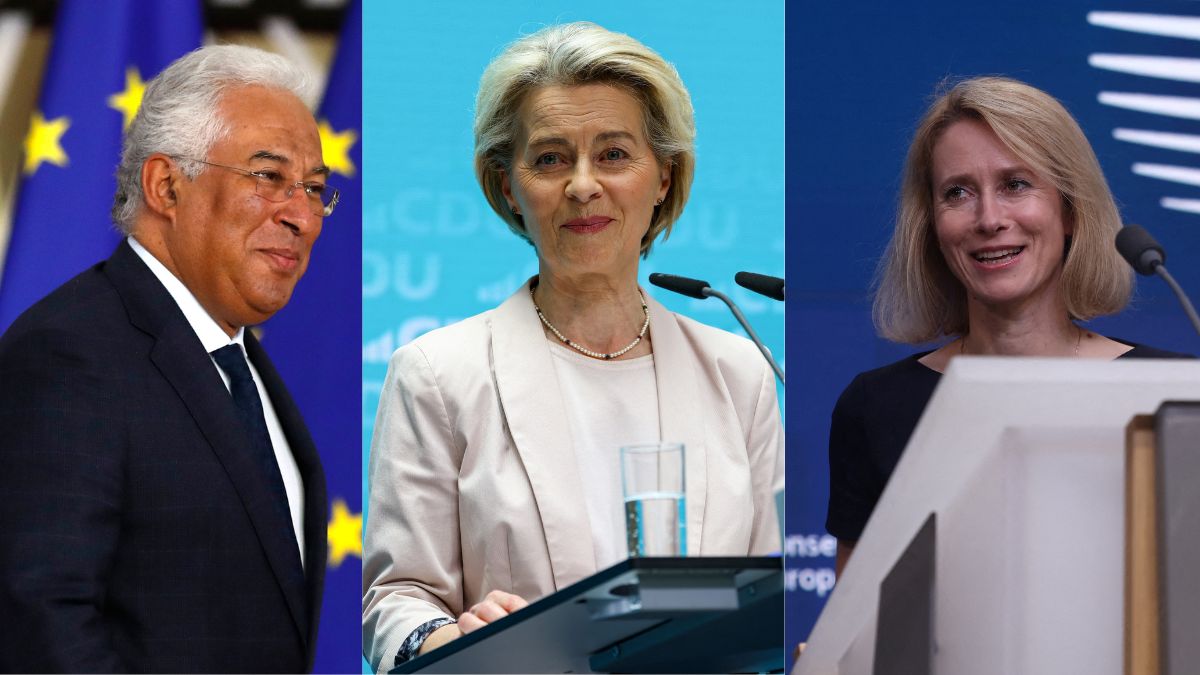
 "EU leaders have chosen Germany’s Ursula von der Leyen (centre) for a second term as European Commission president, while Portugal’s António Costa (left) and Estonia’s Kaja Kallas (right) have been nominated for the most senior positions at the European Council and the EU’s foreign policy service, respectively. Reuters,AP")
Following the recent EU Parliament elections, European Union leaders have agreed on the officials who will hold the key positions in the world’s biggest trading bloc in the coming years. This decision encompasses issues ranging from antitrust investigations to foreign policy.
The nominees include Ursula von der Leyen for the European Commission, António Costa for the European Council, and Kaja Kallas as the High Representative for Foreign Affairs and Security Policy.
We take a brief look at their profiles and what their roles will include:
Ursula von der Leyen
Ursula von der Leyen, a 65-year-old German politician, has been endorsed for a second term as president of the European Commission. Her endorsement was bolstered by the centre-right European People’s Party’s success in the EU Parliament elections.
Von der Leyen has been praised for her leadership during the COVID-19 crisis, particularly for the collective procurement of vaccines for EU citizens. However, she has faced criticism for the opaque negotiations with vaccine manufacturers.
Von der Leyen has also championed the EU’s Green Deal, aiming for climate neutrality by 2050. However, her commitment to these policies has been questioned, especially as the EU seemed cautious about antagonising farmers concerned that environmental and climate laws could drive them to bankruptcy.
Role and responsibilities of the European Commission President
Under the EU treaties, the president of the European Commission sets the policy agenda for the EU’s executive arm, represents the commission in European Council meetings, and participates in G7 and G20 summits.
The European Commission also leads trade negotiations and polices competition. Von der Leyen’s second term now requires approval from European lawmakers in a vote likely to take place in July. In 2019, she won a narrow majority with 383 votes in favour, 327 against, and 22 abstentions, becoming the first woman to head the institution.
“I would plain and simply like to express my gratitude to the leaders who endorsed my nomination for a second mandate. I am very honoured,” von der Leyen said following her nomination.
António Costa: European Council President
António Costa, the former prime minister of Portugal, has been chosen to replace Charles Michel as Council president. The 62-year-old socialist’s appointment is for a renewable 2 1/2 year term. Costa’s nomination was supported by the Socialists’ second-place finish in the EU elections.
However, his appointment was controversial due to his government’s involvement in a widespread corruption investigation that forced him to resign as prime minister last year. Costa denies any wrongdoing and has not been charged with a crime, reported AP.
The European Council president is responsible for chairing summits and finding consensus within the European Council, which brings together the EU member states.
Costa will also represent the EU at international summits alongside von der Leyen. Known as a skilled political negotiator, he will play a crucial role in maintaining unity among the 27 member states.
“It is with a strong sense of mission that I will take up the responsibility of being the next President of the European Council. I will be fully committed to promoting unity between all 27 member states and focused on putting on track the Strategic Agenda,” Costa stated, expressing his gratitude to his socialist family and the Portuguese government for their support.
Kaja Kallas: High Representative for Foreign Affairs and Security Policy
Kaja Kallas, the 47-year-old prime minister of Estonia, has been nominated as the EU’s top diplomat, making her the highest-ranking Estonian in EU history. She will be replacing Spaniard Josep Borrell who has been in the position since December 2019.
Kallas is a staunch supporter of Ukraine and a vocal critic of Russia within the EU and NATO. Her nomination comes despite the liberal group’s fourth-place finish in the European elections.
If confirmed by the European Parliament, she will also become Vice-President of the EU Commission.
As the High Representative for Foreign Affairs and Security Policy, Kallas will be responsible for representing the EU’s common foreign and security policy to the world. She will need confirmation from the EU Parliament before officially taking on the role. Kallas has been a significant advocate for NATO providing a comprehensive defence plan for the Baltic states bordering Russia.
“This is an enormous responsibility at this moment of geopolitical tensions,” Kallas said in a statement. “I will be at the service of our common interests. Europe should be a place where people are free, safe, and prosperous.”
What have EU leaders said?
EU leaders agreed on the nominations during a summit in Brussels, despite resistance from Italian Prime Minister Giorgia Meloni and Hungarian Prime Minister Viktor Orbán. Meloni abstained on von der Leyen’s vote, opposed Costa and Kallas, and expressed her dissatisfaction with the selection process. Orbán voted against von der Leyen, abstained on Kallas, and supported Costa.
“It seems to me that, so far, there’s been an unwillingness to account for the message delivered by citizens at the ballot box,” Meloni said before the summit. Orbán called the deal “shameful.”
In contrast, German Chancellor Olaf Scholz stated the need for Europe to prepare for future challenges, citing Russia’s aggression against Ukraine as a significant concern. “We are living in difficult times. We are faced with major challenges, not least Russia’s terrible war of aggression against Ukraine. It is therefore important that Europe prepares itself now for the tasks that need to be tackled,” Scholz said.
Belgium’s Alexander De Croo rebuked Meloni’s criticism, stating, “Democracy is not only about blocking, democracy is about who wants to work together, and those three groups are willing to work together to the benefit of all Europeans. What we need in the next five years is political stability and being able to act fast.”
Von der Leyen also addressed Meloni’s abstention, saying, “It is important to work well with Italy, like with all other member states. This is a principle for me which I follow all the time.”
What is the selection process?
The selection of the top EU jobs involves a comprehensive and strategic bargaining process. EU leaders convened to discuss and negotiate the appointments, taking into account the results of the European Parliament elections and the need to strike a geographical and political balance.
The process began with an informal meeting on June 17, followed by a summit in Brussels on June 28-29. Leaders needed to achieve a qualified majority backing for the candidates, meaning 15 of the 27 EU leaders, representing 65 per cent of the EU’s population. The European Commission president also requires majority support in the European Parliament.
Traditionally, the Commission presidency goes to the party that won the most seats in the Parliament election, securing von der Leyen’s position as she was the candidate of the centre-right European People’s Party.
The Council presidency was expected to go to the Socialists, who came second, and the foreign policy post to the liberal Renew Europe camp, which came third. This balance ensures representation from different political and geographical backgrounds within the EU.
Also Read | European Parliament at the crossroads: A swing to the Right
Von der Leyen and Kallas’s nominations require confirmation by the European Parliament, while Costa’s appointment is automatically elected by his peers. The new Parliament will convene on July 16, with the Commission president’s vote potentially occurring that week.
With inputs from agencies