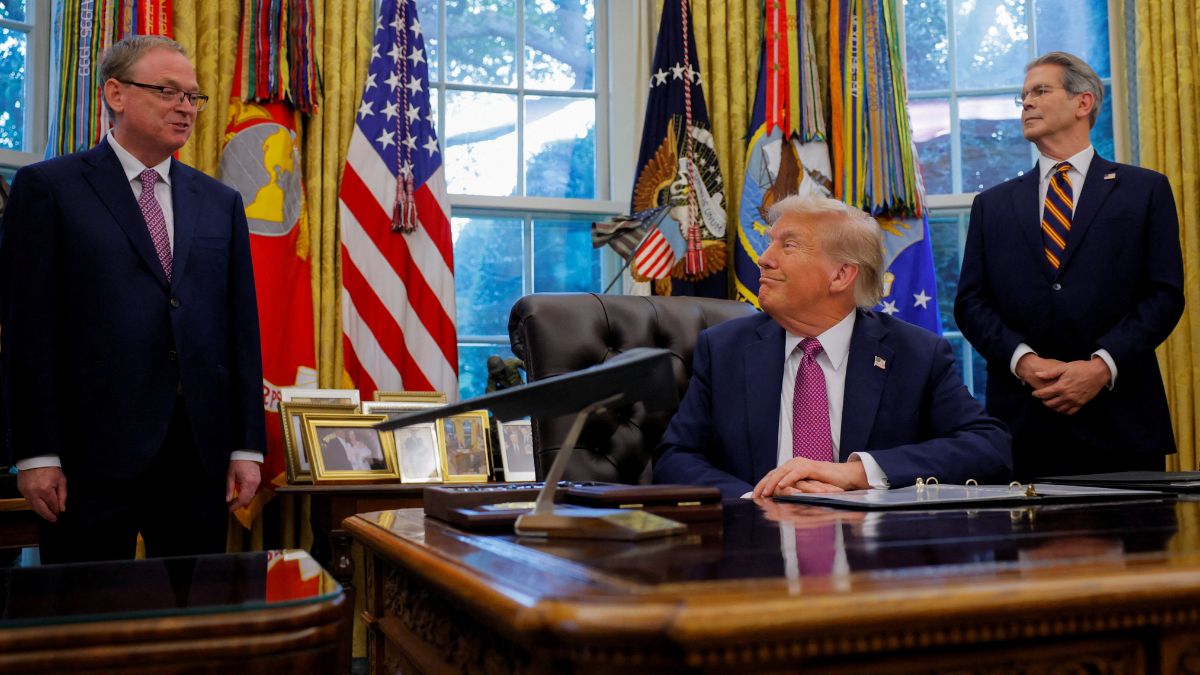
 "US President Donald Trump and US Secretary of the Treasury Scott Bessent listen as National Economic Council Director Kevin Hassett speaks, at the White House in Washington, DC, US, September 5, 2025. File Image/Reuters")
United States President Donald Trump will soon be deciding on who will succeed Jerome Powell as the next chair of the Federal Reserve.
With Powell’s term ending in May 2026 — and an additional, separate 14-year Federal Reserve Board term set to open on February 1, 2026 — the White House is engaged in an accelerated search process that could redefine the direction of American monetary policy for years.
The evaluation period is entering its final stage, and the administration appears close to revealing its preferred candidate from a tight shortlist of five.
This comes at a moment when Trump has openly criticised the current head of the central bank, questioned the pace of monetary adjustment, and spoken frequently about his desire for swift reductions in borrowing costs.
His previous selection of Powell during his first term, later reappointed by former US President Joe Biden, has long been a source of public tension.
The upcoming Federal Open Market Committee (FOMC) deliberations on December 9-10 have raised the stakes further.
The White House insists that the selection will be grounded in merit and capability, but some former officials and analysts fear political alignment could weigh heavily in the final outcome.
US Treasury Secretary Scott Bessent, who is overseeing the vetting process and conducting interviews, has indicated that the announcement could arrive before the Christmas holiday.
The president has also stated that he already has a strong sense of who he wants for the role.
Quick Reads
View AllAs Bessent completes the final round of candidate meetings, the race has narrowed to five individuals: Kevin Hassett, Christopher Waller, Kevin Warsh, Michelle Bowman, and Rick Rieder.
Why the Fed chair appointment is important
The Fed chair is America’s most influential economic policymaker, shaping interest rate strategy, guiding responses to inflation fluctuations, and serving as the public face of US monetary policy.
Decisions made by the chair move global markets instantly, influence credit availability, and affect the economic outlook for households, businesses, and governments.
The position also entails substantial regulatory responsibilities. As part of the Board of Governors, the chair helps frame rules that govern banks and financial institutions, working closely with other regulators and meeting regularly with US Congress.
The chair leads the FOMC, which sets the target for the federal funds rate — the benchmark that determines borrowing costs on everything from home mortgages to auto loans to business credit lines.
Whoever is appointed must be confirmed by the Senate, now controlled by Republicans.
Powell, once his term ends, may remain on the board for up to two more years unless he chooses to step down entirely, which would create another position for the administration to fill.
Who the top contenders are
Kevin Hassett
Among the contenders, Kevin Hassett has increasingly been regarded as the leading choice.
Advisers close to the president and various White House allies believe that Hassett’s longstanding relationship with Trump and his alignment with the president’s economic thinking make him uniquely positioned for the role.
The belief that he would embrace more forceful rate cuts has gained traction among those advocating for faster monetary easing.
Hassett’s background spans decades of involvement in Republican economic policymaking. Before joining Trump’s administration during his first term, he served as an economic adviser to George W Bush, John McCain, and Mitt Romney.
During Trump’s first presidency, he served as chair of the Council of Economic Advisers, later returning during the Covid-19 emergency period.
However, he has also faced criticism, notably for a widely debated model released in 2020 projecting that Covid-19 deaths would drop to zero by mid-May of that year.
Earlier in his career, he co-authored the book Dow 36,000 in 1999, which predicted a dramatic rise in stock market valuations. The book was later criticised for its optimistic assumptions, as it took more than two decades for the market to reach that level.
Nevertheless, Hassett has openly expressed willingness to become the Fed chair. In an interview, he said, “I want to serve my country and I want to serve my president. But you know, we’ll see how it goes. There are a lot of great candidates.”
He also stated that he would “be cutting rates right now” because “the data suggests that we should,” a stance that positions him closely with Trump’s views and distinguishes him from more cautious candidates.
Markets reacted quickly to reports citing him as the top contender, with Treasury yields declining and the 10-year yield falling below 4 per cent following indications of his frontrunner status.
Christopher Waller
Christopher Waller, currently serving as a Federal Reserve governor, is another major figure under consideration. Unlike some rivals, Waller already holds a senior position within the institution and has years of experience inside the Federal Reserve System.
He joined the Board of Governors following a narrow 48-47 Senate confirmation in December 2020 — the closest vote for any Fed governor since 1980.
Waller stated that his most recent discussion with Bessent was positive, saying, “I talked to Scott about 10 days ago. We had a nice, a great, meeting.”
Kevin Warsh
Kevin Warsh brings a different form of experience to the table, derived from both central banking and high-level work in the private sector.
Warsh, who began his career at Morgan Stanley in mergers and acquisitions, later served in the White House under President George W Bush before being appointed to the Federal Reserve Board in 2006.
His tenure at the Fed included significant involvement during the 2008 financial crisis. He became the institution’s main liaison to Wall Street, participating in emergency responses and coordinating with major banks at critical moments.
When he stepped down in 2011, he had established a reputation as a central figure in the crisis response.
Trump previously considered Warsh for the Fed chair position in 2017 before ultimately nominating Powell.
In September this year, Trump named Warsh as one of the “top three” options for replacing Powell, alongside Hassett and Waller.
Michelle Bowman
Michelle Bowman, who currently serves as the Fed’s vice chair for supervision, is one of the institution’s most prominent regulatory figures.
Initially appointed by Trump in 2018 and reappointed in 2020, she has held senior roles across federal agencies, as well as positions in the banking industry through her family’s bank in Kansas.
Before joining the Fed, she worked in the Department of Homeland Security and at FEMA during the George W Bush administration. Her background in community banking lends her a distinct perspective within the Federal Reserve System.
Bowman has also demonstrated a willingness to vote independently. In 2024, she became the first Fed governor since 2005 to oppose an interest rate decision. This year, she dissented again, this time joined by Waller.
Rick Rieder
Rick Rieder rounds out the list of finalists. As the chief investment officer for global fixed income at BlackRock, he oversees approximately $2.4 trillion in assets, making him one of the most influential figures in global asset management.
His career spans decades on Wall Street, beginning at Lehman Brothers before joining BlackRock.
While he has not served within the Federal Reserve System itself, he has been a member of the Fed’s Investment Advisory Committee on Financial Markets, providing insights from major financial institutions to policymakers.
Rieder’s experience in private-sector portfolio management would mark a significant shift from traditional central bank leadership profiles.
How Trump’s relationship with the central bank has fared
Since returning to the White House in January, Trump has frequently faulted Powell’s approach to rate setting, labelling him “Too Late,” and pressing for sharper reductions in borrowing costs.
Social media posts and public remarks have highlighted Trump’s belief that the chair should have moved more quickly to cut rates.
The White House has rejected suggestions that loyalty is the defining criterion for the nomination, maintaining that Trump intends to pick the most capable leader for the institution.
Nonetheless, many economists and former officials remain concerned about potential political motivations, particularly after episodes in which the president discussed dismissing central bank officials or openly expressed dissatisfaction with their decisions.
Trump has referenced a desire to consider both well-known figures and less predictable choices, stating, “We have some surprising names and some standard names that everybody’s talking about.”
He also joked that he tried convincing Bessent to take the position himself but that the treasury secretary declined.
Bessent, however, has been cautious in balancing market expectations with the president’s priorities. He described five “very strong candidates,” and has maintained that he is not personally interested in leading the Fed.
Trump, last week referred to Powell as “grossly incompetent,” adding that he would have liked to remove him if advisers had not encouraged patience.
In the same lighthearted tone, Trump added that if Bessent failed to secure lower rates, he might also consider dismissing him.
Why the search matters now
This transition period coincides with increasingly divided views inside the central bank. After leaving rates unchanged through most of 2025, officials opted for cuts of 25 basis points in both September and October.
The upcoming FOMC meeting in December will take place against a backdrop of mixed economic indicators: some evidence of weakening in the labour market, lingering inflation challenges, and delayed or incomplete government data.
Officials are not united on whether additional easing should proceed.
The next chair will therefore inherit a landscape of inflation not yet fully stabilised and growth across sectors uneven.
Conversely, appointing someone more inclined toward gradual adjustments could signal continuity with Powell’s broader approach.
Trump has indicated that he wants someone who understands the economic direction he envisions for the country, a sentiment echoed by former White House press secretary Sean Spicer, who said, “President Trump saw in the first term how important it was to have people who understand his direction and priorities, especially in key positions like FBI director and Federal Reserve chair.”
When the final decision will take place
Bessent has conducted interviews since the summer, speaking with nearly a dozen prospects before reducing the pool to the current five. He has said the final round of discussions will wrap up imminently.
After that, a smaller list of finalists will sit with White House Chief of Staff Susie Wiles and US Vice President JD Vance.
Once Trump makes the selection, the nominee must undergo Senate confirmation — a process likely to begin early in 2026.
If Powell chooses to step down from the Fed Board when his term as chair ends, it would give the administration the opportunity to fill an additional vacancy.
As Bessent put it, there is “a very good chance” that the final decision will be announced before the Christmas holiday.
Trump himself has said, “I think I already know my choice.”
Also Watch:
With inputs from agencies