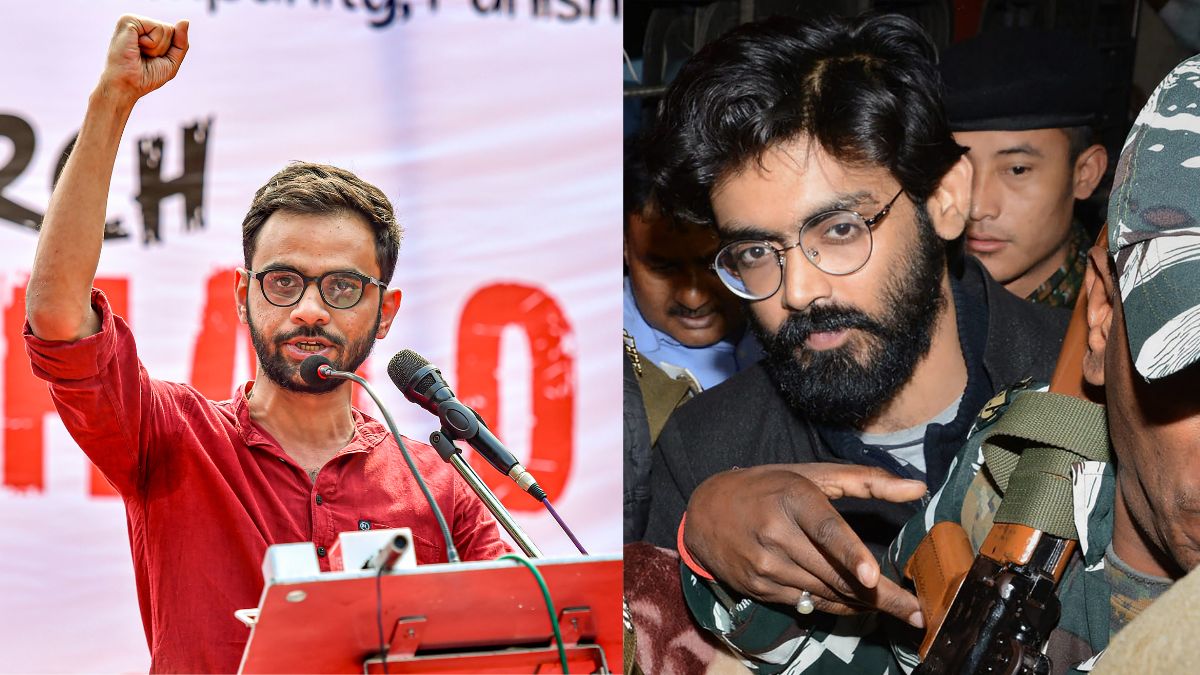
 "Delhi riots case: Why Supreme Court denied bail for Umar Khalid, Sharjeel Imam")
The Supreme Court has denied bail to activists Umar Khalid and Sharjeel Imam in the 2020 Delhi riots case, while granting relief to five other accused in the same case, citing “hierarchy of participation”. The court on Monday (January 5) said that each bail application must be considered individually as not all accused are on “equal footing”.
Both men, booked under the stringent Unlawful Activities (Prevention) Act (UAPA) in the 2020 Northeast Delhi riots, have been in prison for over five years. Their bail applications have been rejected several times by courts.
We take a look.
Why SC rejected Khalid, Imam bails
The Supreme Court dismissed the bail pleas of Umar Khalid and Sharjeel Imam in the Delhi riots case, holding them as the “principal accused” who had a “central and directive role in conceptualising, planning and coordinating the alleged terrorist act”.
A bench of Justices Aravind Kumar and NV Anjaria said it “cannot treat all individuals equally” for bail, adding that all applicants were not on “equal footing as regards culpability”.
“All the appellants do not stand on equal footing as regards culpability. The hierarchy of participation emerging from the prosecutions case requires the court to examine each application individually,” it said.
The top court said that the material suggests the case of Khalid and Imam stands on a qualitatively different basis than that of the other five accused.
It observed that the prosecution materials prima facie disclosed “a central and formative role” and “involvement in the level of planning, mobilisation and strategic direction extending beyond episodic and localised acts,” reported LiveLaw.
Quick Reads
View AllImam had approached the Supreme Court for bail, expressing anguish over being “labelled” a “dangerous intellectual terrorist”, without a full-fledged trial or a single conviction.
The apex court said that the delay in trial does not operate as a “trump card” that “automatically displaces statutory safeguards”.
The apex court observed that “while the period of incarceration undergone by them is substantial, and has been duly considered”. “The court is not persuaded that on the present accord, continued detention has crossed the threshold of constitutional impermissibility as to override the statutory embargo… Complexity of the prosecution, the nature of the evidence relied upon, and the stage of the proceedings do not justify their enlargement on bail at this juncture…”, it added.
Supreme Court denies bail to Umar Khalid and Sharjeel Imam in Delhi riots 'larger conspiracy' case, grants bail to 5 others
— News18 (@CNNnews18) January 5, 2026
"Our argument before the top court was - these riots were pre-planned...": Special public prosecutor Rajat Nair speaks to News18's @anany_b@SaroyaHem |… pic.twitter.com/YWjEuwlTzH
The court further said that the petitioners could apply for bail again only after a year.
The bench said their bails will be considered “on completion of the examination of the protected witnesses relied upon by the prosecution or upon the expiry of the period of one year from the date of this order” whichever is earlier, adding that it is only then the “two applicants would be ability to renew their prayer for grant of bail before the jurisdiction of court”.
The bail petitions of the accused were heard by the Supreme Court earlier, with the judgment reserved on December 10. The accused had moved the apex court against the September 2 judgment of the Delhi High Court that denied them bail.
Delhi riots case against Khalid, Imam
Khalid was arrested in September 2020 following the February riots in Delhi that left 53 people dead and more than 700 injured.
Imam was arrested in January 2020 for alleged controversial speeches during protests against the Citizenship Amendment Act (CAA) and the proposed National Register of Citizens. Later, the Delhi Police made him an accused in its larger conspiracy case behind the North East Delhi riots.
Khalid, Imam and the other accused were booked under Section 15 of the UAPA, which defines a terrorist act, penalising any “with intent to threaten or likely to threaten the unity, integrity, security, economic security, or sovereignty of India or with intent to strike terror or likely to strike terror in the people or any section of the people in India.”
However, the provision says that such terror is by use of “bombs, dynamite or other explosive substances or inflammable substances or firearms…or any other means.”
The main point of the prosecution’s case is that by conspiring and causing a “chakka jam” (road blockade), the accused committed a “terrorist act”, as per Indian Express.
The Delhi Police have opposed bail pleas of Imam and Khalid several times, stating that their alleged offences were a deliberate attempt to “destabilise” the state and cannot be seen as spontaneous protests. They claimed that the accused launched a “well-orchestrated pan-India” conspiracy aimed at “regime change” and “economic strangulation”.
The police alleged that the violence was “planned” by those who organised the protests against the contentious Citizenship Amendment Act.
Khalid, a former Jawaharlal Nehru University (JNU) student, has been denied bail at least five times by different courts over the past five years.
The Delhi High Court had rejected the bail pleas of the accused on September 2, 2025, observing that the material on record showed a prima facie case of conspiracy. It also found that Khalid and Imam were the first to act after the Citizenship Amendment Bill was passed in early December 2019, by creating WhatsApp groups and distributing pamphlets in Muslim-populated areas, calling for protests and chakka-jaams.
Seeking bail, Imam had expressed anguish before the apex court for being “labelled" a “dangerous intellectual terrorist", without a full-fledged trial or a single conviction.
The Delhi Police had said that Imam’s speeches can be attributed to other accused and used as evidence against them in the Delhi riots case. “Acts of one conspirator can be attributed to others. Sharjeel Imam’s speeches can be attributed to Umar Khalid. Sharjeel Imam’s case will be considered as evidence against the others," Additional Solicitor General SV Raju, appearing for Delhi Police, told the apex court on December 10.
He also argued that Khalid deliberately planned to leave Delhi before the riots to “deflect responsibility”.
Senior advocate Siddharth Dave, who represented Imam, argued that he was arrested before the communal violence rocked Northeast Delhi for his speeches, which alone cannot make up the offence of “criminal conspiracy" in the riots case.
Why 5 other accused got bail
The other five accused in the 2020 Delhi riots case – Gulfisha Fatima, Meeran Haider, Mohd Samir Khan, Shadab Ahmed and Shifa ur Rehman – have been granted conditional bail by the apex court.
The apex court said that “having regard to the role attributed, the nature of the material relied upon and the present stage of proceedings, continued incarceration is not shown to be indispensable to the conduct of a fair trial provided strict safeguards are imposed.”
“The grant of bail in their favour does not reflect any dilution of the seriousness of the allegation, nor does it amount to a finding of guilt. It represents a calibrated exercise of constitutional discretion structured to preserve both liberty of the individual and security of the nation.”
In the “interest of national security and public order,” the top court imposed 12 bail conditions on the accused, the violation of which would lead to a suspension of the relief.
“The constitution guarantees personal liberty, but it does not conceive liberty as an isolated or absolute entitlement detached from the security of the society in which it operates. The sorority’s integrity and the nation’s security, as well as the preservation of public order, are not abstract concerns; rather, they are constitutional values that Parliament is entitled to protect through law. Where a special statutory framework has been enacted to address offences perceived to strike at these foundations, courts are duty-bound to give effect to the framework, subject always to the constitutional discipline,” the bench said.
With inputs from agencies

 "US-Venezuela tensions LIVE: Maduro to be produced in New York court as Trump warns Rodrigues of 'a very big price'")
 "Is Trump handing over Venezuela to ‘anti-American socialists’ he loathes?")
 "How Venezuela’s Nicolas Maduro became a follower of Indian godman Sathya Sai Baba")
 "From Maduro to Saddam, a look at foreign heads of state taken into US custody")
 "US-Venezuela tensions LIVE: Maduro to be produced in New York court as Trump warns Rodrigues of 'a very big price'")
 "Is Trump handing over Venezuela to ‘anti-American socialists’ he loathes?")
 "How Venezuela’s Nicolas Maduro became a follower of Indian godman Sathya Sai Baba")
 "From Maduro to Saddam, a look at foreign heads of state taken into US custody")