

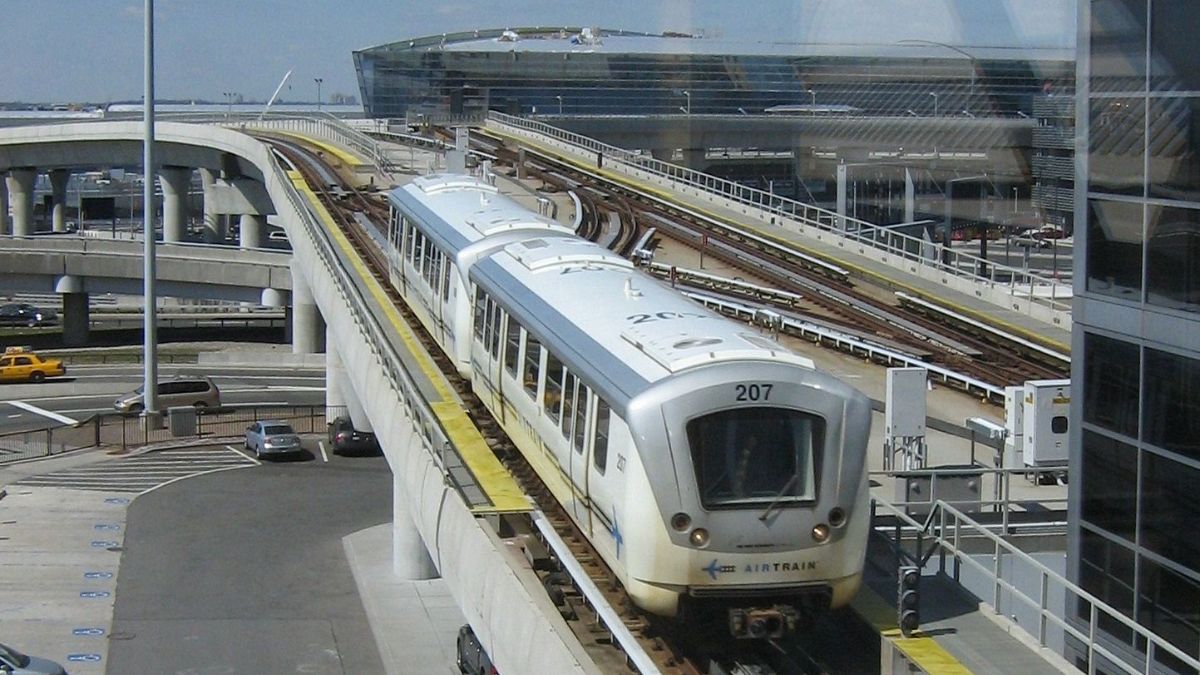
 "Delhi is set to get its first air train between airport terminals. What is it?")
In the next few years, trudging between distant airport terminals in Delhi on DTC buses will become a thing of the past.
Delhi International Airport Ltd (DIAL), led by the GMR group, has already begun working on a solution. They’ve teamed up with Aeroports de Paris (Groupe ADP), their French partner, to finalise plans for a futuristic air train system at Indira Gandhi International Airport.
As one of the world’s busiest airports, this project is set to revolutionise how passengers navigate between airport terminals in Delhi, offering a faster, more efficient, and stress-free experience.
Here’s everything we know so far about the project.
What is an air train?
An air train, also known as a Sky Train at many airports globally, operates on an Automated People Mover (APM) system. Its primary goal is to reduce the time it takes for passengers to transfer between terminals, making the process smoother—particularly for those on connecting flights.
The proposed air train in Delhi will cover a distance of 7.7 km and will make moving between four stops — Terminal 2/3, Terminal 1, Aerocity, and Cargo City a seamless affair, a tender document quoted by the Times of India said.
“In addition to providing required connectivity between terminals, APM system will enhance passenger convenience, improve ASQ score and reduce carbon footprint,” it added.
Currently, Delhi Airport, the busiest in India, handles over 70 million passengers annually and plans to double that figure to 130 million within the next 6–8 years.
With 25 per cent of travellers being transit flyers, the air train is essential for smooth transfers between terminals, ensuring the airport can manage these growing volumes efficiently.
When will it be ready?
According to sources cited by the Times of India, Delhi’s air train project is expected to receive bids in October and November. The winner will be chosen based on the cost they propose, along with whether they offer a revenue-sharing model or require viability gap funding for the project.
“If all goes well, a contract will be awarded before the end of this fiscal year. Work will then begin, and it is targeted to be over before the end of CY 2027,” the sources revealed. This timeline has been communicated to the Union Aviation Ministry by DIAL.
Another option under consideration for Delhi’s air train project is an 8 km route with six stations, including hotels and office districts of Aerocity, partially funded by passengers, as reported by News18.
“DIAL’s model for having so many stops, including two at Aerocity, will not only mean higher travel time between T1 and T2/3 but also require foolproof security at the nonterminal stops,” a senior Govt official was quoted as saying last Nov when that plan was discussed.
But authorities are still weighing this alternative against the proposed 7.7 km route, which includes four key stops.
How much will it cost?
In terms of costs, Times Now reveals that the central government has instructed DIAL’s Singapore-based consultant, GMR, to fund the nearly Rs 3,500-crore project before imposing any development fees on passengers. This means the air train must be fully operational before any additional charges can be applied.
Globally, air trains are typically free for passengers to ensure seamless terminal transit. However, the cost of improving airport infrastructure is often recouped through aeronautical charges set by the Airport Economic Regulatory Authority (AERA), such as landing and parking fees for airlines or other expenditures at the airport. and through User Development Fees (UDF) for passengers.
For instance, Mumbai Airport charged UDFs that included a metro component of Rs 20 for domestic and Rs 120 for international departures, from 2016 to 2023. This component was removed once the target sum for metro connectivity, Rs 518 crore, was raised.
With input from agencies

 "Russian drones over Poland: Trump’s tepid reaction a wake-up call for Nato?")
 "As Russia pushes east, Ukraine faces mounting pressure to defend its heartland")
 "Why Mossad was not on board with Israel’s strike on Hamas in Qatar")
 "Turkey: Erdogan's police arrest opposition mayor Hasan Mutlu, dozens officials in corruption probe")
 "Russian drones over Poland: Trump’s tepid reaction a wake-up call for Nato?")
 "As Russia pushes east, Ukraine faces mounting pressure to defend its heartland")
 "Why Mossad was not on board with Israel’s strike on Hamas in Qatar")
 "Turkey: Erdogan's police arrest opposition mayor Hasan Mutlu, dozens officials in corruption probe")



