

 "Why China seethes as Indian team names Arunachal peak after Dalai Lama")
China is fuming over Arunachal Pradesh, again. Beijing has taken objection to an Indian mountaineering team naming a previously unnamed peak in the state after the 6th Dalai Lama.
China has reiterated its territorial claims over Arunachal Pradesh, hitting out at the mountaineering team for carrying out an “illegal operation” in what it claims is “Chinese territory”.
Let’s take a closer look.
What happened?
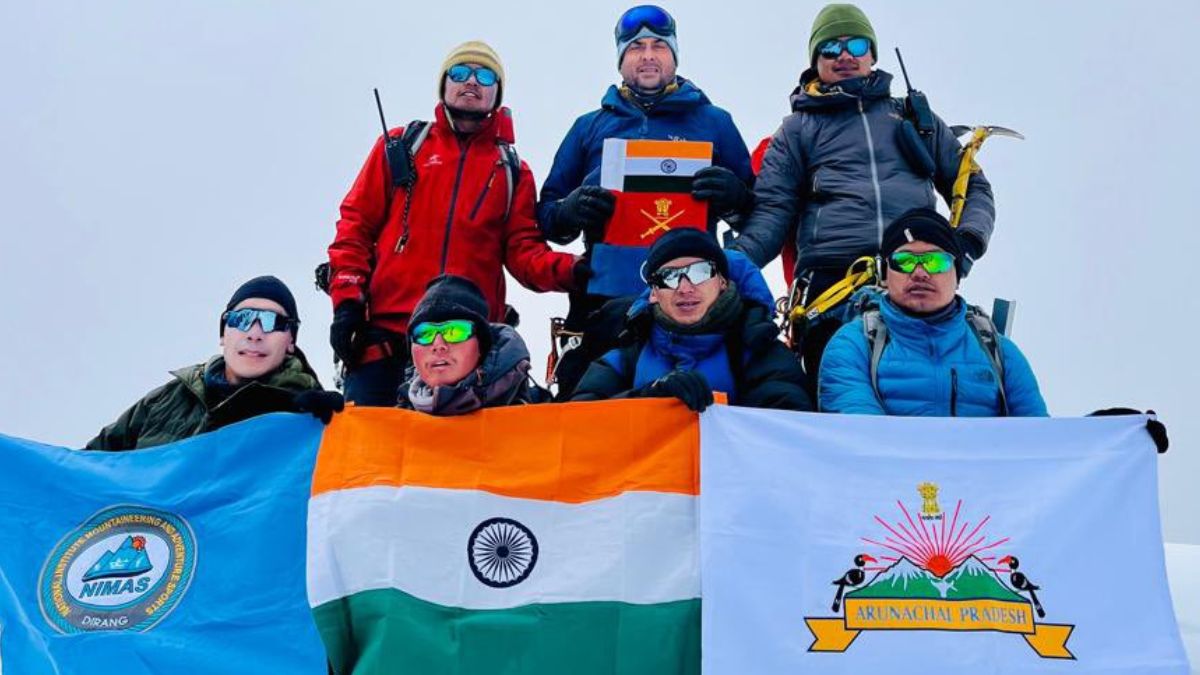
Last week, a 15-member team from the National Institute of Mountaineering and Adventure Sports (NIMAS) under the Ministry of Defence scaled an unnamed peak in Arunachal Pradesh.
The team, led by NIMAS director Colonel Ranveer Singh Jamwal, scaled the unnamed and unclimbed 20,942 ft high peak located in the Gorichen range in 15 days.
They named the summit ‘Tsangyang Gyatso Peak’ after the 6th Dalai Lama Tsangyang Gyatso, who was born in 1682 in Tawang.
According to a Defence Ministry statement, the decision to name the peak after the 6th Dalai Lama was taken as a tribute to his timeless wisdom and contributions to the Monpa community and beyond.
Defence spokesperson Lieutenant Colonel M Rawat said the peak was one of the most technically challenging in the region. He highlighted the team faced “immense challenges, including sheer ice walls, treacherous crevasses, and a two-km-long glacier”.
Taking to X, Arunachal Pradesh Chief Minister Pema Khandu extended his wishes to the NIMAS team for the feat. “Led by Director Ranveer Jamwal, they’ve successfully summited an untamed peak in the Gorichen Massif of Mon Tawang Region of Arunachal Pradesh, reaching an impressive 6,383 meters!” he tweeted on Wednesday (September 25).
This untamed peak has been named "Tsangyang Gyatso Peak" in honour of His Holiness Tsangyang Gyatso, the Sixth Dalai Lama, from the Mon Tawang region.
— Pema Khandu པདྨ་མཁའ་འགྲོ་། (@PemaKhanduBJP) September 25, 2024
This groundbreaking feat showcases the spirit of adventure, connecting this remote land to the world. It also opens new… pic.twitter.com/w95ut34nh1
What has China said?
China conveyed its displeasure on Thursday (September 26) over the naming of the peak in Arunachal Pradesh.
When asked about the naming, Chinese Foreign Ministry spokesperson Lin Jian said he was “not aware”. However, Lin added that Arunachal Pradesh, which Beijing refers to as ‘Zangnan’ is a “Chinese territory”.
He told the media in Beijing: “It’s illegal, and null and void for India to set up the so-called “Arunachal Pradesh” in Chinese territory,”
“This has been China’s consistent position,” Lin added.
India-China rift over Arunachal Pradesh
Beijing claims the entire state of Arunachal Pradesh, which it calls “Zangnan, the southern part of Tibet”, as an “inherent part of China’s territory”. The country’s maps depict Arunachal Pradesh as part of China.
Beijing has been assigning new names to places in the Indian state to assert its territorial claims since 2017.
India has rejected China’s claims over Arunachal Pradesh. Responding to China renaming 11 places in the Indian state last year, the Ministry of External Affairs (MEA) said, “Arunachal Pradesh is, has been, and will always be an integral and inalienable part of India. Attempts to assign invented names will not alter this reality.”
China expresses strong reservations every time any Indian leader visits Arunachal Pradesh. Earlier this year, New Delhi rejected Beijing’s objection to Prime Minister Narendra Modi’s visit to the state.
After Modi’s trip, the United States recognised Arunachal Pradesh as Indian territory, further angering China which reportedly accused Washington of exploiting the dispute of other countries for its geopolitical interests.
Why the Dalai Lama irks China
The Indian mountaineers’ naming of a summit in Arunachal Pradesh did not only rebuff Beijing’s claim over the state but also hit where it hurts by titling it after the 6th Dalai Lama.
Before China’s invasion in 1950, Tibet existed as an independent state, with its own unique culture, language, and religion. The Dalai Lama is the spiritual leader of Tibet, known as the “roof of the world”.
China annexed Tibet in 1951 and has since maintained tight control over the region.
Tenzin Gyatso, the 14th Dalai Lama, had to flee Tibet in 1959 after China’s troops crushed an uprising against Chinese rule. He has since been residing in India.
The Dalai Lama has called for Tibet’s autonomy for years while living in exile in Dharamshala. Chinese officials have previously berated the Dalai Lama as a “wolf in monk’s clothing” who seeks to destroy the Asian country’s sovereignty by pressing for independence. However, the Dalai Lama maintains he seeks autonomy that would allow Tibetans to follow their culture, language and religion under China’s rule.
Beijing does not believe him and sees him as a “separatist”. China routinely opposes the Tibetan spiritual leader’s meetings with world leaders. As CNN noted, Beijing views such meetings as a challenge to its national sovereignty and claim over Tibet.
China wants to decide the next Dalai Lama, who has immense influence over the Tibetans.
“The fact that the Chinese government wants a reincarnation of their choice shows they consider the institution important enough that it needs to be owned and manipulated in order to finally settle to Tibet issue,” Amitabh Mathur, a former adviser to the Indian government on Tibetan affairs, told The Guardian in 2021.
There is speculation that there could be two Dalai Lamas after the current leader dies – one chosen by the Dalai Lama and the other by China.
With inputs from agencies

 "Russian drones over Poland: Trump’s tepid reaction a wake-up call for Nato?")
 "As Russia pushes east, Ukraine faces mounting pressure to defend its heartland")
 "Why Mossad was not on board with Israel’s strike on Hamas in Qatar")
 "Turkey: Erdogan's police arrest opposition mayor Hasan Mutlu, dozens officials in corruption probe")
 "Russian drones over Poland: Trump’s tepid reaction a wake-up call for Nato?")
 "As Russia pushes east, Ukraine faces mounting pressure to defend its heartland")
 "Why Mossad was not on board with Israel’s strike on Hamas in Qatar")
 "Turkey: Erdogan's police arrest opposition mayor Hasan Mutlu, dozens officials in corruption probe")



