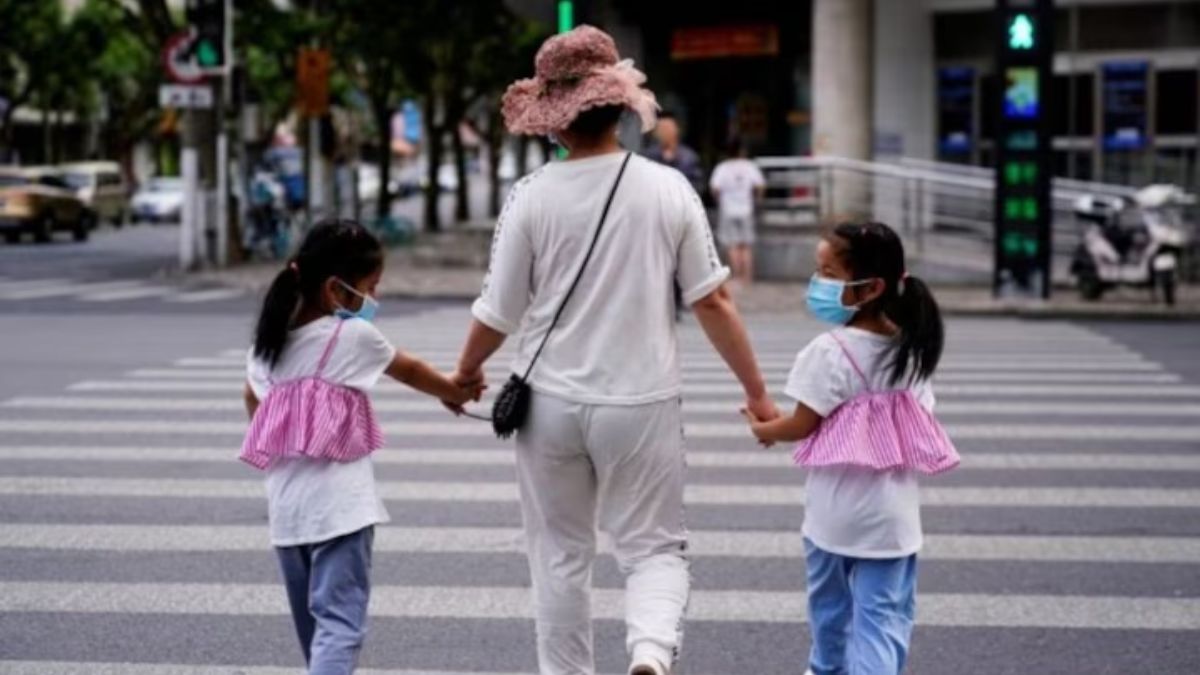
 "From subsidies to free pre-schools: How China is scrambling to reverse the plummeting birth rate")
China’s central government introduced a childcare subsidy on July 28 that will provide families with 3,000 yuan (around £312) a year for each child under the age of three. The announcement came days after plans were unveiled to roll out free preschool education across the country.
These developments mark a shift from previous years, when the government largely left the issue of addressing China’s declining birth rate to local authorities. Many of those efforts, which range from cash incentives to housing subsidies, have made little difference. By stepping in directly, Beijing has signalled that it sees the situation as urgent.
Why is China’s birth rate declining
Fewer Chinese women are choosing to have children, and more young people are delaying or opting out of marriage. This has contributed to a situation where China’s population shrank for a third consecutive year in 2024. An ageing population and shrinking workforce pose long-term challenges for China’s economic growth, as well as its healthcare and pension systems.
Before the central government’s recent roll-out, regions in China had already been experimenting with policies to increase birth rates. These include one-time payouts for second or third children, monthly allowances and housing and job training subsidies.
One of the most eye-catching local policies came from Hohhot, the capital city of Inner Mongolia province. In March 2025, the authorities there began offering families up to 100,000 yuan (£10,400) for having a second and third child, paid annually until the children turn ten.
The authorities in some other cities, including eastern China’s Hangzhou, have offered childcare vouchers or subsidies for daycare. Policies like these have seen the number of births increase slightly in a few regions. But uptake is generally low and none have managed to change the national picture.
There are several reasons why incentive-based policies have not moved the needle. First, the subsidies are generally small – often equivalent to just a few hundred US dollars. This barely makes a dent in the cost of raising a child in urban China.
China ranks among the most expensive countries in the world for child-rearing, surpassing the US and Japan. In fact, a 2024 report by the Beijing-based YuWa Population Research Institute found that the average cost of raising a child in China until the age of 18 is 538,000 yuan (£59,275). This is more than 6.3 times as high as China’s GDP per capita.
The burden is so widely felt that people in China jokingly refer to children as tunjinshou, which translates to “gold-devouring beasts”.
Second, the incentives largely don’t address deeper issues. These include expensive housing, intense education pressures, childcare shortages and some workplaces that penalise women for taking time off. Many Chinese women fear being pushed out of their jobs simply for having kids.
Some local authorities have attempted to tackle the structural realities that make having and raising children in China difficult, and have enjoyed some success. In Tianmen, for example, parents of a third child can claim US$16,500 (£12,500) off a new home.
However, these policies are confined to specific districts and villages or are limited to select groups. Support remains fragmented and insufficient, while the prospects of scaling these piecemeal initiatives nationwide are slim.
Third, gender inequality in China is still deeply entrenched. Women carry most of the childcare and housework burden, with parental leave policies reflecting that imbalance. While mothers are allowed between 128 to 158 days of maternity leave, fathers receive only a handful – varying slightly by province. Despite public calls for equal parental leave, major legal changes seem far off.
These factors have together given rise to a situation where, as in east Asia more broadly, many young people in China simply are not interested in marrying or having children.
According to one online survey from 2022, around 90 per cent of respondents in China said they wouldn’t consider having more children even if they were offered an annual subsidy of 12,000 yuan (£1,250) – far more than the recently announced 3,000 yuan subsidy.
Is it too late for Beijing?
The new measures show that Beijing is taking China’s declining birth rate seriously. But it might be too late. Fertility decline is hard to reverse, with research showing that social norms are difficult to snap back once they shift away from having children.
South Korea has spent decades offering its citizens generous subsidies, housing support and extended parental leave. Yet, despite a recent uptick, its birth rate has remained among the lowest in the world.
Projections by the UN paint a stark picture. China’s population is expected to drop by 204 million people between 2024 and 2054. It could lose 786 million people by the end of the century, returning its population to levels last seen in the 1950s.
Still, the recent announcements are significant. They are the first time the central government has directly used fiscal tools to encourage births, and reflect a consensus that lowering the cost of preschool education can help boost fertility. This sets a precedent and, if urgency keeps rising, the size and scope of support may increase as well.
However, if China hopes to turn things around, it will need more than cash. Parenting must be made truly viable and even desirable. Alongside financial aid and free preschool, families need time and labour support.
This also means confronting cultural expectations. Raising a child shouldn’t be seen as a woman’s job alone. A real cultural shift is needed – one that treats parenting as a shared responsibility.
My generation, which was born under the one-child policy, grew up in a time where siblings
were heavily fined. I was one of them. But, just as fines didn’t stop all of those who wanted more children, cash rewards will not easily convince the many who don’t.
Ming Gao, Research Fellow of East Asia Studies, Lund University
This article is republished from The Conversation under a Creative Commons license. Read the original article.


 "Trump finds new raid target? Report says US actively seeking regime change in Cuba by 2026-end")
 "Trump meets Zelenskyy in Davos, says 'a ways to go' on ending Ukraine war")
 "Power shift in Hanoi: Vietnam party list hints PM and president losing clout")
 "Can Trump’s Board of Peace replace the United Nations?")
 "Trump finds new raid target? Report says US actively seeking regime change in Cuba by 2026-end")
 "Trump meets Zelenskyy in Davos, says 'a ways to go' on ending Ukraine war")
 "Power shift in Hanoi: Vietnam party list hints PM and president losing clout")
 "Can Trump’s Board of Peace replace the United Nations?")