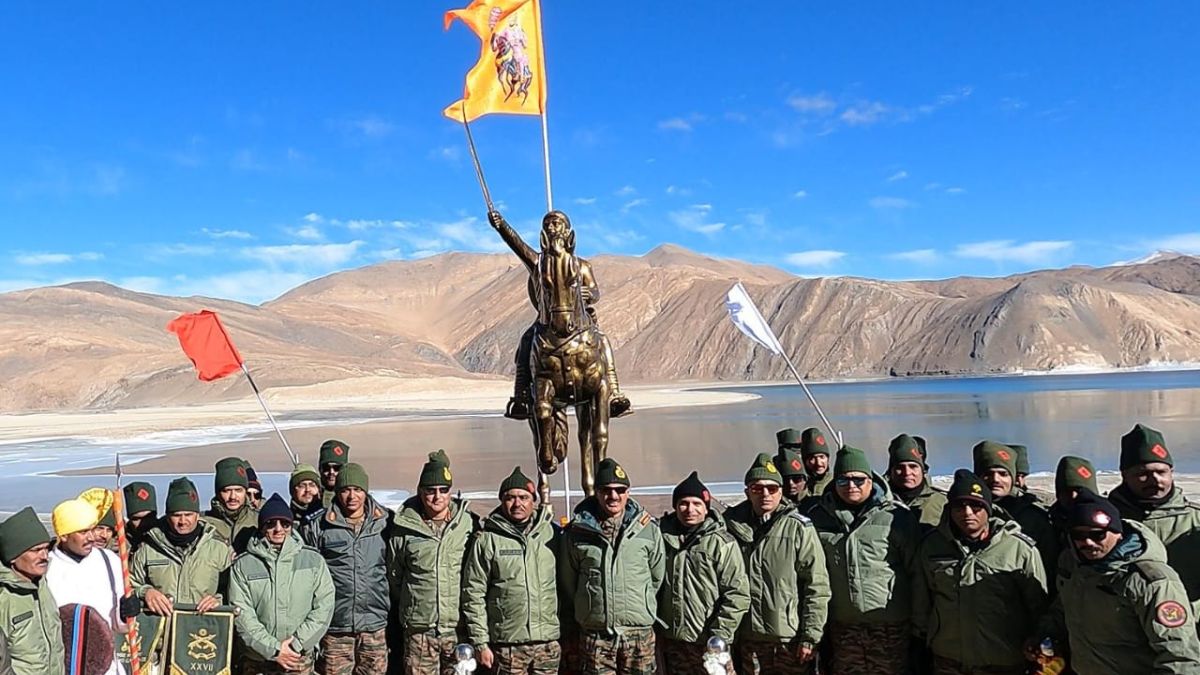
 "A Chhatrapati Shivaji Maharaj statue has been installed on the bank of Pangong Tso in eastern Ladakh. X/@firefurycorps")
A grand statue of Chhatrapati Shivaji Maharaj has been unveiled on the bank of Pangong Tso at an altitude of 14,300 feet. The statue was installed by the Indian Army on December 26, while it made the announcement two days later.
The installation of Chhatrapati Shivaji’s statue on the shore of Pangong Lake in eastern Ladakh matters due to its location near the Line of Actual Control (LAC) with China. However, the development has stirred a row with some questioning its relevance to Ladakh’s culture.
Let’s take a closer look.
Chhatrapati Shivaji’s statue in Ladakh
The Indian Army’s Leh-based 14 Corps, also known as Fire and Fury Corps, announced the inauguration of the statue on Saturday (December 28), saying it celebrates the “unwavering spirit” of the Maratha warrior.
“The towering symbol of valour, vision and unwavering justice was inaugurated by the General Officer Commanding Fire and Fury Corps Lt Gen Hitesh Bhalla, who is also the Colonel of the Maratha Light Infantry,” it said on X.
“The event celebrates the unwavering spirit of the Indian ruler, whose legacy remains a source of inspiration for generations.”
As the PTI news agency noted, this comes amid the Army’s recent efforts to integrate India’s “ancient strategic acumen” into the modern military domain.
Row over the statue
The statue of the Maratha king has been questioned for its relevance to Ladakh’s heritage and ecology.
Chushul Councillor Konchok Stanzin expressed disappointment over the alleged lack of consultation with local communities.
“As a local resident, I must voice my concerns about the Shivaji statue at Pangong. It was erected without local input and I question its relevance to our unique environment and wildlife. Let’s prioritise projects that truly reflect and respect our community and nature,” he tweeted.
Some military veterans also said the statue should have been of Dogra General Zorawar Singh’s. He had led Jammu’s Dogra Army to conquer Ladakh in the 19th century.
General Singh’s military campaign between 1834 and 1840 is credited for the merger of the erstwhile Ladakh kingdom with the Dogra kingdom, which was then part of the Sikh empire ruled by Maharaja Ranjit Singh of Lahore, as per The Tribune report.
The military operation led to the assimilation of Ladakh into the erstwhile princely state of Jammu and Kashmir, forming the borders of present-day eastern Ladakh.
While some have welcomed the Indian Army’s move to honour Shivaji, critics call for recognising and commemorating General Zorawar Singh’s legacy in the region.
Why the statue’s location matters
Chhatrapati Shivaji’s statue on the shore of the picturesque Pangong Tso in eastern Ladakh holds significance amid India’s recent border disengagement process with China. The 135-kilometre-long strategic lake straddles the LAC, the de facto border between the two neighbours.
In October, India and China completed the disengagement of troops in the two friction points of Demchok and Depsang at the LAC in eastern Ladakh. This marked the end of the roughly four-and-half-year-long border standoff, which broke out in 2020 on several points along the LAC after a violent clash between the Indian and Chinese troops in the Pangong Lake area.
After a series of military and diplomatic talks, both sides completed the disengagement on the north and south banks of the Pangong Tso in 2021.
Since the border standoff with China, the Indian Army has bolstered the infrastructure push in Ladakh, including building roads and bridges and improving mobility.
With inputs from agencies