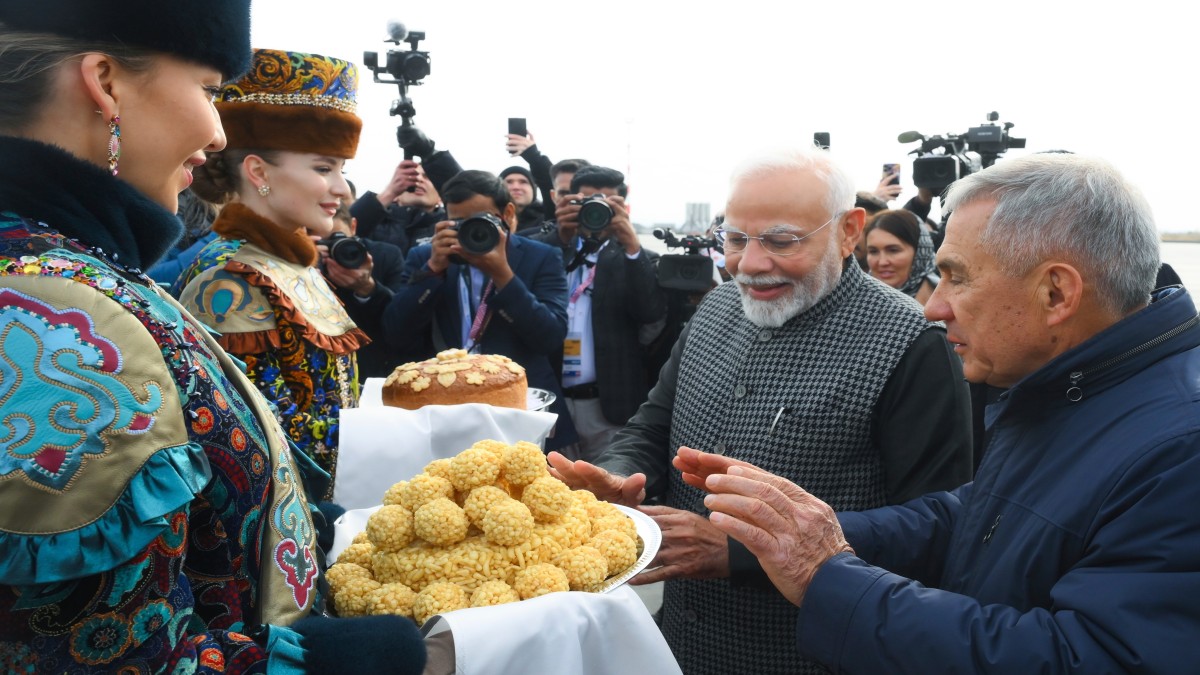
 "Indian Prime Minister Narendra Modi, second right, tries Tatar traditional sweet Chak-chak upon his arrival at Kazan International Airport for the BRICS Summit in Kazan, Russia, Tuesday, October 22, 2024. AP")
Prime Minister Narendra Modi landed in Russia’s Kazan on Tuesday to attend the Brics summit.
He was greeted with plates of traditional Russian cuisine when he arrived in the fifth-largest city in Russia.
Donning vibrant Tatar clothing, local women welcomed PM Modi, who is visiting the Soviet nation for two days, with chak-chak and a korovai loaf.
The food offered to the world leaders, including the Indian leader, has significance in both history and culture.
They have their origins in the hospitality and culinary traditions of the Tatar and Bashkir regions of Russia, which include Kazan.
Here’s all we know about them.
What is chak-chak?
Chak-chak, which means ‘a little bit’ or ‘small’, is a dessert made of fried pieces of wheat dough shaped like Ratlami sev. It can be round or cubical.
The round ones that PM Modi was offered resembled mua from Odisha, muri-r-moa from Bengal, or murhi-ka-laai from Bihar.
The national dessert originated in the Tatarstan and Bashkortostan regions.
According to legends, chak-chak appeared for the first time among the nomadic people of Central Asia and has its roots in Volga, Bulgaria. Before the 1990s, Bulgaria was a close ally of the Soviet Union during the Cold War.
“Chak-chak is not only a staple at everyday gatherings but also plays a significant role in traditional celebrations, like weddings,” Yekaterinburg-based Emilia told India Today. It symbolises good marriage, love and strong family life.
Chak-chak is made by cutting unleavened dough into several shapes, usually little balls or Indian sev. After that, these dough pieces are deep-fried in oil until the sides are brown and crispy. After that, a hot syrup consisting of sugar, honey, and water is poured over the fried pieces, which are then piled high.
What is Korovai?
- The next offering to PM Modi was korovai, a loaf of bread decorated with intricate floral patterns.
With great cultural significance, traditional bread is a must at weddings, where it is shared among guests as a symbol of the newlyweds’ future together.
Each flourish crafted from the dough has a specific meaning. For instance, roses symbolise beauty, ears of wheat mean future prosperity, and a wreath of periwrinkle represents strong connection binding the couple together.
Unlike chak-chak, Emilia told India Today, “Korovai is a popular ritual bakery product that has its origins in the Eastern Slavic lands. Earlier, the Slavs worshipped the Sun God. Hence the round shape of the sun. In most cases, the bread is served at wedding celebrations as a treat for all guests."
Korovai also represents unity, prosperity, and fertility.
An attractive loaf is created by weaving together several layers of dough during the korovai preparation process.
The bread has several intriguing customs associated with it. In the past, for example, Emilia says, enjoying a slice of bread with salt meant becoming close with the host and sharing all of his worries and problems.
With inputs from agencies