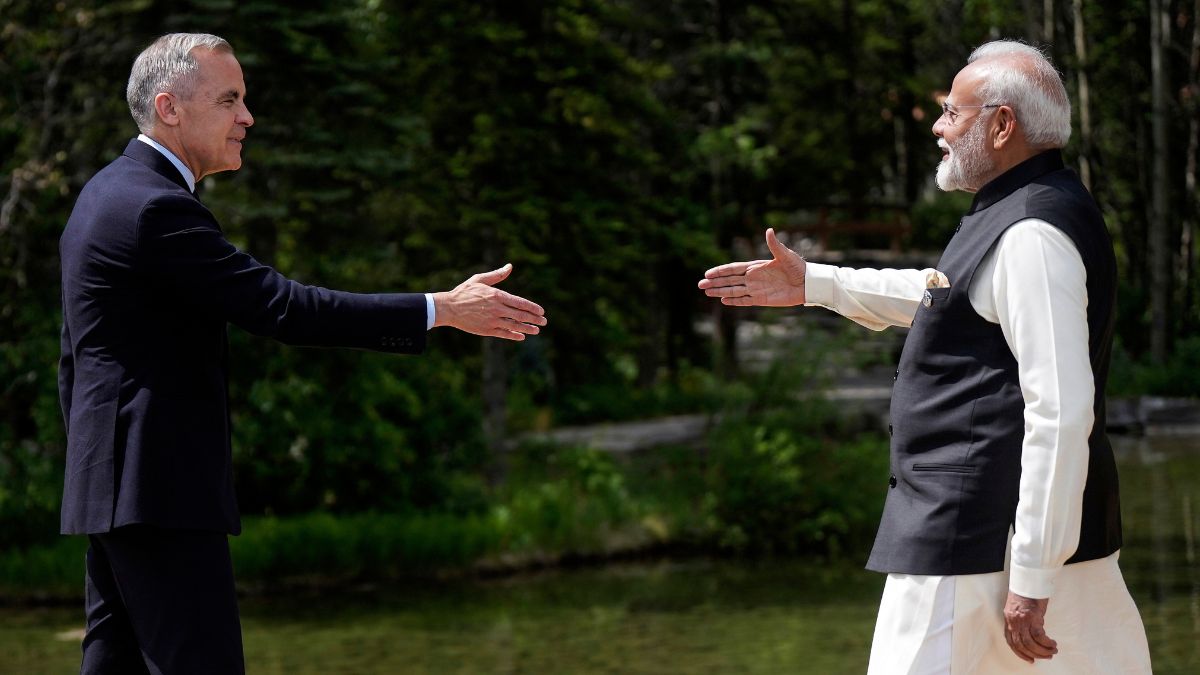
 "Canada's Prime Minister Mark Carney, left, and Prime Minister Narendra Modi reach to shake hands at the G7 Summit in Kananaskis, Alberta, Canada, June 17, 2025. File Image/The Canadian Press via AP")
Canadian Prime Minister Mark Carney is embarking on a multi-country Indo-Pacific tour that places India at the centre of Ottawa’s efforts to recalibrate its foreign economic policy and repair strained diplomatic relationships.
His four-day visit to India from February 27 to March 2, 2026, forms part of a wider itinerary that also includes Australia and Japan, reflecting Canada’s focus on diversifying partnerships beyond its traditional reliance on the United States.
The India leg of the trip carries particular diplomatic weight.
It is Carney’s first official bilateral visit to New Delhi since becoming prime minister and comes after several years of disrupted relations between the two countries.
The Canadian prime minister is set to begin his visit in Mumbai on Friday, where he will hold a series of interactions with Indian and Canadian business leaders and stakeholders.
These engagements are designed to encourage investment flows and deepen corporate linkages at a time when both governments are signalling a renewed commitment to commercial cooperation.
Carney will then travel to New Delhi, where delegation-level talks with Prime Minister Narendra Modi are scheduled to take place at Hyderabad House on March 2.
Quick Reads
View AllThe two leaders are expected to assess the progress made across a wide range of sectors under the India-Canada Strategic Partnership framework, while also reviewing ongoing initiatives in trade and investment, energy cooperation, critical minerals, agriculture, education, research, innovation and people-to-people ties.
Both governments have indicated that the forthcoming meetings are intended to reinforce the positive momentum that has been built through personal interactions of the prime ministers over the past year, especially on the sidelines of the G7 and G20 summits in 2025.
This resumption of high-level political engagement paved the way for the restoration of consular services, which had been curtailed during the period of diplomatic strain.
The decision to restore these services was taken after Carney and Modi met on the sidelines of the G7 summit in Alberta in June 2025, marking one of the earliest signals that both governments were seeking to reset ties.
Canadian Foreign Minister Anita Anand is accompanying Carney on the India leg of the trip.
“I will be returning to India with the Prime Minister this week to further diversify trade and to unlock additional opportunities for Canadians, including by elevating all sectors of the Canadian economy and enhancing our people-to-people ties,” she said in a post on X.
A boost to India-Canada trade talks on the menu?
Trade diversification has emerged as a defining theme of Carney’s foreign policy agenda since he took office in March 2025.
Ottawa has publicly identified the reduction of Canada’s heavy dependence on the US market as a strategic priority, particularly in light of escalating trade disputes with Washington under US President Donald Trump.
India has been positioned as a central pillar of this recalibration, given the size of its market, its expanding manufacturing base, and its growing role in global supply chains.
In November 2025, Carney and Modi met on the sidelines of the G20 summit in South Africa, where they agreed to formally launch negotiations on a Comprehensive Economic Partnership Agreement (CEPA).
The two leaders set an ambitious target of raising two-way trade to CAN$70 billion (US$51 billion) by 2030, a significant increase from recent levels.
Trade flows between the two countries had reached approximately CAN$28 billion in goods and services in 2023, before diplomatic tensions disrupted consular operations and complicated commercial engagement.
Canada’s most recent official data shows that trade in physical goods stood at CAN$13.3 billion in 2024.
India’s key exports to Canada during this period included pharmaceuticals, gems and jewellery, textiles and machinery, while Canada’s shipments to India were dominated by timber, pulp and paper, and mining-related products.
Carney’s India visit is also being closely watched because of Canada’s ongoing trade tensions with the US. Trump has threatened to impose steep tariffs on Canadian goods and has publicly warned Ottawa against pursuing closer trade engagement with Beijing.
In recent months, Trump indicated that he could levy 100 per cent tariffs on Canadian imports if Canada were to conclude a trade deal with China.
Carney has argued that expanding Canada’s export destinations is necessary to mitigate the risks posed by unilateral trade actions from major partners. In this context, India is seen as a critical market for Canadian goods and services, as well as a destination for long-term investment.
In January, Carney became the first Canadian prime minister in eight years to undertake an official visit to Beijing. The two sides announced a “new strategic partnership” during that trip, which included reduced tariffs on Canadian canola and Chinese electric vehicles.
While Canadian officials have said that a comprehensive trade deal with China is not under consideration, the outreach has added to Washington’s concerns about Ottawa’s evolving trade posture.
“In a more uncertain world, Canada is focused on what we can control. We are diversifying our trade and attracting massive new investment," Carney said in a statement.
How can India-Canada co-operate on energy?
Energy security and resource cooperation are expected to feature prominently in discussions during Carney’s India visit.
Reports indicate that Canada may agree to supply India with uranium, liquefied natural gas and liquefied petroleum gas, potentially opening a new chapter in bilateral energy ties.
Such arrangements would align with India’s long-term efforts to diversify its energy import sources and expand low-carbon power generation capacity.
The two sides are also in discussions on a longer-term framework for uranium supply, alongside collaboration in critical minerals that are central to the global clean energy transition.
Canada’s natural resource base and India’s growing demand for reliable energy inputs have created overlapping interests in this domain.
Any progress in this area would be situated within India’s broader policy shift toward securing stable supplies of fuel and raw materials needed for industrial growth and decarbonisation efforts.
In December, New Delhi passed legislation allowing domestic and international companies to build, own and operate nuclear power plants. This move is widely seen as an effort to attract foreign capital and technology into a sector that is expected to play a larger role in India’s future energy mix.
Critical minerals, which are essential for batteries, electric vehicles and other clean energy applications, are likely to be a focal point of discussions.
Canada’s resource endowments and India’s manufacturing ambitions create scope for collaboration across the upstream and downstream segments of these supply chains.
What about India-Canada education links?
Both governments have expressed interest in expanding cooperation in artificial intelligence and digital technologies, with discussions underway on joint innovation programmes that connect Canadian research capabilities with India’s scale of implementation.
The two countries already share deep ties in education and research. There are more than 200 institutional partnerships linking universities and research centres in India and Canada, facilitating academic exchange and collaborative projects.
India also remains one of the largest sources of international students in Canada, with more than 319,000 Indian students currently enrolled in Canadian universities.
The India-Canada CEOs Forum, scheduled to be attended by both leaders during the visit, is expected to serve as a platform for private sector stakeholders to identify new areas of collaboration in technology-driven sectors.
Business leaders are likely to explore opportunities in artificial intelligence, logistics, digital infrastructure and agri-food supply chains.
Will India-Canada turn the page on security?
Relations between India and Canada deteriorated sharply after Canadian authorities accused Indian officials of involvement in the killing of a Sikh activist near Vancouver in June 2023, allegations that New Delhi rejected.
The dispute led to the downgrading of diplomatic engagement and disruptions to consular and trade services between the two countries.
Since mid-2025, both Ottawa and New Delhi have sought to stabilise ties. Modi’s participation in the G7 summit in Canada in June 2025 was widely seen as a symbolic step toward resetting the relationship, following a period of sharp diplomatic exchanges during the tenure of former Canadian prime minister Justin Trudeau.
Trudeau had alleged a potential Indian link in the killing of Khalistani terrorist Hardeep Singh Nijjar, a claim that India rejected as “absurd.”
Security cooperation is expected to feature in Carney’s closed-door discussions in India. New Delhi is likely to raise concerns related to Khalistani extremist networks, organised crime figures and economic offenders believed to be operating from Canadian territory.
Indian officials have sought greater cooperation from Ottawa in cracking down on such networks and enhancing intelligence sharing.
While no formal agreements on extradition or intelligence-sharing frameworks are expected to be concluded during this visit, both sides are expected to signal intent to deepen collaboration through existing channels, including national security advisor dialogues and law enforcement exchanges.
On Wednesday, a senior official in the Carney administration told Canadian media outlet Toronto Star that they no longer believed India was connected to violent crimes in Canada.
As a gesture of goodwill, Canada has also initiated legal proceedings to revoke the citizenship of Tahawwur Rana, a Pakistani-born Canadian national linked to the 2008 Mumbai terror attacks. Rana was extradited to India by the United States in April 2025 after having been arrested in 2009 for his role in the attacks.
After concluding his engagements in India, Carney is scheduled to travel to Canberra, where he will address both houses of Australia’s parliament, becoming the first Canadian prime minister to do so in two decades.
He is also set to meet Australian Prime Minister Anthony Albanese to discuss defence cooperation and developments in artificial intelligence.
From Australia, Carney will travel to Tokyo, where he is scheduled to hold talks with Japanese Prime Minister Takaichi Sanae.
With inputs from agencies
Inhaling global affairs on a daily basis, Anmol likes to cover stories that intrigue him, especially around history, climate change and polo. He has far too many disparate interests with a constant itch for travel. You can follow him on X (_anmol_singla), and please feel free to reach out to him at anmol.singla@nw18.com for tips, feedback or travel recommendations