

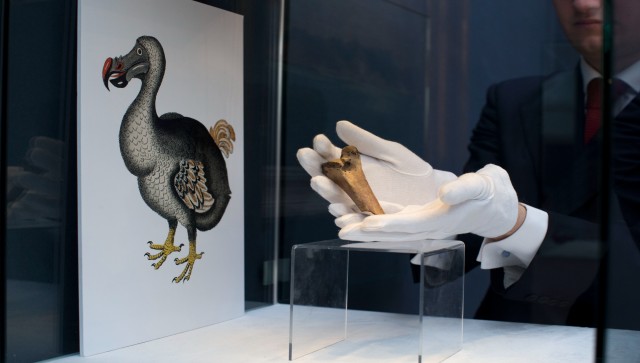
 "Can the dodo be brought back from the dead?")
Everyone knows the saying “as dead as a dodo.” Well, we may soon have to bid bye-bye to that phrase. A US-based biotech firm is partnering with a Mauritius wildlife foundation to “de-extinct” the species that died out in 1681. But what do we know? And how would such a de-extinction work? Let’s take a closer look: What do we know? The company behind the plan is Colossal Biosciences, as per IFLScience.com. The genetic engineering firm has partnered with the Mauritian Wildlife Foundation. This is a nonprofit group with close links to the government. As per CNN, Colossal Biosciences lead paleogeneticist Beth Shapiro has finished sequencing the dodo’s genome. The company says it has also fully sequenced the genome of two other birds that will play a vital role in the process – an extinct relative of the dodo’s called the solitaire and the dodo’s closest living relative the Nicobar pigeon. How would it work? As per CNN, Colossal researchers have discovered that cells known as primordial germ cells (PGCs) can be produced in a chicken embryo. The question is now whether these cells can transform into sperm and eggs. Scientists previously used PGCs to create a chicken whose father was a duck. They did this by placing PGCs into the duck embryo – which resulted in an adult duck with the sperm of a rooster. The duck then mated with a hen – which produced a chick.
Colossal says this is the plan of action.
It will first see how the dodo and solitaire genes compare with that of the Nicobar pigeon. They will then alter the PGCs so that it manifests the physical traits of a dodo. The PGCs will then be put into the embryos of a sterile chicken and rooster. Now, in theory, the chicken and rooster will become fertile and their offspring will have the traits of the dodo. “Physically, the restored dodo will be indiscernible from what we know of the dodo’s appearance,” Colossal’s chief animal officer Matt James told CNN via email. As Colossal Biosciences founder and CEO Ben Lamm explained to IFLScience, “First you need to look at, what is the closest phylogenetic relative? What is the animal that is still existing on the planet that’s the closest on the family tree?” “You need to find the closest phylogenetic relative because you’ve got to find and build a reference genome, and you need tissue samples to do that.” “Then, you’ve got to get tissue samples containing the ancient DNA of those extinct species. Ancient DNA is different from existing living DNA, because it’s massively fragmented. It’s not all exogenous, meaning that there are other microbes and living things that have contaminated it over time. So you get snippets of ancient DNA and then you basically piece them together,” Lamm added. Shapiro, speaking to Discover Wildlife, remained cautious. “There are a tonne of existing technical challenges that would need to be solved in order to bring a dodo back to life,” Shapiro said.
Besides, bringing the dodo back doesn’t solve the issue of why it went extinct in the first place.
“We believe that dodos became extinct because introduced species including rats, cats and pigs consumed their eggs. Because dodos didn’t fly, they nested on the ground. This made their nests easy access for potential predators and consumers of eggs. It would not make sense to bring dodos back to Mauritius unless this challenge could be solved,” Shapiro said. James, speaking to IFLScience, echoed Shapiro. “Colossal’s de-extinction projects are only successful if the animals are rewilded and brought back to their natural habitat. We look forward to working with Mauritius to ensure this happens with the dodo,” James said. Beth also cautioned at looking at de-extinction as a silver bullet for humanity’s ails. “De-extinction is not a solution to the extinction crisis of the present day,” Beth told Discover Wildlife. “We may get close someday. We may figure out how to make enough changes in a genome that we can engineer something that is physically similar to a dodo. And maybe that bird, returned to the Mauritian ecosystem, will fill the ecological niche that the dodo once filled and provide some improved stability to the Mauritian ecosystem. And that would be great.” The company previously announced its plan to genetically resurrect the woolly mammoth. With inputs from agencies


 "Russian drones over Poland: Trump’s tepid reaction a wake-up call for Nato?")
 "As Russia pushes east, Ukraine faces mounting pressure to defend its heartland")
 "Why Mossad was not on board with Israel’s strike on Hamas in Qatar")
 "Turkey: Erdogan's police arrest opposition mayor Hasan Mutlu, dozens officials in corruption probe")
 "Russian drones over Poland: Trump’s tepid reaction a wake-up call for Nato?")
 "As Russia pushes east, Ukraine faces mounting pressure to defend its heartland")
 "Why Mossad was not on board with Israel’s strike on Hamas in Qatar")
 "Turkey: Erdogan's police arrest opposition mayor Hasan Mutlu, dozens officials in corruption probe")



