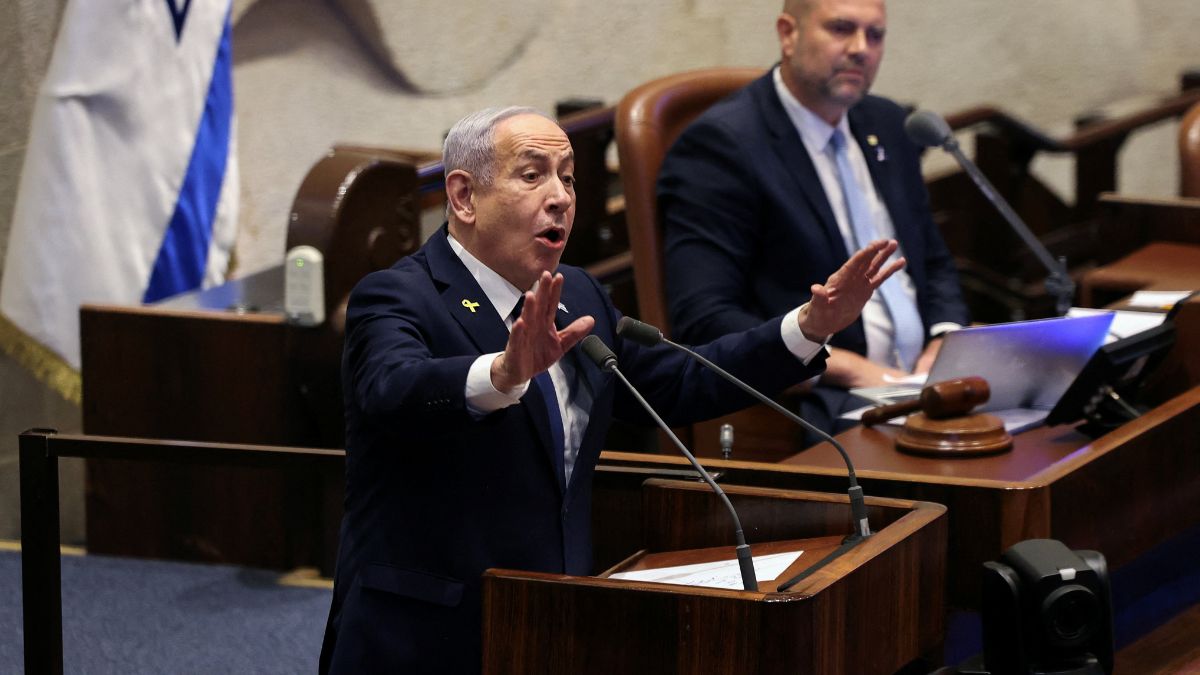
 "Israeli Prime Minister Benjamin Netanyahu speaks at the plenum of the Knesset, Israel's parliament, in Jerusalem, November 10, 2025. File Image/Reuters")
Israeli Prime Minister Benjamin Netanyahu has submitted a rare and highly contentious request for a presidential pardon even as his years-long corruption trial continues.
His plea places President Isaac Herzog in an unprecedented position, and comes at a time when Israel is navigating deep internal fractures and ongoing national security crises.
Netanyahu’s action — a pre-conviction appeal unusual in Israeli history — has drawn sharp rebuttals from legal experts.
How Netanyahu submitted a pardon request
Netanyahu’s legal team formally approached the Israeli president on Sunday, asking for clemency before the conclusion of the judicial process.
His lawyers argued that doing so would help ease internal conflict and contribute positively to Israel’s collective interests.
Netanyahu reinforced their submission by appearing in a short video released by the Likud party, where he stated, “My lawyers sent a request for pardon to the president of the country today. I expect that anyone who wishes for the good of the country support this step.”
He did not acknowledge any wrongdoing nor concede any aspect of the charges he currently faces.
Instead, he highlighted the strain imposed by the trial’s intensity, explaining that he is required to appear in court multiple times weekly, a commitment he described as incompatible with directing the country’s affairs.
Netanyahu insisted that he still believes the legal proceedings would ultimately result in his full exoneration if allowed to continue.
Despite this, Netanyahu contended that the demand to testify three times a week during a period of heightened security challenges makes it impossible to serve effectively.
In his words, the courtroom schedule amounts to “an impossible demand that is not made of any other citizen.”
This argument ties directly to the timeline of his indictment and trial. The charges — announced by the Justice Ministry in 2019 — have been the subject of legal examination for years, with the trial formally beginning in 2020.
It has been prolonged by political deadlocks, elections, wartime emergencies, and repeated postponements requested by Netanyahu’s defence.
Netanyahu’s request becomes even more unusual in light of traditional Israeli presidential pardons, which have typically been considered only after all legal processes have been exhausted and a conviction has been handed down.
What Netanyahu is accused of
At the heart of the controversy are three interconnected corruption cases — frequently referred to in Israel as Cases 1000, 2000, and 4000. Together, they involve allegations of bribery, fraud, and breach of trust.
These cases revolve around accusations that:
Netanyahu accepted valuable gifts from billionaires and political benefactors.
He used his public office to provide regulatory or political benefits to a major telecommunications company.
He attempted to negotiate preferential news coverage with a prominent media publisher.
The Justice Ministry moved forward with indictments only after prolonged investigations involving police, prosecutors, and testimony from numerous figures in business, media, and politics.
Netanyahu has rejected all allegations and insists that the charges are part of a long-running political campaign aimed at removing him from leadership.
Throughout his trial, Netanyahu has portrayed the cases as politically motivated, reiterating the claim that he has been targeted by an entrenched establishment.
Prosecutors, however, argue that the prime minister abused his authority to a degree that warrants serious criminal penalties, with the three cases collectively representing one of the most significant corruption trials in Israel’s history.
What Netanyahu’s defence has been
Netanyahu has pointed to Israel’s continuing security operations — including confrontations with Hamas, tensions with Hezbollah, and the recent conflict with Iran — as reasons the trial should be halted.
In his statement following the public revelation of the pardon request, Netanyahu said he believed it would benefit Israel by reducing internal friction and creating an environment more conducive to political and social cohesion.
He suggested that concluding the legal chapter quickly would help ease national tensions and contribute to what he characterised as an essential need for “broad reconciliation.”
Netanyahu also referenced United States President Donald Trump’s interventions. Earlier this month, Trump sent a letter to Herzog urging him to grant Netanyahu a pardon, calling the corruption case “a political, unjustified prosecution.”
Trump had previously spoken in the Israeli Knesset recommending a pardon while Herzog stood beside him. Netanyahu cited this support, saying that Trump’s call sought to allow him to pursue vital mutual interests between Israel and the United States.
Government members aligned with Netanyahu echoed his concerns. Defence Minister Israel Katz called for the charges to be dismissed, describing them as flawed, while other coalition figures, including Itamar Ben-Gvir and Bezalel Smotrich, joined in publicly supporting the prime minister.
How experts have reacted
Experts focused on the unprecedented nature of a sitting prime minister requesting a pardon while criminal proceedings are ongoing.
Opposition leader Yair Lapid criticised the prime minister’s move, stating that Netanyahu should not be pardoned unless he admits guilt, expresses remorse, and withdraws from political life immediately.
He said, “You cannot grant Netanyahu a pardon without an admission of guilt, an expression of remorse and an immediate withdrawal from political life.”
Others echoed the principle that Israeli democracy requires accountability from leaders. Former military chief Gadi Eisenkot addressed Netanyahu directly, declaring, “Netanyahu, Israel is a state governed by the rule of law. There cannot be one legal system for ordinary citizens and another for you.”
Watchdog groups and legal scholars also warned of the dangers. Yohanan Plesner of the Israel Democracy Institute argued that Netanyahu was framing the request in a way that absolves him of responsibility while presenting it as an act of public service.
He said the request sends a “problematic message to all public figures and to what our public norms might look like.”
Legal professionals stressed that a pardon would not automatically stop the legal process unless the attorney general decided to halt prosecution.
Emi Palmor, the former director general of the Justice Ministry, explained that only the attorney general could suspend proceedings, pointing out that a presidential pardon does not directly terminate the trial.
Others raised concerns regarding equality before the law. Israeli legal experts have emphasised that a sitting prime minister requesting clemency during an active trial has no precedent in the country’s history.
They maintain that bypassing judicial outcomes risks undermining public trust in legal institutions.
How Herzog has responded
Herzog’s office described the request as “extraordinary” and affirmed that it would be reviewed through established procedures.
According to the presidency, the clemency petition has been forwarded to the Justice Ministry’s pardons department, an entity responsible for gathering necessary professional opinions.
Once compiled, those assessments will be transmitted to the president’s legal adviser, who will prepare recommendations for Herzog. The president has said that he will review all submissions fully and responsibly.
Although Herzog and Netanyahu have had political differences in the past, their working relationship is considered functional.
Herzog previously expressed that a legal settlement might be the most appropriate resolution to the prime minister’s legal troubles, though such an arrangement has not materialised.
The Israeli Constitution and precedent give the president broad authority regarding pardons, but the framework has rarely been used before conviction.
The Israel Democracy Institute noted earlier this month that pardons issued before judicial processes are complete are extremely unusual and risk eroding rule-of-law principles.
What this means for Netanyahu & Co.
Netanyahu, the longest-serving prime minister in Israeli history, has been a dominant figure since first taking office in 1996.
He has navigated multiple terms and prolonged electoral deadlocks. His current coalition, formed after elections in late 2022, is regarded as the most right-wing in Israel’s modern history.
His tenure has been marked by major crises, including wars, diplomatic rifts, and internal upheavals. The October 7, 2023 Hamas attack — the deadliest single-day assault on Jews since the Holocaust — occurred while Netanyahu was in office.
The ensuing Gaza war has caused massive destruction and casualties, drawing substantial international criticism.
Israel has also simultaneously faced confrontations with Hezbollah and Iran.
Supporters argue that these challenges justify alleviating Netanyahu’s legal burdens to ensure effective national leadership.
At the same time, Netanyahu’s critics point to the judicial overhaul proposed by his government shortly after taking office, which sought to limit court powers.
Massive protests erupted in 2023 as opponents warned the measures threatened democratic checks and balances. The plan was frozen after October 7, but parts of it resurfaced in 2025, adding to the mistrust surrounding the prime minister.
What next
The next steps follow a formal and procedural structure:
Justice Ministry Review – The pardons department collects legal opinions from relevant authorities.
Presidential Legal Assessment – These submissions go to the president’s legal adviser for analysis.
Final Recommendation – The adviser prepares guidance for President Herzog.
Presidential Decision – Herzog ultimately decides whether to approve or deny the request.
Legal experts stress that the president is not bound by the recommendations, though they traditionally carry weight.
They also emphasise that pausing the trial is not automatic; only the attorney general has that authority.
The process could take weeks or months.
With inputs from agencies