

 "How Bangladesh leader’s threat to cut off India’s ‘Seven Sisters’ has sparked a diplomatic row")
A diplomatic row has erupted between India and Bangladesh after a rise in anti-India rhetoric in the neighbouring country. Amid this, India summoned the Bangladesh High Commissioner in Delhi on Wednesday (December 17) over recent threats to the security of the Indian mission in Dhaka.
The development comes in the wake of provocative remarks against India by some Bangladeshi politicians. Ties between New Delhi and Dhaka have been strained since the ouster of former Bangladesh Prime Minister Sheikh Hasina last August.
Let’s take a closer look.
Anti-India remarks by Bangladesh leaders
Bangladesh’s National Citizen Party (NCP) leader, Hasnat Abdullah, known for his anti-India rhetoric, made hostile remarks against India recently. He threatened to isolate the Seven Sisters and provide refuge to Northeast separatists if Bangladesh is destabilised.
The northeastern states of Arunachal Pradesh, Assam, Manipur, Meghalaya, Mizoram, Nagaland, and Tripura are collectively referred to as the Seven Sisters. Assam, Meghalaya, Tripura and Mizoram share a long and porous land border with Bangladesh.
“If Bangladesh is destabilised, the fire of resistance will spread beyond borders. Since you are housing those who destabilise us, we will give refuge to the separatists of Seven Sisters too,” Abdullah, chief organiser (southern region) of the student-led NCP, said Monday (December 15), as per ThePrint.
“I want to say clearly to India that if you shelter forces who do not respect Bangladesh’s sovereignty, potential, voting rights and human rights, Bangladesh will respond,” he added.
Abdullah was speaking at an all-party protest rally organised by the anti-Hasina platform Inqilab Mancha in Dhaka’s Central Shaheed Minar.
In a veiled attack, he criticised “vultures” for trying to exert control over Bangladesh even after 54 years of independence.
Quick Reads
View AllNCP convener Nahid Islam on Monday called for nationwide rallies on Bangladesh’s Victory Day against alleged “Indian interference”.
Victory Day marks Bangladesh’s independence from Pakistan in 1971.
“On Victory Day tomorrow, we will not take to the streets for celebration. We will take to the streets for resistance. In Dhaka and across Bangladesh, we will hold resistance rallies against Indian hegemony and all anti-Bangladesh conspiracies,” he was quoted as saying by ThePrint.
Abdullah’s controversial remarks on India’s northeast drew backlash, with Assam Chief Minister Himanta Biswa Sarma issuing a warning to Dhaka.
He said that leaders in New Delhi would not remain silent for long if the Bangladesh leaders continue to threaten to cut off the northeastern region from India’s mainland.
“There have been statements from Bangladesh for a year, calling for a merger of the northeast with that country. It is wrong for Bangladesh to even imagine this,” Sarma told journalists.
Underlining that India is a large country, a nuclear nation, and the world’s fourth largest economy, he said the people of Bangladesh have a “bad mindset”. “We should not help the country and let them know that we will not remain silent if such behaviour is directed at India,” he said.
Bangladesh envoy summoned
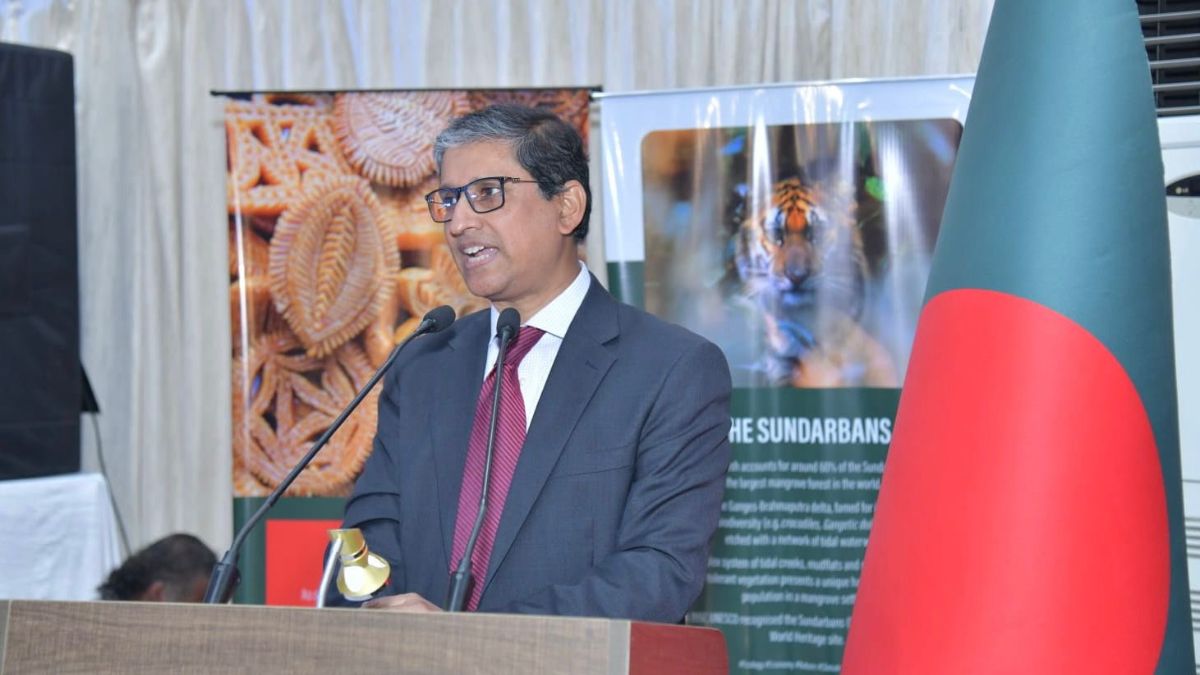
The Ministry of External Affairs (MEA) summoned Bangladesh High Commissioner M Riaz Hamidullah over security concerns of the Indian High Commission in Dhaka.
This came after protests outside the Dhaka mission for the past few days, people familiar with the matter told Hindustan Times (HT).
The MEA said in a statement: “The Bangladesh High Commissioner to India, Riaz Hamidullah, was today summoned by the Ministry of External Affairs and apprised of India’s strong concerns at the deteriorating security environment in Bangladesh. His attention was drawn, in particular, to the activities of some extremist elements who have announced plans to create a security situation around the Indian Mission in Dhaka.”
“India completely rejects the false narrative sought to be created by extremist elements regarding certain recent events in Bangladesh. It is unfortunate that the interim government has neither conducted a thorough investigation nor shared meaningful evidence with India regarding the incidents,” the MEA further said.
The Bangladesh High Commissioner to India, Riaz Hamidullah, was today summoned by the Ministry of External Affairs and apprised of India’s strong concerns at the deteriorating security environment in Bangladesh. His attention was drawn, in particular, to the activities of some… https://t.co/6GOZHBOgsB pic.twitter.com/jNdxSK0Nc3
— ANI (@ANI) December 17, 2025
Diplomatic tensions flared between the two countries after an assassination attempt on Sharif Osman Hadi, a candidate in the upcoming parliamentary elections, last week in Dhaka.
This led to Bangladesh’s Ministry of Foreign Affairs summoning Indian High Commissioner Pranay Verma, urging New Delhi to arrest and hand over the suspects if they had entered Indian territory.
India responded sharply, dismissing the claims. The MEA said it “categorically rejects” allegations that Indian territory is being used for activities inimical to Bangladesh’s interests. It added that New Delhi has never allowed such actions.
Row over Bangladesh leaders’ northeast baiting
Abdullah’s incendiary remarks have evoked memories of Dhaka’s past role in insurgency in India’s Northeast. India has long suspected that militant and separatist groups active in the Northeast used Bangladesh as a safe haven, transit route and logistics base, particularly during the late 1990s and early 2000s.
Militants frequently crossed the border to evade Indian forces, regrouped in Bangladesh, and came back to carry out attacks in India, as per a News18 report.
In Tripura, separatist groups such as the National Liberation Front of Tripura (NLFT) and the All Tripura Tiger Force (ATTF) were linked by Indian security agencies to camps and handlers based in Bangladesh.
Officials alleged that insurgents received training and arms procurement in Bangladesh.
Bangladesh has also been home to Islamist extremist networks. Outfits such as Harkat-ul-Jihad-al-Islami (HuJI) and Jamaat-ul-Mujahideen Bangladesh (JMB) have come under the scanner of Indian agencies for their cross-border presence and for facilitating radicalisation and logistics networks in eastern India.
Under Sheikh Hasina, a crackdown was launched in Bangladesh on anti-India insurgent groups. Her government dismantled extremist networks and handed over several wanted militants, resulting in an improvement of bilateral cooperation.
But since Muhammad Yunus became Bangladesh’s interim leader last August following Hasina’s ouster from power, New Delhi and Dhaka have grown apart. Yunus’ previous remarks on India’s northeast have also angered New Delhi.
During his trip to China in April, the Bangladesh leader had called Northeast India “landlocked”, with “no way to reach out to the ocean”.
Batting for an “extension of the Chinese economy”, Yunus said Bangladesh is the “only guardian of the ocean for all this region”.
His remarks had sparked an uproar in India, with political leaders from the northeast leading the charge against him.
With inputs from agencies


 "Bangladesh Protests Live: Police, army on street as post-Hadi violence targets Indian missions, Awami offices")
 "Who was Claudio Valente, Brown University shooting suspect who also killed MIT professor?")
 "Ukraine to US midterms: Will 2026 seal Trump's place in history?")
 "Bill Gates, quotes from ‘Lolita’ on woman’s body: What newly released Epstein photos reveal")
 "Bangladesh Protests Live: Police, army on street as post-Hadi violence targets Indian missions, Awami offices")
 "Who was Claudio Valente, Brown University shooting suspect who also killed MIT professor?")
 "Ukraine to US midterms: Will 2026 seal Trump's place in history?")
 "Bill Gates, quotes from ‘Lolita’ on woman’s body: What newly released Epstein photos reveal")



