 "Why Bangladesh’s China-backed drone factory is raising alarm bells in India")
Bangladesh’s move to establish a domestic unmanned aerial vehicle (UAV) manufacturing capability through a defence partnership with China has introduced a new strategic variable into South Asia’s security landscape.
The agreement, formally cleared by Bangladesh’s interim administration and backed by state funding, marks a shift from arms procurement to defence-industrial collaboration — placing Chinese technology, and long-term operational presence within close proximity of India’s eastern and northeastern frontiers.
While Dhaka has positioned the initiative as a step toward self-reliance, humanitarian support, and force modernisation, the scale, location, and Chinese involvement in the project have prompted careful scrutiny in New Delhi.
Indian strategists increasingly interpret the development as part of a broader regional pattern in which Beijing embeds itself within neighbouring countries’ military ecosystems through infrastructure, technology transfer, and production facilities rather than one-off equipment sales.
Inside the Bangladesh-China UAV manufacturing agreement
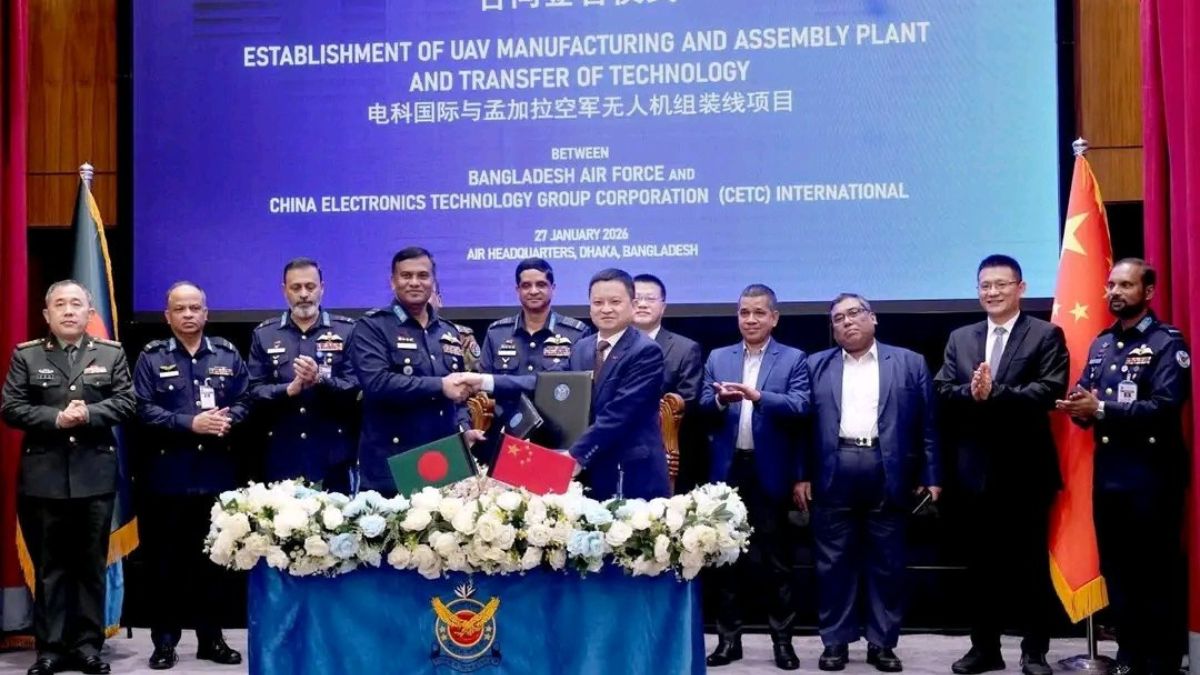
The defence agreement was signed on January 27, between the Bangladesh Air Force (BAF) and China Electronics Technology Group Corporation International (CETC), a state-owned Chinese defence electronics firm.
The signing took place at the Bangladesh Air Force headquarters in Dhaka Cantonment, underscoring the institutional nature of the collaboration.
In an official statement, Bangladesh’s defence ministry confirmed the scope of the partnership, stating, “Under the agreement, BAF and CETC will jointly set up a facility to produce and assemble state-of-the-art UAVs.”
The ministry added that the arrangement includes technology transfer from the Chinese side as well as structured capacity-building measures aimed at enabling Bangladesh to independently manufacture UAVs over the long term.
The agreement outlines a phased approach. In the initial stage, the Bangladesh Air Force will acquire the capability to manufacture and assemble multiple UAV categories, including Medium Altitude Low Endurance (MALE) drones and Vertical Take-off and Landing (VTOL) platforms.
These systems are expected to be deployed for both civilian and military purposes. According to the official release, the UAVs produced under the partnership will support humanitarian assistance and disaster management operations, in addition to their use in military missions.
The inclusion of civilian applications has been emphasised by Bangladeshi authorities as a key justification for the project, particularly in a country prone to natural disasters.
The signing ceremony was attended by several senior figures from both countries.
Present on the occasion were Air Chief Marshal Hasan Mahmood Khan, Chinese Ambassador to Bangladesh Yao Wen, Principal Staff Officer of Bangladesh’s Armed Forces Division Lieutenant General SM Kamrul Hasan, and senior representatives from the Chief Adviser’s office, including Secretary Mohammad Saifullah Panna.
The UAV manufacturing facility is reportedly planned at the proposed Bogra airbase, a site that Bangladeshi officials have described as strategically located.
The project involves not only the establishment of a production and assembly line but also the development of infrastructure associated with the airbase itself.
Formally titled “Establishment of Manufacturing Plant and Transfer of Technology (ToT) for Unmanned Aerial Vehicles (UAVs),” the project has been approved by Bangladesh’s finance ministry following clearance from Chief Adviser Muhammad Yunus, who currently oversees the defence portfolio.
The Bangladesh Air Force has been designated as the implementing authority.
How much the deal will cost
The total approved cost of the project stands at Tk 608.07 crore, equivalent to roughly $55 million, following negotiations with the Chinese partner that reduced the original proposal.
The financial structure of the project has been laid out across four fiscal years, reflecting a phased implementation model rather than a single large expenditure.
Of the total amount, Tk570.60 crore has been earmarked specifically for the importation and installation of manufacturing infrastructure and associated technology.
The remaining funds cover domestic expenditures such as value-added tax, letter-of-credit charges, and other local costs.
Annual spending begins with an allocation of Tk106 crore in the current fiscal year.
Notably, the project will be funded entirely from the Bangladesh Air Force’s existing budget, with no additional allocations planned from the national exchequer.
This funding structure has been presented by Dhaka as evidence that the initiative aligns with existing defence planning rather than representing an extraordinary or reactive expenditure.
CETC International, Bangladesh’s Chinese partner, is a subsidiary of China Electronics Technology Group Corporation, a state-owned conglomerate with a wide portfolio spanning radars, UAVs, telecommunications equipment, electronic warfare systems, secure networks, and military software.
The company’s systems are reportedly in service across more than 110 countries, covering Asia and Africa. CETC also operates as an investment and asset management firm alongside its defence electronics role.
Despite its global footprint, CETC is a sanctioned entity in the United States, a detail that has not gone unnoticed by regional observers tracking the implications of its growing presence in South Asia.
What drones could be produced and their operational role
While Bangladeshi authorities have not officially disclosed the exact UAV model to be manufactured, multiple reports suggest that the platform could be the XY-I, a medium-sized MALE drone developed by CETC and unveiled at Airshow China 2022.
A scale model of the aircraft was displayed at the event, drawing attention for its design similarities to Turkey’s Bayraktar TB2.
According to CETC, the XY-I is designed for both civilian and military missions and offers full autonomous flight capabilities along with all-day endurance.
The drone is intended to support a wide spectrum of tasks, including reconnaissance, surveillance, border patrol, electronic warfare, communications support, and attack roles.
The aircraft features a blended wing body configuration and an inverted V-tail, characteristics that mirror those seen on the Bayraktar TB2. However, it differs in engine layout, employing a two-blade pusher propeller rather than the configuration used on the Turkish platform.
CETC has stated that the XY-I supports a broad range of rapidly interchangeable payloads. These include electro-optical sensors, reconnaissance modules, communications systems, and weapons such as bombs and air-to-surface missiles.
Detailed technical specifications, including range, endurance, and payload capacity, have not been publicly disclosed by the company.
Beyond the airframe itself, analysts note that CETC’s expertise lies in advanced defence electronics rather than basic manufacturing alone. The company’s strengths in sensor fusion, secure data links, and electronic warfare architectures could enable Bangladesh to integrate UAVs into a wider network-centric operational environment.
This would allow drones to function as part of an interconnected battlespace rather than as isolated reconnaissance platforms.
How China is expanding its defence footprint in Bangladesh
China has been Bangladesh’s principal supplier of defence equipment for decades, and the UAV manufacturing agreement builds upon an already extensive military relationship.
Bangladesh’s armed forces currently operate a range of Chinese-origin platforms, including submarines, surface combatants, radar systems, and combat aircraft.
According to several reports, the Bangladesh Air Force is also in the final stages of negotiating a $2.2 billion deal to acquire 20 Chengdu J-10C “Vigorous Dragon” multi-role fighter jets.
The proposed acquisition is intended to replace ageing F-7 and MiG-29 aircraft and significantly enhance the BAF’s air combat capabilities.
Between 2019 and 2023, Bangladesh accounted for approximately 11 per cent of global Chinese arms exports.
The UAV manufacturing project represents a qualitative shift in this relationship by embedding production and technology transfer within Bangladesh rather than relying solely on imports.
From Beijing’s perspective, situating a drone manufacturing facility in Bangladesh offers multiple advantages. The location provides logistical depth and the potential to service South Asian, Southeast Asian, and even West Asian markets from a geographically central hub.
The project also complements China’s broader Belt and Road-linked investments in Bangladeshi ports, transport corridors, and infrastructure, reinforcing dual-use synergies that blur the distinction between civilian development and latent military utility.
By transitioning from arms sales to defence-industrial integration, China increases the long-term interdependence between its systems and Bangladesh’s military planning.
Why India is concerned
New Delhi views the development through the prism of its broader security environment, particularly given Bangladesh’s proximity to India’s northeastern corridor and the two countries’ shared 4,096-kilometre land border.
Indian officials and analysts have expressed concern that long-endurance MALE UAVs operating from Bangladeshi territory could enhance surveillance, reconnaissance, and electronic intelligence-gathering capabilities in regions close to Indian airspace.
The potential for armed UAVs to operate near sensitive border areas has added to these apprehensions.
Several observers have also warned that the establishment of a Chinese-backed drone facility could deepen Beijing’s access and influence within the Bangladeshi armed forces.
Concerns have been raised that the technology involved could allow monitoring of regions along the Indian border, with intelligence potentially serving broader Chinese military objectives.
Following the change of power in Dhaka in 2024, interim leader Muhammad Yunus has accelerated defence and economic engagement with China. This recalibration culminated in multi-billion-dollar agreements signed during his March 2025 visit to Beijing.
Indian policymakers increasingly frame such developments within the context of Beijing’s incremental encirclement strategy, often referred to as the “String of Pearls,” which describes China’s expanding influence across South Asia and the Indian Ocean region.
In this framework, the Bay of Bengal is no longer seen as a peripheral theatre but as a core node in China’s evolving Indo-Pacific defence diplomacy.
With inputs from agencies


 "Why Ajit Pawar was fondly called the ‘dada of Maharashtra politics’")
 "Starmer heads to China, doesn't want UK to 'blow hot and cold' but…")
 "The Learjet 45, the plane that crashed with Ajit Pawar on board in Baramati")
 "India–EU FTA's biggest dividend is not trade; it's co-creation: Febi secretary general | Exclusive")
 "Why Ajit Pawar was fondly called the ‘dada of Maharashtra politics’")
 "Starmer heads to China, doesn't want UK to 'blow hot and cold' but…")
 "The Learjet 45, the plane that crashed with Ajit Pawar on board in Baramati")
 "India–EU FTA's biggest dividend is not trade; it's co-creation: Febi secretary general | Exclusive")