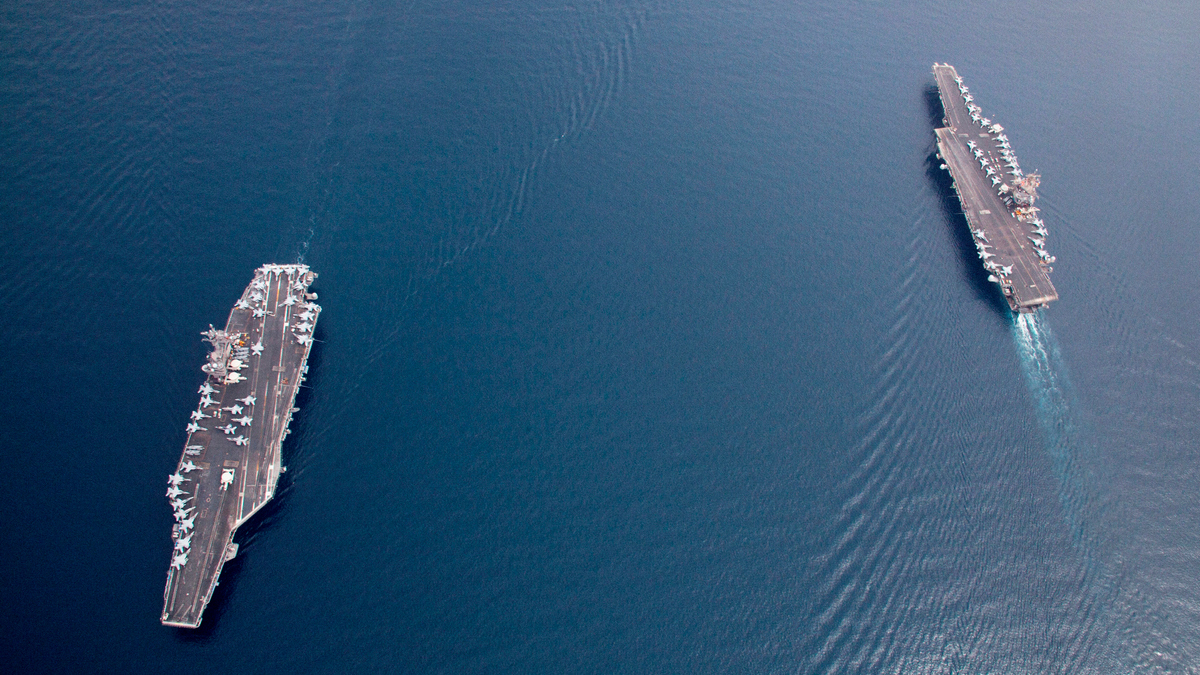
 "The US Navy's USS Enterprise passes the the USS George HW Bush during a transit of the Strait of Bab el Mandeb. Reuters")
After the Strait of Hormuz, a new front could be opening up in the Iran war.
Iran has now threatened to block the Bab el-Mandeb Strait if the United States attempts to take Kharg Island. The development comes as Tehran has dismissed a 15-point ceasefire proposal from the US and offered its own list of demands.
There is also speculation that the United States is preparing to launch a ground invasion of Iran. Tehran has also warned that it is closely monitoring US troop movements in West Asia.
But what happened? What is the Bab el-Mandeb Strait which Iran is threatening to block? What could be the result of such a move?
What happened?
Iran has threatened to cut off access to the Bab el-Mandeb Strait.An Iranian military source has warned that any US-Israeli operations against Kharg Island or other territory could result in areas including the Bab el-Mandeb Strait being cut off.
“If the enemy attempts any ground action on Iranian islands or any part of our territory, or tries to impose costs on Iran through naval movements in the Persian Gulf or the Sea of Oman, we will open other fronts as a ‘surprise,’” the source was quoted as saying by Iran’s semi-official Tasnim News Agency on Wednesday.
The source singled out the Bab el-Mandeb Strait.
“If the Americans intend to take reckless actions regarding the Strait of Hormuz, they should be careful not to add another strait to their list of challenges,” the source added.
The development comes after Iran’s Speaker of Parliament, Mohammad Bagher Ghalibaf, warned that Tehran had received inputs that its “enemies” are preparing to seize one of Iran’s islands with support from a regional nation.
“Our forces are monitoring all enemy movements, and if they take any step, all vital infrastructure of that regional state will be targeted with continuous, relentless attacks,” Ghalibaf wrote on X.
All about the Bab el-Mandeb Strait
Much like Hormuz, the Bab el-Mandeb is also a narrow maritime passage. Known as the ‘Gate of Tears’, the strait is just around 29 kilometres wide at its narrowest point.
The Bab el-Mandeb connects the Red Sea to the Gulf of Aden and the Arabian Sea. It is located between Yemen and the Horn of Africa nations of Djibouti and Eritrea. Like Hormuz, it is a critical route for global trade and energy supplies. It connects Europe, Africa and West Asia.
As per CNN, around 12 per cent of the world’s seaborne-traded oil and a significant percentage of liquefied natural gas passes through the Bab el-Mandeb Strait every year. In 2023, the Bab el-Mandeb witnessed around 8.8 million barrels of oil per day and large LNG shipments passing through the route, according to the US Department of Energy. It is also a key passageway for ships heading to the Suez Canal.
The key Red Sea trade route witnesses $1 trillion (Rs. 93.95 lakh crore) worth of goods pass through it every year. The Houthis in Yemen, a key ally of Iran in the region, began launching attacks on commercial ships in the Red Sea during the Gaza war. The Houthis, who launched a hundred attacks, did so in solidarity with the Palestinian people.
According to The Times of India, the Houthis sank four ships in the Red Sea despite attempts from America and European nations to protect shipping vessels.
“It was a tactical and operational victory and a strategic draw, if not a strategic defeat,” Joshua Tallis, a naval analyst at CNA, was quoted as saying. Already, many shipping companies avoid the Red Sea route. Experts have been keeping their eyes on the Houthis since the beginning of the Iran war. They say it could be only a matter of time before the Houthis come into play.
What could be the result of such a move?
If the Bab el-Mandeb, like Hormuz, becomes off-limits, even more ships will have to take the scenic route by sailing around the Cape of Good Hope in southern Africa. This could make a 20 to 25-day journey last as long as 30 to 40 days. This, in turn, will increase shipping costs, which will make everything more expensive.
Shipping giant Maersk has already halted some Red Sea transits amid fears the route could soon become unsafe, according to a March 1 report.
“Due to the deteriorating security situation in the Middle East region following the escalating military conflict, we have decided… to pause future Trans-Suez sailings through the Bab el-Mandeb Strait for the time being,” Danish container shipping group Maersk said.
The price of crude oil, which has remained over $100 per barrel (Rs. 9,395) in recent days, could also skyrocket.
“The war’s about to get wider and uglier,” Lebanese-Australian podcast host Mario Nawfal, reacting to the Houthi threat, was quoted as saying by India Today.
“If the Houthis go full military alliance with Iran and shut down another key waterway (Bab al-Mandeb), the Red Sea becomes a complete no-go zone, oil prices explode again, and global trade gets choked even harder,” Mario Nawfal posted on X.
Youssef Cherif, the Director of the Columbia Global Centre in Tunis, said that the Houthis blocking the Bab el-Mandeb is part of “Iran’s three-stage strategy”.
“First, the attacks by Iran that blocked Hormuz. Then, the attacks on Lebanon that are distracting Israel. And next will come the Houthis, who’ll block Bab el-Mandeb,” Cherif posted on X.
However, the importance of the Bab el-Mandeb cannot compare with the Strait of Hormuz, which handles roughly one-fifth of global oil and liquefied natural gas supplies. As Kuwait Petroleum CEO Sheikh Nawaf Saud Al-Sabah explained, “There is no substitute for the Strait of Hormuz. It is the world’s strait, under international law and practical reality.”
FAQs
1) Why is the Bab el-Mandeb Strait so important?
The Bab el-Mandeb Strait is a critical maritime chokepoint connecting the Red Sea to the Gulf of Aden and the Arabian Sea. Around 12 per cent of the world’s seaborne oil and large volumes of liquefied natural gas pass through it. It also serves as a key route for ships heading to and from the Suez Canal, linking Europe, Africa and West Asia.
2) What happens if the Bab el-Mandeb Strait is blocked?
If the strait becomes off-limits, ships would have to reroute around the Cape of Good Hope in southern Africa. This would significantly increase travel time—from about 20–25 days to 30–40 days—raising shipping costs and, in turn, making goods and energy more expensive globally.
3) How does this compare to the Strait of Hormuz?
While the Bab el-Mandeb is vital, it is less critical than the Strait of Hormuz, which handles roughly one-fifth of global oil and LNG supplies. A disruption in Hormuz would have a far greater immediate impact on global energy markets, but blocking Bab el-Mandeb would still severely disrupt trade and supply chains.
With inputs from agencies