 "An Indian family loaned Rs 35,000 to the British and now wants it back. Why?")
A century-old pending bill from Madhya Pradesh’s Sehore district is making headlines after a financial claim dating back to the colonial era has surfaced. A family alleges that the British government owes them money borrowed over a century ago, and they have the proof.
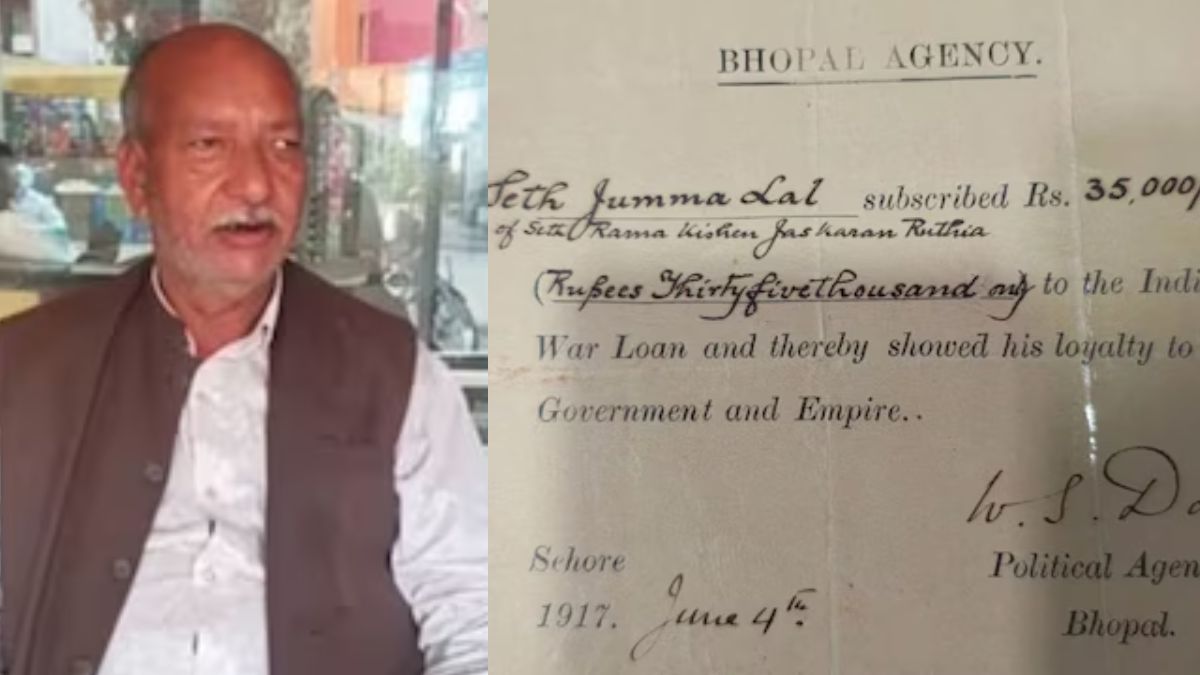
Vivek Ruthia, 63, claims that his late grandfather, Seth Jumma Lal Ruthia, a prominent businessman of Sehore, loaned Rs 35,000 to the British administration in 1917. According to him, the amount, which would now run into crores, was never repaid, News18 reported. The family is now considering sending a legal notice to the British government.
A war loan that the British never repaid
In 1917, when the world was in the grip of war and the colonial administration was under immense financial pressure, local British officials reportedly approached Seth Jumma Lal Ruthia, a prominent trader in cloth and grain in Sehore, for assistance. Ruthia advanced Rs 35,000 to WS Davis, then a British political agent in Bhopal under British rule.
According to the Ruthia family, the amount was given to assist in administrative management in the Bhopal princely state back then. News18 Hindi reported that the patriarch extended the loan and received written documentation confirming the debt and promising repayment.
However, the matter was later forgotten after India’s independence in 1947. And now, more than a century later, Seth Jummalal’s grandson says the money was never repaid as the matter remained unsettled and eventually slipped into obscurity.
“In 1917, my grandfather, the late Seth Jumma Lal Ruthia, loaned Rs 35,000 to the British government. That amount has not been repaid to this day,” Vivek said as quoted by the NDTV.
Document discloses family contribution
Vivek claimed that the family recently found documentary evidence, including certificates and correspondence among old records and a family will following the death of his father, Seth Manak Chand Ruthia. He also noted that the papers had remained in the family’s possession for more than two decades, and that this came to light recently during internal discussions.
According to him, the documents indicate that the loan was taken to streamline administrative management in the Bhopal princely state during British rule and was classified as a war loan.
The document, dated June 4, 1917, mentioned in the report, says, “Seth Jumma Lal of the firm of Seth Rama Kishan Jaskaran Ruthia subscribed ₹35,000 (Rupees thirty five thousand only) to the Indian War Loan and thereby showed his loyalty to the Government and Empire.”
The document appears to have a signature of WS Davis. He was among the officials who managed relations with local rulers, oversaw administrative affairs, and ensured alignment with British authority. Historians also note that Davis, who signed the bond certificate, had literary connections in Bhopal, Times of India (TOI) reported.
The Indian War loan document also makes Seth Jumma’s contribution to the British government in 1917 categorical.
Ruthia readies legal notice to British govt
After the discovery of the old documents decades later, Vivek is now considering sending a legal notice to the British government to recover what he describes as a “historic and unpaid sovereign debt”.
“This is not just about money, but about justice and history. Rs 35,000 in 1917 would amount to crores in today’s currency, including interest,” he said, according to media reports.
“If you calculate the amount based on the gold price of 1917 and compare it to today’s rate, the figure becomes significantly higher. I am exploring legal options now. I will move to recover the money with interest as per statues of present-day law,” Vivek added.
However, legal experts say that such cases involving pre-independence transactions are rare and complex. Establishing the authenticity and legal validity of documents that are over a century old may prove challenging.
The affluent Ruthia family
Before Independence, the Ruthia family was among the most influential and wealthy families in the Sehore and Bhopal princely states, NDTV reported.
It was known for its administrative clout and financial strength. The Ruthias reportedly owned extensive land and property. Even today, it is said that around 20 to 30 per cent of Sehore’s settlements are located on land that once belonged to them.
The family continues to own properties in Sehore, Indore, and Bhopal, and remains active in sectors such as agriculture, hospitality, and real estate.
However, like many traditional landowning families, they are involved in property disputes and cases connected to decades-old rents set at nominal amounts, according to the media outlet.
With inputs from agencies

 "Iran War News Live: Azerbaijan withdraws envoys from Iran after drone strike on its airport")
 "'Hopeful not confident': Finnish President on a peace deal between Russia and Ukraine")
 "Decision to attack Iran taken after Modi had left the shores, says Israeli foreign minister")
 "Why US has given India a 30-day waiver to buy Russian oil")
 "Iran War News Live: Azerbaijan withdraws envoys from Iran after drone strike on its airport")
 "'Hopeful not confident': Finnish President on a peace deal between Russia and Ukraine")
 "Decision to attack Iran taken after Modi had left the shores, says Israeli foreign minister")
 "Why US has given India a 30-day waiver to buy Russian oil")