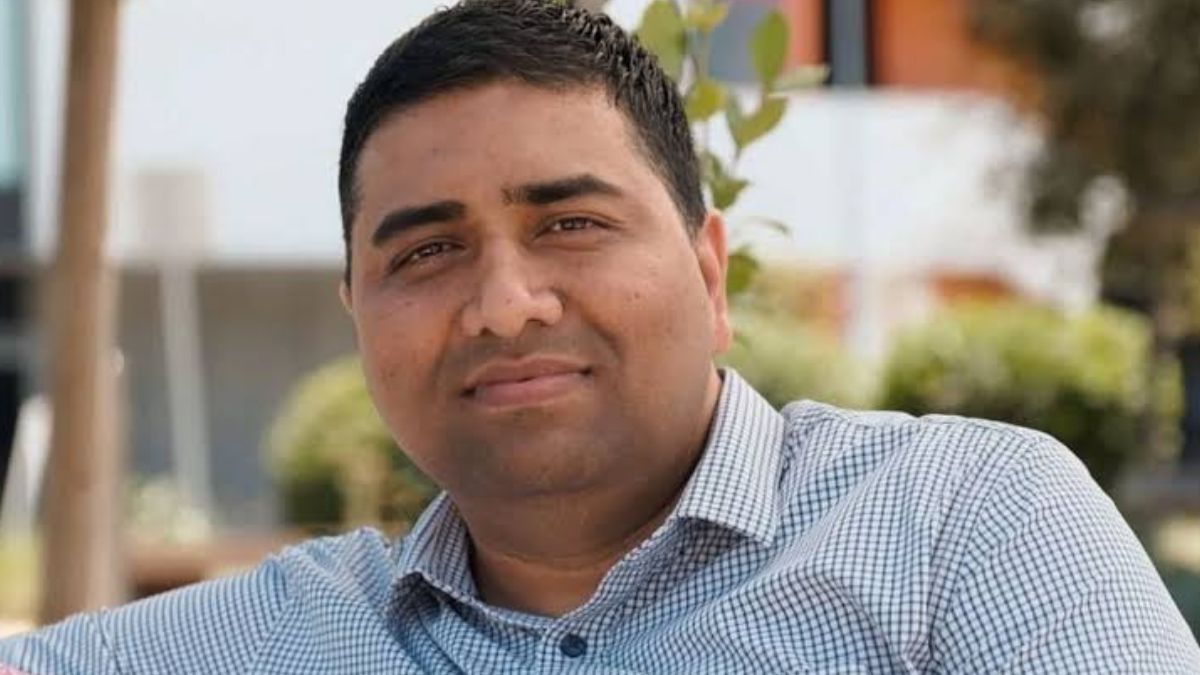
 "Amar Subramanya replaces longtime AI chief John Giannandrea, Apple announced.
Image courtesy: X/@XavierNaxa")
Apple, the Silicon Valley giant, is gearing up for a revamp of its Artificial Intelligence wing. Playing a key role will be Indian-origin researcher Amar Subramanya. He will take over as the new vice president of artificial intelligence from John Giannandrea, who has led the company’s efforts in the field since 2018.
Giannandrea will retire in the spring next year; until then, he will serve as an adviser, according to Reuters.
Apple, a laggard in the AI race, has struggled to catch up with rollouts, particularly with its voice assistant Siri. It has been slow in adding features to its products and has faced intense scrutiny over its position in the global AI landscape.
With this new leadership shake-up, all eyes are on Subramanya and whether he can usher in major changes for Apple in the AI domain.
Who is Amar Subramanya?
Amar Subramanya is a researcher who has previously worked at Google and Microsoft.
According to his LinkedIn profile, Subramanya’s last stint was at Microsoft, where he most recently served as corporate vice president of AI. Before Microsoft, he spent 16 years at Google, where he, among other roles, was the head of engineering for the Gemini assistant, according to Reuters.
The 46-year-old comes to Apple with immense experience and credentials. He earned a BE in electrical, electronics, and communications engineering from Bangalore University in 2001. He went on to complete his PhD at the University of Washington in Seattle in 2009. His dissertation focused on semi-supervised learning and graphical models, innovative techniques for training AI systems, with limited labelled data, according to a report in The Times of India.
His graduate work included practical applications in speech recognition, natural language processing and human activity analysis. He earned the coveted Microsoft Research Graduate Fellowship in 2007 after he tackled multi-sensory fusion for robust speech systems and speaker verification.
Quick Reads
View AllSubramanya has written the book “Graph-Based Semi-Supervised Learning” with scholar Partha Pratim Talukdar. He has authored several academic papers on entity resolution, multilingual Natural Language Processing, cross-document coreference, and audio-visual speech enhancement, reports the ToI.
His 16-year tenure at Google started in research roles, and then he progressed to engineering leadership. He was the head of engineering for Gemini by 2023.
In July 2025, Subramanya jumped ship and joined Microsoft. He was the corporate VP of AI and worked on Copilot, its chatbot.
What will be Subramanya’s responsibilities at Apple?
Subramanya will lead critical areas, including Apple foundation models, machine learning research and will directly report to Craig Federighi, the company’s senior vice president of software engineering.
Meanwhile, the responsibilities previously overseen by Giannandrea will be redistributed under Chief Operating Officer Sabih Khan and Services Chief Eddy Cue, the company added.
Welcoming to the leadership team, Apple CEO Tim Cook expressed confidence in Subramanya’s expertise, which would strengthen its AI roadmap. Cook also thanked John Giannandrea for playing a crucial role in building and advancing the firm’s AI efforts.
The Apple CEO also mentioned Craig Federighi, who Subramanya will be reporting to, stating, “Craig has been instrumental in driving our AI efforts, including overseeing our work to bring a more personalised Siri to users next year.”
Why is Subramanya’s appointment important for AI leadership?
AI is a key battleground for tech giants. However, Apple has lagged behind its peers and is doing all it can to catch up. The firm has struck a deal with OpenAI to integrate ChatGPT into its products, including Siri, according to the Mint.
However, analysts argue that while its tech competitors are investing billions into AI data centres, chips and frontier-scale models, Apple, on the other hand, has taken a slow and conservative approach to bolster its AI field. With Subramanya’s entry, the company is demonstrating a tighter focus on its AI strategy.
The Silicon Valley giant stressed that it is “significantly increasing” its AI spending, and remains committed to a distinctive strategy.
Why Apple still hasn’t cracked AI
In June 2024, Apple debuted its marquee AI product suite. However, in comparison to competitors such as Google, it has been slow to overhaul its products with generative AI.
With real-time language translation in its new AirPod earphones, a feature that Google’s headphones added in 2017, Apple has introduced incremental features. Still, major changes such as an AI-forward upgrade to Siri have been repeatedly postponed.
During a firm’s developer conference in June, its vice-president of software engineering asserted, “This work on Siri needed more time to reach our high-quality bar.”
External developments have shaped Apple’s AI story than internal restructuring.
According to Mint, Jony Ive, Apple’s former chief designer and one of the architects of the iPhone, sold his hardware startup to OpenAI for $6.4 billion, with plans to help the AI lab develop its own hardware. Ive and OpenAI CEO Sam Altman asserted that they have already been completed and could debut within two years.
Now, industry analysts question how Apple will maintain its hardware dominance, with the rising competition in the AI market at this pace. They even argue that while the firm has built an unparalleled loyalty since the iPhone’s debut in 2007, the next innovation could be driven by AI rather than mobile innovation.
With inputs from agencies